
As 5G networks demand 100μs latency and global IP traffic nears 5 zettabytes annually, transmission networks have evolved into the critical infrastructure of modern civilization. This technical exploration demystifies seven core architectural concepts that enable the seamless flow of exabytes across continents, oceans, and orbital space.
1. Photonic Pulse Engineering
At light-speed core of transmission networks lies advanced photonic engineering:
- Coherent DSP Algorithms: 800Gbps modulation with probabilistic shaping
- Nonlinear Fiber Compensation: 3dB Q-factor improvement through neural networks
- Multi-Band Optics: C+L+E spectrum expansion to 20THz capacity
Huawei’s OceanStor 8000 achieves 48Tbps per fiber strand using 140GBd symbol rates.
2. Multi-Layer Protocol Convergence
Modern networks harmonize legacy and next-gen protocols:
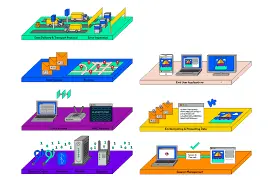
SDH Circuit Switching → OTN Frame Mapping → IP/MPLS Packet Routing → FlexE Channel Bonding A transatlantic cable system simultaneously carries 100G Ethernet, 10G SONET, and 5G fronthaul through unified OTN framing.
3. Software-Defined Photonics
Programmable optical layer enables:
- 1ms Wavelength Reconfiguration: Adaptive to traffic spikes
- AI-Driven Spectrum Defragmentation: 45% efficiency gain
- Digital Twin Validation: Pre-test new modulation formats
Telefónica reduced service activation time from weeks to minutes using SDN-controlled ROADMs.
4. Quantum-Secure Backbones
Next-gen security mechanisms protect fiber arteries:
- Quantum Key Distribution (QKD): 2,000km entanglement-based encryption
- Optical Steganography: Hiding data in polarization noise
- Photon-Counting IDS: Detecting fiber tapping through photon arrival variance
A financial dark fiber network thwarted 14 interception attempts using phase-shift quantum signatures.
5. Hyper-Dense Wavelength Division
Spectral efficiency breakthroughs include:
- 96-Wavelength C-band Systems: 75GHz channel spacing
- Continuous Nyquist Spacing: 0% guard band between channels
- Super Channel Technology: 1.6Tbps single-carrier transmission
NTT’s 1Pbps trial combined 12.5THz spectrum across S+C+L bands.
6. Submarine Network Innovations
Deep-sea cable systems incorporate:
- Pressure-Tolerant SDM Fibers: 12-core cables with 144Tbps capacity
- Optical Repeater AI: Predictive fault detection through nonlinear signatures
- Marine Ecosystem Sensors: Monitoring climate change while transmitting data
The MAREA cable achieves 99.99997% availability despite Atlantic hurricane impacts.
7. Space-Terrestrial Integration
Emerging orbital networks complement terrestrial infrastructure:
- Low Earth Orbit (LEO) Laser Links: 10Gbps inter-satellite handoffs
- Ground Station SDN: Seamless traffic shifting between Starlink and fiber
- Atmospheric Compensation: Adaptive optics overcoming cloud turbulence
SpaceX’s Gen2 constellation provides 50ms latency between London and Sydney via orbital paths.
Performance Benchmark Evolution
Transmission Network Capabilities Timeline:
| Era | Speed | Reach | Efficiency |
|---|---|---|---|
| 1990s (SDH) | 2.5Gbps | 600km | 0.8b/s/Hz |
| 2000s (DWDM) | 40Gbps | 3,000km | 2.4b/s/Hz |
| 2010s (Coherent) | 100Gbps | 10,000km | 4.0b/s/Hz |
| 2020s (800G) | 800Gbps | 15,000km | 11.2b/s/Hz |
| 2030s (Pbps) | 1.6Tbps | Quantum repeaters | 18.0b/s/Hz |
Future Network Horizons
Cutting-edge research promises:
- Petabit Fibers: Hollow-core cables with 99.7% light speed
- Neuromorphic Photonics: Brain-inspired optical signal processing
- Quantum Repeaters: Entanglement distribution across continents
Huawei and NICT’s joint experiment achieved 1Pbps over 205km using multi-core fibers.

Leave a comment