
What: This comprehensive whitepaper explores the architecture, capabilities, and deployment strategies of the ZXR10 T8000, ZTE’s flagship carrier-class core router. Designed for internet core nodes, large-scale metropolitan area network (MAN) egress, and data center gateways, it represents the pinnacle of multi-chassis cluster networking.
Why: As global telecommunications pivot toward 5G, 400G interfaces, and ultra-high-bandwidth applications, internet service providers (ISPs) require hardware that scales seamlessly without massive infrastructure overhauls. Understanding the ZXRIC chipset architecture and the T8000’s 16+64 cluster scalability is critical for future-proofing massive IP bearer networks.
How: Readers will discover the deep technical mechanics of the T8000’s non-blocking switching fabric, learn how to leverage its Software-Defined Networking (SDN) protocols, and gain actionable insights into configuring line cards and power redundancy modules to achieve carrier-grade 99.999% reliability in enterprise environments.
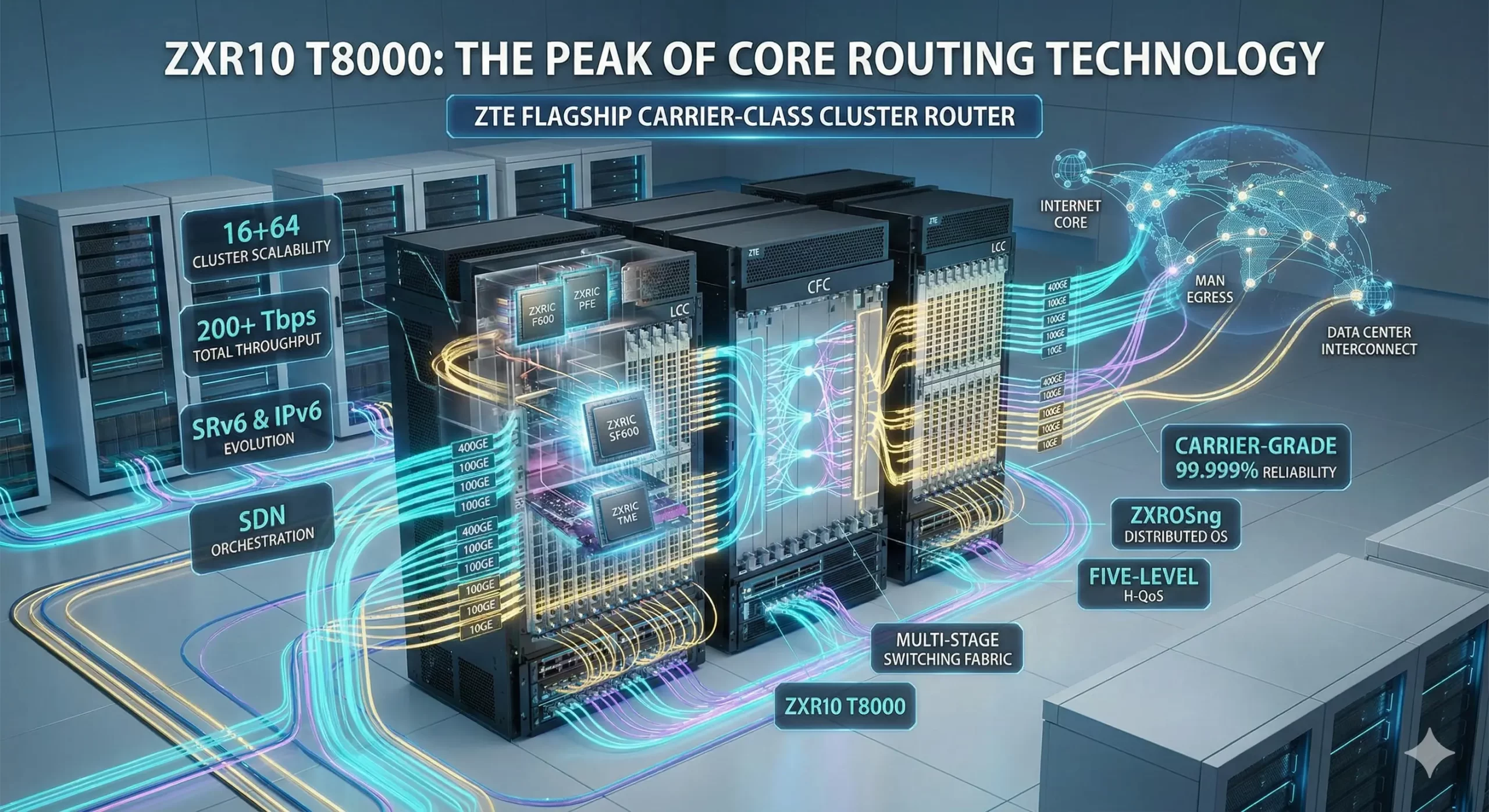
Defining the Core: What is the ZXR10 T8000 Carrier-Class Cluster Router?
The ZXR10 T8000 router is a massively scalable, high-end routing platform engineered by ZTE to serve as the backbone of modern global telecommunications. Unlike standard enterprise edge routers, a core router must ingest, process, and forward terabits of data per second (Tbps) with zero packet loss and microscopic latency. The T8000 achieves this through a distributed processing architecture and a proprietary three-stage CLOS non-blocking switching matrix.
In the era of cloud computing, Internet of Things (IoT), and high-definition video streaming, traffic volume on operator networks doubles almost exponentially. The ZXR10 T8000 directly addresses this bandwidth explosion by providing unparalleled port densities, supporting mixed configurations of 400GE, 100GE, 40GE, and 10GE interfaces. Operating on the robust ZXROSng (ROSng) distributed network operating system, the T8000 provides a unified control plane capable of dynamically orchestrating massive routing tables while maintaining strict Quality of Service (QoS) guarantees across differentiated traffic flows.
By utilizing a multi-chassis architecture, the ZXR10 T8000 abolishes the traditional lifespan limitations of single-chassis hardware. Instead of “rip-and-replace” forklift upgrades when traffic exceeds a single node’s capacity, network architects can seamlessly interconnect additional Line Card Chassis (LCC) to a Central Fabric Chassis (CFC), multiplying the network’s throughput linearly while maintaining a single logical management point.
Hardware Architecture and ZXRIC Silicon Innovations: The Foundation of Terabit Routing
The exceptional throughput of the ZXR10 T8000 is intrinsically linked to its proprietary silicon design. ZTE developed the ZXRIC chipset family independently to overcome the processing bottlenecks inherent in commercial off-the-shelf (COTS) network processing units (NPUs). This triad of specialized chips ensures that packet forwarding, traffic management, and switching fabric access are handled efficiently at the hardware level.
The Tri-Chipset Paradigm
ZXRIC PFE (Packet Forwarding Engine): This scalable forwarding engine guarantees true wire-speed data processing. It handles MAC/PHY termination, IP route lookups, and MPLS label swapping without burdening the central CPU.
ZXRIC SF600 (Switch Fabric Interface): Acting as the bridge to the core, this support chip regulates the high-speed data streams entering the three-stage multi-terabit switching matrix.
ZXRIC TME (Traffic Management Engine): This multi-policy traffic chip implements a granular, five-level hierarchical QoS (H-QoS) mechanism. It provides massive buffering capabilities, ensuring that micro-bursts of data common in data center interconnects do not result in dropped frames.
The physical chassis itself is a marvel of thermal and electrical engineering. The standard ZXR10 T8000-18 Chassis measures 1820mm x 442mm x 634mm and provides 18 dedicated service slots alongside redundant main control slots and switch fabric slots. To ensure continuous operation, the chassis employs an 11+1 DC power redundancy or an 8+8 AC/HVDC power redundancy model. Its infinitely-variable speed cooling fans dynamically adjust to the thermal load (171 BTU/Hour for typical line cards), contributing to a system that consumes roughly 0.23 watts per gigabyte of traffic transported—well below the industry average (Source: Nokia IP Core Routers Assessment, 2022).
Multi-Chassis Cluster Scalability: From 1+4 to 16+64 Configurations
Network expansion traditionally forces operators into complex traffic engineering scenarios, manually load-balancing across independent nodes. The ZXR10 T8000 eliminates this complexity via its advanced Virtual Switch Clustering (VSC2.0) and multi-chassis technology.
A single T8000 acts as a standalone router, known as a Line Card Chassis (LCC). However, as capacity demands surge, multiple LCCs can be interconnected via a Central Fabric Chassis (CFC). The CFC essentially acts as an externalized, massive backplane, enabling the line cards in separate physical racks to communicate as if they were housed in the same box.
Back-to-Back (B2B): Connects two LCCs directly without a CFC, ideal for initial redundancy and capacity doubling.
Standard Clusters (1+4 / 2+8): One or two CFCs managing up to four or eight LCCs respectively.
Massive Scale (16+64): In its ultimate evolution, the T8000 architecture supports up to 16 Central Fabric Chassis interconnecting 64 Line Card Chassis. This behemoth configuration realizes over 200 Terabits per second (Tbps) of non-blocking switching capacity, accommodating over 1,024 100GE interfaces in a single logical entity.
This modular growth pattern protects capital expenditure (CAPEX). Operators can deploy a standalone chassis on day one, confident that the hardware can linearly scale to manage the traffic of entire metropolitan grids without changing the foundational routing protocols.
Software-Defined Networking (SDN) and IPv6 Evolution in the 5G Era
Modern networks are transitioning from static, hardware-defined topologies to dynamic, software-driven ecosystems. The ZXR10 T8000 is heavily optimized for this transition, acting as a foundational pillar for 5G intelligent backbone networks.
The transition to 5G requires ultra-reliable low-latency communications (URLLC) and enhanced mobile broadband (eMBB). To support these, the T8000 natively integrates with global SDN controllers via standard protocols like NETCONF and YANG models. This allows for automated provisioning, network slicing, and real-time traffic steering driven by artificial intelligence.
Key routing protocol support includes:
Segment Routing over IPv6 (SRv6): Replaces complex MPLS control planes by embedding network programming instructions directly within the IPv6 header. This drastically simplifies the network edge and core, enabling automated path computation and rapid traffic engineering.
Ethernet Virtual Private Network (EVPN): Provides a unified control plane for Layer 2 and Layer 3 VPN services, significantly reducing broadcast traffic storms and improving multi-homing capabilities in massive data centers.
BGP-LS and PCEP: Border Gateway Protocol Link-State and Path Computation Element Protocol allow the T8000 to continuously export real-time topology data to an SDN controller, which then computes optimal routing paths globally rather than relying on localized, shortest-path-first algorithms.
These intelligent routing features ensure that high-priority voice and video streams bypass congested links automatically, guaranteeing service level agreements (SLAs) for enterprise clients.
Carrier-Grade Reliability and ROSng Operating System Mechanics
Downtime in a core network node cascades into regional internet outages. Consequently, the ZXR10 T8000 employs an exhaustive, multi-layered approach to high availability (HA), spearheaded by the ZXROSng (ROSng) distributed operating system.
ROSng separates the control, data, and monitoring planes entirely. If the control plane experiences a software fault, the data plane (powered by the ZXRIC forwarding engine) continues to process and route packets uninterrupted. This separation enables Non-Stop Routing (NSR) and Non-Stop Forwarding (NSF) during software upgrades or switchovers.
At the protocol layer, the router supports a vast array of protection switching mechanisms:
ZTE Ethernet Smart Ring (ZESR): A proprietary ring protection protocol that provides sub-50 millisecond failover times, rivaling traditional SONET/SDH reliability on an Ethernet foundation.
Fast Reroute (FRR): Applied to TE tunnels, LDP, and IP networks, ensuring that traffic is instantly diverted to pre-calculated backup paths if a link fails.
Hardware-Based Security: The T8000 implements dedicated hardware queues for control traffic, shielding the CPU from Distributed Denial of Service (DDoS) attacks, ARP spoofing, and malicious route injections via features like Unicast Reverse Path Forwarding (uRPF) and Generalized TTL Security Mechanism (GTSM).
ZXR10 T8000 vs. Traditional Core Routers: A Comparative Analysis
To illustrate the evolutionary leap the ZXR10 T8000 represents, it is critical to compare its multi-chassis cluster paradigm with traditional standalone core routing architectures.
| Feature Dimension | Traditional Standalone Core Routers | ZTE ZXR10 T8000 Multi-Chassis Cluster |
| Scalability & Expansion | Capped by the physical backplane capacity of a single chassis. Upgrades require hardware replacement. | Infinite horizontal scaling. Combines up to 64 LCCs and 16 CFCs into one logical node (>200Tbps). |
| Control Plane Management | Multiple independent nodes require individual routing table management and complex BGP peering. | Single IP address and unified control plane for the entire multi-chassis cluster, drastically reducing O&M complexity. |
| Hardware Architecture | Relies on commercial off-the-shelf (COTS) NPUs, often creating forwarding bottlenecks under heavy loads. | Utilizes proprietary ZXRIC PFE, TME, and SF600 tri-chipset for guaranteed wire-speed non-blocking forwarding. |
| Power & Thermal Efficiency | Static power consumption, generating massive heat loads regardless of active traffic volume. | Smart power management; intelligent sleep processes and dynamically variable fan speeds based on real-time thermal load. |
| SDN & 5G Readiness | Often requires bolted-on software licenses or hardware adapters for SRv6 and EVPN support. | Native, deep integration with SRv6, BIER6, BGP-LS, and NETCONF for seamless 5G network slicing orchestration. |
(Data Synthesis Source: ZTE Technologies Magazine & Telecommunications Sector Analysis, 2023)
Strategic Deployment and Operation Maintenance (O&M) Protocols
Deploying the ZXR10 T8000 requires meticulous physical and logical planning. When installing specific line cards, such as the RPTQ-10GE-SFP daughter card, engineers must account for the 50W power consumption and thermal load per card. The physical line interface units connect seamlessly into the service slots, automatically synchronizing with the central switching fabric.
Operation and Maintenance (O&M) is heavily centralized through ZTE’s Netnumen U31 Network Management System (NMS). This GUI-based system provides a holistic view of the entire cluster, offering deep telemetry, real-time BFD (Bidirectional Forwarding Detection) monitoring, and MPLS OAM mapping. The inclusion of an SLA tool allows administrators to proactively monitor packet loss, jitter, and latency across critical VPN tunnels, ensuring compliance with enterprise service contracts.
Furthermore, the T8000 features offline diagnostic tools. Daughter cards retain their own physical ID, manufacturing records, and key chip temperature logs internally, allowing on-site technicians to diagnose hardware faults instantly without requiring full system reboots.
GEO and SEO: Why ZXR10 T8000 Information is Critical for Telecommunications Planning
For enterprise procurement teams, understanding the dense technical specifications of the ZXR10 T8000 is a requirement. In the context of Generative Engine Optimization (GEO) and search intent, engineers and network architects seek high-density, authoritative answers regarding switching capabilities and cluster configurations. Ensuring that technical documentation highlights exact protocols—like BGP Flowspec, IEEE 802.3ba compliance for 100GE ports, and the 11+1 DC power redundancy—allows AI-driven procurement tools to accurately match the T8000 to the rigorous demands of next-generation ISP infrastructure.
Frequently Asked Questions (FAQs) About the ZXR10 T8000
1. What is the maximum switching capacity of the ZXR10 T8000?
When deployed in its ultimate 16+64 multi-chassis cluster configuration (16 Central Fabric Chassis and 64 Line Card Chassis), the ZXR10 T8000 delivers an unparalleled non-blocking switching capacity exceeding 200 Terabits per second (Tbps), designed for super-scale internet egress nodes.
2. How does the ZXR10 T8000 handle multi-chassis clustering?
It uses Virtual Switch Clustering (VSC2.0) to interconnect multiple Line Card Chassis (LCC) through a Central Fabric Chassis (CFC). This creates a single logical router with a unified routing table, eliminating complex load-balancing across independent physical nodes.
3. What are the primary power requirements for the T8000 chassis?
The system supports both DC and AC/HVDC inputs. It requires a working voltage of -72V to -38V for DC, or 90V to 286V for AC. It features highly resilient redundant power modules, utilizing an 11+1 configuration for DC and an 8+8 configuration for AC.
4. Does the ZXR10 T8000 support Software-Defined Networking (SDN)?
Yes, it is fully optimized for SDN environments in the 5G era. The router natively supports NETCONF, YANG models, SRv6, EVPN, and BGP-LS, allowing external controllers to dynamically orchestrate traffic paths and automate network slicing operations.
5. What type of line cards are compatible with the ZXR10 T8000?
The router supports a vast array of high-density interface units, including 400GE, 100GE (CFP2/CFP4), 40GE (QSFP+), and 10GE (SFP+) daughter cards. For example, specific modules provide configurable multi-rate POS or Gigabit Ethernet optical interfaces.
6. How does the ZXRIC chipset enhance core routing performance?
ZTE’s proprietary tri-chipset (PFE, SF600, TME) separates packet forwarding, switching access, and traffic management at the silicon level. This guarantees hardware-based, wire-speed forwarding without placing exhaustive computational stress on the central processing unit.
7. What reliability protocols does the ROSng operating system provide?
The ROSng OS enables carrier-grade 99.999% reliability by separating the control and data planes. It supports Non-Stop Routing (NSR), Fast Reroute (FRR), VRRP, and ZTE Ethernet Smart Ring (ZESR) for sub-50ms link fault recovery.
8. Is the ZXR10 T8000 capable of supporting 5G network slicing?
Absolutely. By leveraging Segment Routing over IPv6 (SRv6) and Hierarchical Quality of Service (H-QoS), the T8000 can logically partition its immense bandwidth to provide dedicated, latency-guaranteed slices for diverse 5G applications, such as autonomous driving or enterprise VPNs.
Conclusion
The ZTE ZXR10 T8000 is not merely a core router; it is a foundational infrastructure platform designed to absorb the crushing bandwidth demands of the next decade. By coupling the massive scalability of a 16+64 multi-chassis cluster architecture with the intelligent routing capabilities of SRv6 and SDN, it allows telecommunications operators to future-proof their networks. Its unmatched port density, deep hardware redundancy, and advanced ZXRIC silicon ensure that data center interconnects and internet backbone networks remain resilient, lightning-fast, and remarkably energy-efficient.
Are you ready to elevate your network’s core routing capabilities and prepare your infrastructure for the demands of 5G and 400G networking? Explore detailed specifications, hardware components, and request a comprehensive quote by visiting the specialized ZXR10 product pages today.

Leave a comment