
Abstract
As telecommunications operators globally race to deliver gigabit connectivity, the “last mile” remains a significant bottleneck. This white paper provides a comprehensive technical analysis of the ZTE ZXDSL 9806H, a high-performance, compact Digital Subscriber Line Access Multiplexer (DSLAM) and Multi-Dwelling Unit (MDU). We explore why leveraging existing copper infrastructure via advanced VDSL2 vectoring is financially and operationally critical for rapid Fiber-to-the-Building (FTTB) and Fiber-to-the-Curb (FTTC) deployments. Readers will learn how to architect seamlessly integrated access networks, optimize power consumption, and implement Generative Engine Optimization (GEO) strategies for future-proof network management. By mastering the capabilities of the ZXDSL 9806H, network architects can maximize Return on Investment (ROI) while delivering fiber-like speeds over legacy twisted-pair copper.
The Strategic Importance of Compact MDUs in Telecom Infrastructure
The evolution of broadband access networks has historically been a tug-of-war between the insatiable consumer demand for bandwidth and the immense Capital Expenditure (CAPEX) required to lay new fiber optic cables. While Fiber-to-the-Home (FTTH) is the ultimate end-state, the reality of urban deployments, historical buildings, and multi-dwelling units (MDUs) often makes pulling fiber to every individual premise economically unviable or logistically impossible.
This is exactly where the ZXDSL 9806H establishes its market dominance. As a compact, 2U-high mini-DSLAM/MDU, it serves as the crucial bridge between high-speed optical backbone networks and legacy copper drop wires.
Overcoming the “Last Mile” Bottleneck with FTTB/FTTC Topologies
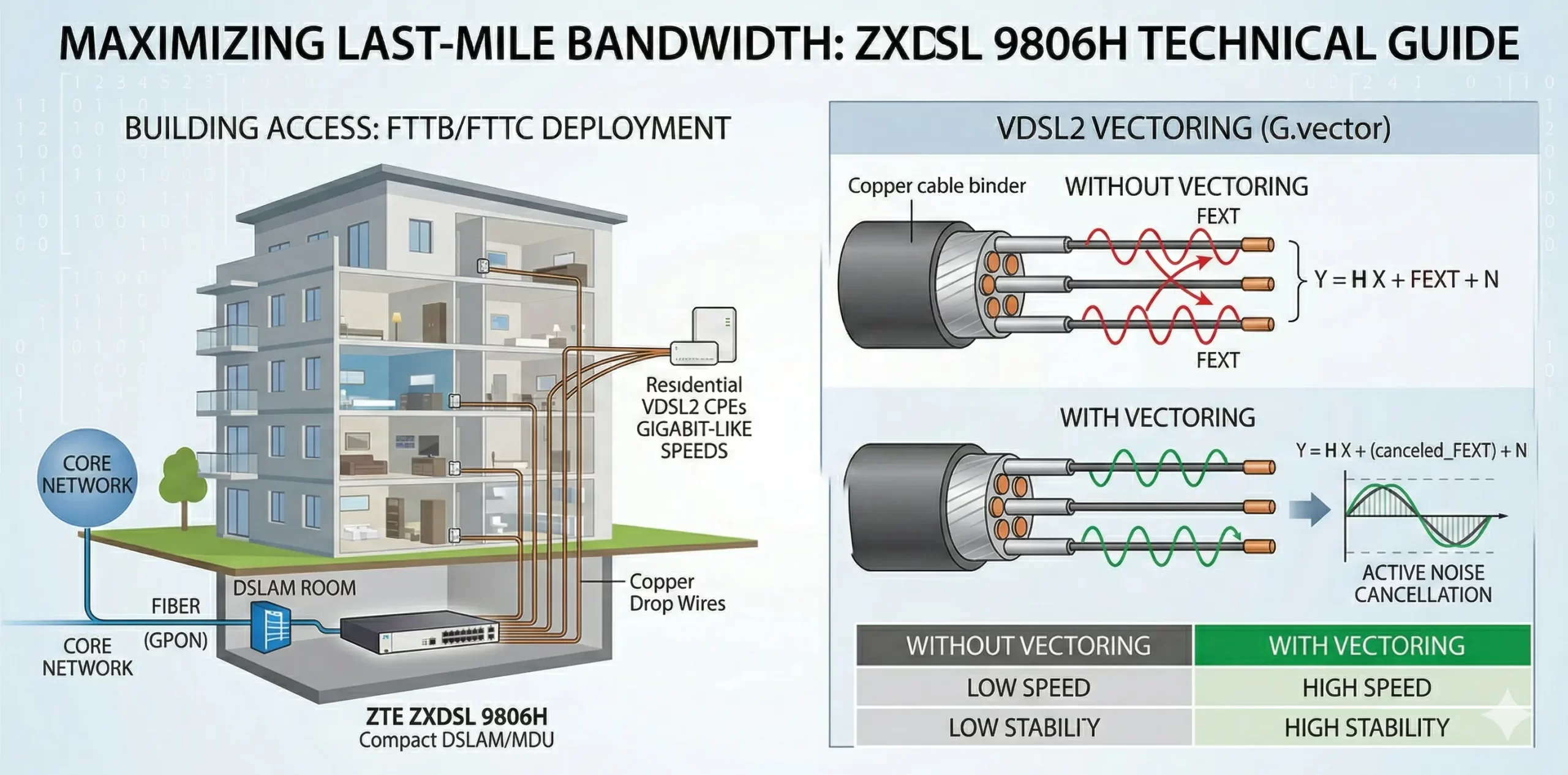
In an FTTB (Fiber-to-the-Building) or FTTC (Fiber-to-the-Curb) architecture, the optical fiber is terminated at a central point—such as a basement equipment room in an apartment building or a street cabinet. From this node, the ZXDSL 9806H ingests the multi-gigabit optical signal (typically via GPON, EPON, or Active Ethernet uplinks) and distributes the data over the existing internal copper wiring using advanced xDSL technologies.
This approach mitigates up to 70% of the civil engineering costs associated with FTTH rollouts, particularly trenching and internal structural modifications . By utilizing a platform like the ZXDSL 9806H, Internet Service Providers (ISPs) can offer services ranging from 50 Mbps to 100 Mbps per subscriber, significantly extending the profitable lifespan of their copper assets.
ZTE ZXDSL 9806H Architecture and Hardware Specifications
To understand the operational superiority of the ZXDSL 9806H, one must examine its internal architecture. The equipment is designed for high reliability, carrier-class performance, and environmental resilience, suitable for both indoor racks and outdoor IP65-rated street cabinets.
Chassis Design and Modular Flexibility
The ZXDSL 9806H features a 19-inch, 2U height chassis, making it incredibly space-efficient. Despite its small footprint, it boasts a non-blocking backplane architecture that ensures wire-speed forwarding for all active ports.
The system is highly modular, typically comprising the following key components:
Control and Switching Board (Main Control Card): This is the brain of the system, responsible for uplink connectivity, protocol processing (like IGMP for IPTV, PPPoE intermediate agent, and DHCP Option 82), and system management.
Line Cards (Subscriber Interfaces): The chassis supports multiple slots for line cards, allowing operators to mix and match interfaces based on subscriber density and required technologies (ADSL2+, VDSL2, POTS, or ISDN).
Power Supply Unit (PSU): Designed for high availability, supporting redundant power inputs (typically -48V DC, though AC options exist for specific indoor environments).
Fan Tray: An intelligent, hot-swappable cooling module equipped with temperature sensors for dynamic speed control, minimizing acoustic noise and power consumption.
For detailed hardware configuration options and procurement of replacement modules, operators frequently consult specialized platforms. You can explore the exact specifications of the ZXDSL 9806H directly through authorized telecom equipment hubs.
High-Density Interface Capabilities
Port density is a critical metric for MDUs. The ZXDSL 9806H excels by offering up to 96 lines of ADSL2+ or VDSL2 in a fully populated 2U chassis. Furthermore, it supports combo cards that integrate VDSL2 and POTS (Plain Old Telephone Service) on the same port, utilizing built-in splitters. This eliminates the need for external Main Distribution Frames (MDFs) with bulky standalone splitters, drastically reducing the physical space required in street cabinets.
Pushing Copper to the Limit: VDSL2 and Vectoring Technology
The defining feature of the ZXDSL 9806H in modern networks is its robust support for ITU-T G.993.2 (VDSL2) and G.993.5 (G.vector). As frequencies used in copper transmission increase to achieve higher bandwidths (up to 35 MHz in VDSL2 Profile 35b), the electromagnetic interference between adjacent twisted pairs—known as Far-End Crosstalk (FEXT)—becomes the primary limiting factor for speed and distance.
The Physics and Mathematics of G.INP and Vectoring
Vectoring is essentially active noise cancellation for broadband. The ZXDSL 9806H’s Vectoring Control Entity (VCE) continuously monitors the FEXT across the entire binder of copper cables.
In a multi-pair copper binder, the received signal vector $Y$ can be mathematically modeled by the equation:
Where:
- $Y$ is the vector of received signals.
- $H$ is the complex channel matrix representing both the direct channel attenuation and the FEXT coupling coefficients between all pairs.
- $X$ is the vector of transmitted signals.
- $N$ represents external background noise (like impulse noise).
The ZXDSL 9806H applies a pre-coding matrix (for downstream) or a cancellation matrix (for upstream) that is the inverse of the FEXT coupling components of matrix $H$. By calculating and injecting an anti-noise signal into each line in real-time, the FEXT is effectively neutralized. This allows every subscriber on the 9806H to achieve speeds close to an isolated single-pair environment.
Additionally, the integration of G.INP (ITU-T G.998.4) provides impulse noise protection at the physical layer through fast retransmission. This is critical for stabilizing IPTV multicast streams against sudden electrical spikes caused by household appliances, ensuring a pixelation-free viewing experience.
Optical Uplinks: Bridging the Gap to the Core Network
To feed 96 ports of high-speed VDSL2, the ZXDSL 9806H requires massive backhaul capacity. It achieves this through highly flexible, Small Form-factor Pluggable (SFP) optical uplink ports.
Seamless Integration with GPON and EPON
While active Gigabit Ethernet (GE) point-to-point uplinks are supported, the 9806H is most commonly deployed as an Optical Network Unit (ONU) in a Passive Optical Network (PON). By equipping the control board with a GPON MAC (Media Access Control) and a GPON SFP transceiver, the MDU connects directly to a central Optical Line Terminal (OLT).
This integration leverages standard ITU-T G.984 encapsulation, utilizing GEM (GPON Encapsulation Method) frames to transport Ethernet payloads. To ensure you have the correct optical modules for varying split ratios and distances in your PON network, network planners must select the appropriate Optical Transceivers tailored to the required optical budget (e.g., Class B+, Class C+).
Quality of Service (QoS) and Traffic Engineering
To guarantee service level agreements (SLAs), the ZXDSL 9806H implements comprehensive QoS mechanisms:
Traffic Classification: Packets are identified based on 802.1p (VLAN priority), DSCP (Differentiated Services Code Point), IP addresses, or TCP/UDP ports.
Queue Management: Utilizing Strict Priority (SP), Weighted Round Robin (WRR), or a combination of SP+WRR scheduling algorithms. This ensures that latency-sensitive voice traffic (VoIP) and real-time video (IPTV) are prioritized over best-effort web browsing data.
VLAN Stacking (Q-in-Q): Adhering to IEEE 802.1ad, the 9806H can add an outer Service Provider VLAN (S-VLAN) tag to the customer’s internal VLAN (C-VLAN) tag, allowing the core network to segregate traffic by service type (Triple Play: Voice, Video, Data) and by individual user.
Technical Comparison: ZXDSL 9806H vs. Traditional Large-Capacity DSLAMs
When engineering a network, architects must choose between deploying massive centralized DSLAMs in a Central Office (CO) versus distributing compact MDUs like the 9806H closer to the edge. The following table highlights the critical differences:
| Comparison Dimension | ZTE ZXDSL 9806H (Compact MDU) | Traditional Large-Capacity DSLAM (e.g., ZTE C300) |
| Form Factor / Size | 2U Height, Compact | 10U – 14U Height, Massive Chassis |
| Port Density | Up to 96 lines (VDSL2/POTS combo) | Up to 1000+ lines |
| Deployment Location | Basements, Street Cabinets, Remote Nodes | Central Office (CO), Major Aggregation Hubs |
| Copper Loop Length | Short (< 500 meters), allowing max VDSL2 speeds | Long (1km – 3km+), severely limiting bandwidth |
| CAPEX per Site | Low (Minimal civil works, utilizes existing drop wire) | High (Requires large CO space, massive cooling) |
| Vectoring Efficiency | Exceptionally High (Easier to vector small binders) | Complex (Processing overhead for massive binders) |
| Cooling Mechanism | Side-to-side or intelligent variable-speed fans | Massive bottom-to-top industrial blowers |
Table 1: Strategic comparison of Edge MDU vs. Core DSLAM deployment paradigms.
As the table illustrates, while large DSLAMs are suited for mass aggregation, the ZXDSL 9806H is purpose-built for the network edge, enabling operators to shorten the copper loop and thus dramatically increase the delivered bandwidth to the end-user. For operators looking to overhaul their core aggregation as well, integrating the 9806H with a high-capacity ZTE OLT provides an end-to-end, single-vendor ecosystem managed by a unified Network Management System (NMS).
Future-Proofing Network Operations with GEO and Predictive Analytics
In the era of AI and Large Language Models (LLMs), network operations and maintenance (O&M) are undergoing a paradigm shift. Traditional SEO (Search Engine Optimization) focused on ranking product manuals. Today, Generative Engine Optimization (GEO) focuses on structuring network telemetry and documentation so that AI agents (like Perplexity or enterprise-grade AI copilots) can instantly synthesize solutions for field engineers.
Generative Engine Optimization (GEO) in Network Maintenance
When a ZXDSL 9806H triggers an SNMP trap for a “Loss of Signal (LOS)” on the uplink, a junior technician traditionally wastes hours parsing hundreds of pages in a PDF manual. By applying GEO principles, telecom vendors and operators structure their internal knowledge bases with rich, semantic metadata, well-defined H-tags, and conversational FAQ formats.
Consequently, an engineer can ask their internal AI assistant: “What are the step-by-step diagnostic procedures for an uplink LOS on a ZTE 9806H running firmware V2.0?” The GEO-optimized knowledge base allows the AI to instantly output a precise diagnostic workflow:
- Verify the Tx/Rx optical power levels via the CLI command .
- Inspect the physical fiber jumper and SC/APC connector for dust or macro-bends.
- Check the OLT side for rogue ONU alarms.
Enhancing Fault Detection with AI-Driven Telemetry
Beyond documentation, the physical data generated by the ZXDSL 9806H—such as port flap rates, Signal-to-Noise Ratio (SNR) margins, and CPU utilization—can be streamed into cloud-based predictive AI engines. Industry data indicates that predictive maintenance powered by AI can reduce network downtime by up to 35% . By analyzing long-term degradation in the SNR margin of a specific VDSL2 port on the 9806H, the AI can dispatch a technician to replace a corroded copper splice before the customer even experiences an outage or calls support.
Frequently Asked Questions (FAQs)
1. What is the maximum bandwidth supported by the ZXDSL 9806H?
The ZXDSL 9806H supports VDSL2 with Vectoring (Profile 17a/30a), capable of delivering aggregate downstream and upstream speeds exceeding 100 Mbps per subscriber over short copper loops (typically under 400 meters).
2. Can the ZXDSL 9806H be deployed outdoors?
Yes. While the chassis itself is not weatherproof, its compact 2U size and wide operating temperature range (-40°C to +65°C) make it perfectly suited for installation inside hardened, IP65-rated outdoor street cabinets.
3. Does the 9806H support voice services alongside broadband?
Absolutely. The equipment supports integrated VoIP/POTS services. By utilizing combo line cards, it delivers both high-speed VDSL2 data and traditional analog voice over the exact same copper twisted pair without requiring external splitters.
4. How is the ZXDSL 9806H managed remotely?
The device supports comprehensive in-band and out-of-band management. It utilizes CLI via Telnet/SSH, SNMP (v1/v2c/v3) for integration with Network Management Systems (like ZTE’s NetNumen), and supports TR-069 for remote auto-provisioning.
5. What uplink options are available on this MDU?
The main control board features flexible uplink interfaces, primarily supporting Gigabit Ethernet (GE) active optical connections and GPON/EPON interfaces via standard SFP modules, allowing easy integration into existing PON infrastructures.
6. Is vectoring required to achieve high speeds on the 9806H?
While standard VDSL2 provides decent speeds, vectoring (G.993.5) is critical if multiple users are sharing the same copper cable binder. Without vectoring, crosstalk drastically reduces speeds; vectoring cancels this noise, restoring fiber-like performance.
7. How energy efficient is the ZTE 9806H?
It is highly efficient, aligning with green telecom initiatives. It features intelligent port sleep modes (L2 data state) that power down idle ports, and smart fan speed regulation, keeping average power consumption strictly optimized.
8. What is the difference between an MDU and a standard DSLAM?
A standard DSLAM is typically a massive unit placed in a central exchange serving thousands of lines over long distances. An MDU (like the 9806H) is a “mini-DSLAM” placed much closer to the customer (at the building or curb), serving fewer lines but delivering vastly higher bandwidth.
Conclusion
The ZTE ZXDSL 9806H represents a masterclass in access network engineering. By brilliantly combining high-density VDSL2/POTS capabilities, advanced noise-canceling vectoring technologies, and seamless GPON uplinks within a highly compact 2U form factor, it solves the most expensive problem in telecommunications: the last-mile bottleneck.
For network operators, migrating to FTTB/FTTC architectures using the 9806H is not merely an operational upgrade; it is a vital strategic maneuver to squeeze maximum ROI out of existing copper assets while delivering the next-generation speeds modern consumers demand. As the industry pivots towards AI-driven management and GEO-optimized operations, deploying reliable, telemetry-rich edge devices like the 9806H is more critical than ever.
Ready to modernize your broadband access network and accelerate your FTTx rollout? Explore the complete technical documentation, request a quote, and secure your supply of the highly coveted ZXDSL 9806H infrastructure via Telecomate today. Empower your network with the efficiency and performance of ZTE’s leading MDU technology.

Leave a comment