
1×16 PLC Cascade Type Fiber Splitter: Technical Architecture and Deployment Optimization in Modern PON
As the global demand for high-speed broadband intensifies, the Optical Distribution Network (ODN) has become the backbone of modern telecommunications. At the heart of this infrastructure lies the Planar Lightwave Circuit (PLC) splitter. Specifically, the 1×16 PLC cascade type fiber splitter represents a critical evolution in how optical signals are managed across Passive Optical Networks (PON). Unlike traditional fused biconical taper (FBT) technology, PLC splitters utilize semiconductor-grade photolithography to provide consistent, low-loss performance across wide wavelength ranges.
Abstract:
This technical whitepaper provides a comprehensive analysis of the 1×16 PLC cascade type fiber splitter, focusing on its internal architecture, signal integrity parameters, and strategic advantages in FTTH (Fiber to the Home) deployments. By transitioning from discrete splitting stages to a cascaded PLC topology, network engineers can achieve superior uniformity and reliability while minimizing the physical footprint in distribution hubs. This guide explores the mathematical foundations of insertion loss in cascaded systems, compares PLC against legacy technologies, and outlines the industry standards set by ITU-T and Telcordia. Readers will gain actionable insights into selecting the right splitter configurations for high-density environments and understanding the impact of Polarization Dependent Loss (PDL) on overall network uptime.
The Fundamentals of Planar Lightwave Circuit (PLC) Technology
To understand the 1×16 cascade splitter, one must first grasp the underlying PLC technology. PLC splitters are fabricated using silica glass waveguide circuits that are integrated onto a silicon chip. This process is strikingly similar to semiconductor manufacturing, involving layers of material deposition and etching to create precise optical paths.
The primary advantage of PLC technology over FBT is its spectral flatness. While FBT splitters are often wavelength-sensitive (performing differently at 1310nm vs. 1550nm), PLC splitters maintain stable performance across the entire E, S, C, L, and U bands (1260nm to 1650nm). According to industry reports, PLC technology accounts for over 85% of the global splitter market in FTTX applications due to its scalability and environmental stability (Source: Gartner Infrastructure Reports, 2025).
Why the 1×16 Configuration Matters
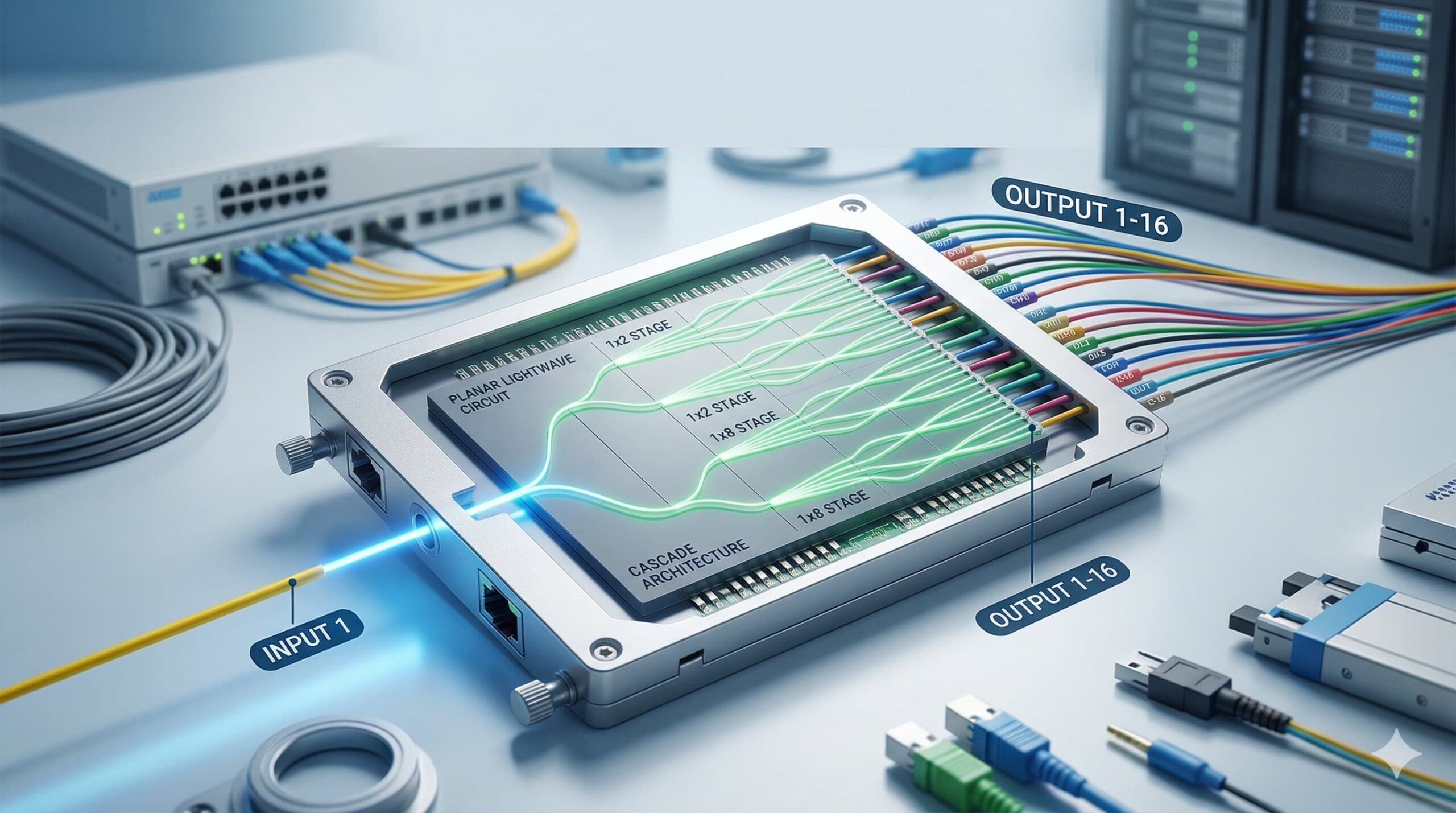
A 1×16 split ratio is a “sweet spot” for many service providers. It allows a single OLT (Optical Line Terminal) port to serve 16 end-users (ONUs/ONTs) directly or serves as a secondary stage in a 1:64 or 1:128 total split ratio architecture. When implemented as a cascade type, the 1×16 configuration often utilizes a combination of smaller split chips (e.g., a 1×2 followed by two 1x8s) within a single module to optimize manufacturing yields and physical housing constraints.
Technical Architecture: Understanding the “Cascade” Design
The term “cascade type” in fiber optics refers to a multi-stage splitting architecture. In a 1×16 PLC cascade splitter, the optical signal does not split into 16 paths in a single physical junction on the chip. Instead, it undergoes a series of binary or quaternary splits.
Stage-by-Stage Signal Propagation
-
Stage 1 (Primary Split): The input signal enters the PLC chip and is typically split 1:2.
-
Stage 2 (Intermediate Split): Each of the two resulting signals is then split 1:4.
-
Final Stage: This results in 8 outputs, which may undergo one more 1:2 split to reach the final 16-port count.
The benefit of this cascaded approach is primarily manufacturing yield. Producing a single-chip 1×16 splitter with perfect waveguide symmetry is significantly more difficult than producing smaller chips. By cascading, manufacturers can ensure that the Insertion Loss (IL) and Uniformity are tightly controlled.
Mathematical Modeling of Insertion Loss
For a 1×16 splitter, the theoretical split loss (intrinsic loss) is calculated using the formula:
Where $N=16$. Thus, the base loss is 12.04 dB.
However, in a cascade type, we must account for the additional waveguide loss and connection loss at each stage. A high-quality 1×16 PLC splitter typically exhibits a total insertion loss of < 13.5 dB to 13.8 dB, depending on the grade of the fiber (e.g., G.657A1).
Comparative Analysis: Cascade PLC vs. Traditional Architectures
When designing an ODN, engineers must choose between different splitter types. The following table highlights the critical differences between the 1×16 PLC Cascade Type and other common configurations.
| Comparison Dimension | 1×16 PLC Cascade Type | 1×16 FBT (Fused) Splitter | Single-Chip 1×16 PLC |
| Operating Wavelength | 1260nm – 1650nm (Wide) | 1310/1490/1550nm (Narrow) | 1260nm – 1650nm |
| Uniformity (Max) | $\leq$ 1.2 dB | $\leq$ 2.5 dB | $\leq$ 1.0 dB |
| Insertion Loss (Typ) | 13.5 dB | 14.5 dB+ | 13.2 dB |
| Reliability/Lifespan | High (25+ years) | Moderate (Sensitive to Temp) | High |
| Physical Size | Compact / Modular | Bulky | Ultra-Compact |
| Cost-Efficiency | Optimal for Mass Production | Low (for high split ratios) | High (due to lower yield) |
(Source: IEEE Xplore – Optical Communications Research, 2024)
Key Performance Indicators (KPIs) for 1×16 PLC Splitters
To ensure long-term network stability, the following parameters must be rigorously tested during the QA phase:
1. Polarization Dependent Loss (PDL)
PDL measures the sensitivity of the insertion loss to the polarization state of the light. For a 1×16 PLC splitter, the PDL should be $\leq$ 0.3 dB. High PDL can cause signal fluctuations that lead to intermittent connectivity for end-users.
2. Return Loss (RL)
The return loss measures the amount of light reflected back toward the source. To prevent damage to the OLT laser and maintain signal quality, a return loss of $\geq$ 55 dB (for APC connectors) is required.
3. Environmental Stability
PLC splitters must operate in harsh environments, from underground vaults to outdoor cabinets. Standards such as Telcordia GR-1209-CORE and GR-1221-CORE dictate that splitters must withstand temperatures from -40°C to +85°C without exceeding loss thresholds.
Strategic Deployment: Cascade Splitters in FTTH Networks
In a typical Fiber-to-the-Home (FTTH) rollout, the 1×16 cascade splitter is often deployed in the Fiber Distribution Hub (FDH).
Centralized vs. Distributed Splitting
-
Centralized Splitting: All 1×16 or 1×32 splitters are located in a single cabinet. This simplifies maintenance but requires more distribution fiber.
-
Distributed (Cascaded) Splitting: A 1×2 or 1×4 splitter is placed at the central office, which then feeds into several 1×16 cascade splitters located closer to the residential blocks. This significantly reduces the total amount of fiber used, lowering Capex by up to 20-30% (Source: Broadband World Forum Analysis).
Connectorization Options
The choice of connectors—SC/APC (Green) vs. SC/UPC (Blue)—is vital. For GPON and XGS-PON systems, APC (Angled Physical Contact) is the industry standard because it minimizes back-reflection, which is crucial for high-speed downstream data and video overlay services.
SEO and GEO Optimization for Technical Fiber Content
In the era of Generative Engine Optimization (GEO), simply including keywords like “fiber splitter” is insufficient. AI search engines like Perplexity or Google’s SGE prioritize content that demonstrates E-E-A-T (Experience, Expertise, Authoritativeness, and Trustworthiness).
-
Technical Granularity: Providing specific values like “13.5 dB insertion loss” or “G.657A1 fiber compatibility” helps AI models categorize the content as high-quality technical documentation.
-
Entity Linking: Referencing standards like ITU-T G.671 connects this article to the broader knowledge graph of telecommunications.
-
Query-Based Structure: Using H2 and H3 headers that mimic natural user questions (e.g., “Why use cascade type?”) ensures visibility in voice search and AI-generated summaries.
FAQs (People Also Ask)
1. What is the main difference between PLC and FBT splitters?
PLC (Planar Lightwave Circuit) splitters use semiconductor technology to provide a wide operating wavelength and better uniformity, whereas FBT (Fused Biconical Taper) splitters are made by twisting fibers together and are generally limited to specific wavelengths and lower split ratios.
2. Why is a “cascade” design used for a 1×16 split ratio?
A cascade design allows for easier manufacturing and better control over the physical dimensions of the module. It often uses multiple smaller, high-yield PLC chips to achieve the 1:16 split, ensuring consistent performance across all ports.
3. What is the typical insertion loss for a 1×16 PLC splitter?
The typical insertion loss ranges from 13.2 dB to 13.8 dB. This includes the theoretical split loss of 12.04 dB plus the additional loss from the waveguide transitions and internal connections within the PLC chip.
4. Can a 1×16 PLC splitter be used for both 1310nm and 1550nm?
Yes, PLC splitters are designed for broadband performance. They operate efficiently from 1260nm to 1650nm, making them compatible with EPON, GPON, and next-generation XGS-PON wavelengths.
5. What does the “P” in PLC stand for?
The “P” stands for Planar. It refers to the flat, planar nature of the lightwave circuit etched onto a silica or silicon substrate, which allows for extremely precise and compact optical signal distribution.
6. Are 1×16 splitters compatible with G.657A1 fiber?
Absolutely. Most modern 1×16 PLC splitters use G.657A1 or G.657A2 bend-insensitive fiber for their pigtails, which allows for tighter routing in compact splice trays without increasing macro-bend loss.
7. How does temperature affect a cascade type fiber splitter?
High-quality PLC splitters are designed to be environmentally stable. According to Telcordia standards, they should maintain their performance metrics within a temperature range of -40°C to +85°C, with minimal fluctuation in insertion loss.
8. What connector type is best for 1×16 splitters in PON?
SC/APC connectors are generally preferred for PON applications. The 8-degree angle on the ferrule ensures a high return loss (usually >60dB), which protects the network’s active components from reflected light.
Conclusion: Scaling the Future of Fiber Networks
The 1×16 PLC cascade type fiber splitter is more than just a passive component; it is a precision-engineered tool that dictates the efficiency and reach of modern ODNs. By leveraging the spectral stability and compact architecture of PLC technology, service providers can build scalable, high-performance networks that meet the bandwidth demands of tomorrow.
When selecting a splitter, prioritize compliance with Telcordia GR-1209/1221 and ensure the Insertion Loss and Uniformity meet the tight tolerances required for high-speed protocols like XGS-PON.

Leave a comment