
Abstract
This comprehensive whitepaper explores the technical architecture, deployment strategies, and lifecycle management of the ZTE ZXR10 3928E-FI, a highly specialized Intelligent Routing Switch designed for fiber-dense edge networks. As enterprise networks and Metro Ethernet infrastructures continue to evolve, understanding the operational mechanics of legacy optical switches like the 3928E-FI is critical for maintaining network stability and planning future upgrades. This article dissects the hardware configuration—specifically its 24-port 100Mbps SFP interfaces and Gigabit uplinks—alongside its robust Layer-2 and Layer-3 capabilities powered by the ZXROS operating system. Furthermore, we address the critical challenges of managing hardware that has reached its End of Market (EOM) and End of Service (EOS) milestones. Network architects and IT procurement managers will learn actionable strategies for extending the lifespan of their existing infrastructure, sourcing reliable secondary market hardware, and mapping out a seamless migration path to next-generation Gigabit and 10G optical edge solutions.
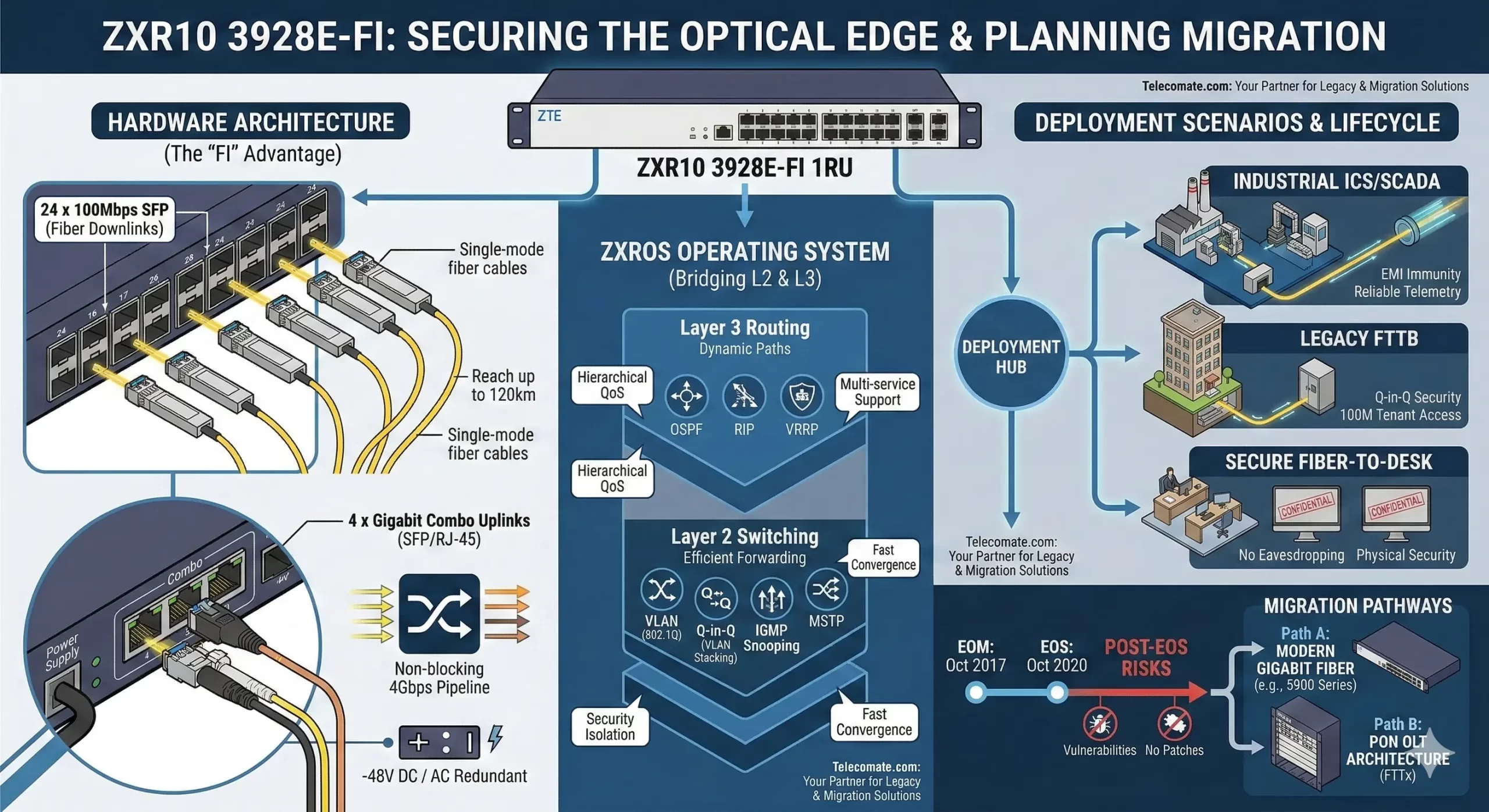
Unveiling the ZTE ZXR10 3928E-FI: Legacy Fiber Connectivity at the Edge
In the expansive ecosystem of telecommunications hardware, the transition from copper-based access to fiber-optic access marked a pivotal shift in network design. The ZTE ZXR10 3900E Series, and specifically the 3928E-FI model, was engineered to facilitate this transition at the network edge. Classified as an Enterprise Service Switch (ESS), this device bridges the gap between traditional Layer-2 access switches and robust Layer-3 routing platforms.
The “FI” in the model name explicitly denotes its “Fiber Interface” configuration. Unlike its sibling, the standard 3928E which utilizes 24 Base-T copper ports, the 3928E-FI is equipped exclusively with optical downlinks. This fundamental design choice made it a cornerstone product for Internet Service Providers (ISPs), utility companies, and industrial network operators who required the extended reach, electromagnetic interference (EMI) immunity, and security inherent to fiber optics, but did not yet require Gigabit speeds to every endpoint.
While the broader telecom industry has aggressively pivoted toward 10G, 40G, and 100G edge aggregation (Source: Dell’Oro Group Ethernet Switch Report, 2023), the reality of global network infrastructure is that thousands of these 100Mbps optical switches remain active in production environments. Managing, troubleshooting, and eventually replacing the 3928E-FI requires a deep understanding of its original design intent and its ongoing operational parameters.
Technical Specifications: Demystifying the “FI” Fiber Interface
The hardware architecture of the 3928E-FI is meticulously tailored for specific aggregation scenarios. Understanding its port configuration and switching capacity is essential for proper network dimensioning.
Optical Port Configuration and Uplink Architecture
The front panel of the ZXR10 3928E-FI is dominated by its optical interfaces:
24 x 100Mbps Optical Ethernet (SFP): These Small Form-factor Pluggable (SFP) ports typically accommodate 100Base-FX or 100Base-LX transceivers. Operating at 1310nm or 1550nm wavelengths, these ports can drive signals over multi-mode fiber (up to 2km) or single-mode fiber (up to 20km or more), making them ideal for sprawling campus environments or Metropolitan Area Networks (MAN).
4 x 1Gbps Uplinks: The switch provides versatile uplink capabilities via four combination interfaces. These can operate as either Optical Ethernet via Gigabit SFP (QGLB) or Electrical Ethernet via 10/100/1000Base-T RJ-45 (QGTB). This 4-port Gigabit uplink array ensures a non-blocking 4Gbps pipeline to the core or distribution layer, achieving a healthy oversubscription ratio of 6:1 (2.4Gbps downlink capacity vs. 4Gbps uplink capacity).
Management and Out-of-Band Interfaces
For administration, the switch includes dedicated out-of-band management interfaces, ensuring that network engineers can access the device even if the data plane is saturated or experiencing a broadcast storm:
1 x RJ-45 Ethernet Management Port: Dedicated for out-of-band SNMP, SSH, or Telnet access.
1 x RS232 Console Port: The traditional serial interface for initial configuration, disaster recovery, and deep-level bootloader access.
Power and Environmental Resilience
Telecom edge equipment is frequently deployed in suboptimal environments, such as un-air-conditioned street cabinets or industrial factory floors. The 3928E-FI is designed to accommodate redundant power supplies (typically dual AC 110/220V or dual DC -48V options), ensuring high availability. The fiber interfaces intrinsically provide galvanic isolation, protecting the switch hardware from ground loops and electrical surges that frequently plague copper-based deployments in industrial settings.
ZXROS Architecture: Bridging Layer-2 Switching and Layer-3 Routing
The true intelligence of the 3928E-FI resides in its operating system: ZTE’s ZXROS (specifically running legacy versions like ZXROS v4.08, which received extensive security certifications including SERTIT-028). ZXROS is a modular, Unix-like operating system that separates the control plane from the forwarding plane, allowing the switch to perform hardware-accelerated routing without exhausting the CPU.
Advanced Layer-2 Forwarding Mechanics
At its core, the device functions as an aggressively optimized Layer-2 switch. It builds and maintains highly efficient MAC address tables to make split-second forwarding decisions.
VLAN and Q-in-Q: Beyond standard 802.1Q VLAN tagging, the switch supports Q-in-Q (VLAN stacking). This allows ISPs to encapsulate customer VLANs within service provider VLANs, effectively expanding the 4,096 VLAN limit and keeping customer traffic securely isolated across the MAN.
Spanning Tree Protocols: To prevent broadcast storms in redundant topologies, it supports standard STP (802.1D), Rapid STP (802.1w), and Multiple STP (802.1s), allowing for sub-second convergence times when a primary optical link fails.
Multicast Management: Through IGMP Snooping, the switch intelligently maps multicast streams (such as IPTV or video surveillance data) only to the ports where receivers have actively requested the stream, preserving the limited 100Mbps bandwidth on other ports.
Layer-3 Routing at the Edge
Unlike basic access switches, the “E” in 3928E denotes enhanced routing capabilities. Operating at Layer 3 allows the switch to inter-VLAN route locally rather than bouncing traffic back to a core router, drastically reducing latency.
Dynamic Routing Protocols: The switch supports RIP v1/v2, OSPF (Open Shortest Path First), and in some advanced licensing scenarios, BGP (Border Gateway Protocol). This allows the 3928E-FI to dynamically adapt to network topology changes and calculate the most efficient path for packet delivery.
VRRP for Gateway Redundancy: By utilizing the Virtual Router Redundancy Protocol (VRRP), two 3928E-FI switches can act as a single virtual default gateway for downstream clients. If the primary switch fails, the secondary takes over packet forwarding within milliseconds, ensuring zero-downtime operations for critical enterprise services.
Strategic Deployment Scenarios for 100M Optical Ethernet
While 100Mbps speeds seem antiquated in the era of Wi-Fi 6 and 10G fiber-to-the-home, there are specific architectural domains where the legacy capabilities of the 3928E-FI are still highly relevant.
1. Industrial Control Systems (ICS) and SCADA
In manufacturing plants, power grids, and railway communication systems, reliability supersedes sheer throughput. SCADA (Supervisory Control and Data Acquisition) telemetry data requires mere kilobits of bandwidth, but it demands absolute protection from the massive electromagnetic interference generated by heavy machinery. The 24 fiber ports of the 3928E-FI provide perfect optical isolation, preventing electrical faults from traversing the network.
2. Legacy FTTB (Fiber to the Building) Aggregation
During the initial waves of fiber rollouts, many ISPs deployed a Fiber-to-the-Building model. A switch like the 3928E-FI would be placed in the basement of a multi-dwelling unit (MDU). Each apartment received a dedicated 100M fiber pair. For ISPs that have not yet upgraded these buildings to GPON/XGS-PON due to the prohibitive cost of replacing in-building wiring, these switches remain the critical aggregation point.
3. High-Security Government and Military Networks
Copper cables emit electromagnetic radiation that can be intercepted using specialized eavesdropping equipment (van Eck phreaking). Fiber optics do not radiate signals, making them inherently secure. Government agencies frequently mandate “Fiber-to-the-Desk” for classified networks. The 3928E-FI serves as an excellent edge aggregator for these secure, physically separated networks.
Hardware Lifecycle Management: Navigating EOM, EOS, and Procurement
Managing telecom networks requires strict adherence to hardware lifecycles. For the ZXR10 3900E series, ZTE officially announced critical End-of-Life milestones:
End of Market (EOM): October 31, 2017
End of Service (EOS): October 31, 2020
(Source: ZTE Official End-of-Market Announcement, 2017).
The Reality of Post-EOS Operations
Once a device reaches EOS, the manufacturer no longer provides software patches, security updates, or direct technical support. For organizations still operating the 3928E-FI, this presents a calculated risk. Vulnerabilities discovered post-2020 will not be patched, meaning these switches must be strictly isolated from the public internet, secured behind robust firewalls, and managed via heavily restricted out-of-band management networks.
Sourcing Legacy Hardware and Spares
Because replacing an entire fleet of edge switches can cost millions of dollars, many network operators choose to maintain their legacy environments by leaning on the secondary market. When sourcing legacy or end-of-life ZTE network equipment, procurement teams must rely on reputable third-party vendors who provide tested, refurbished units.
Having cold spares on hand is no longer an option—it is a mandatory operational requirement. As one of the prominent legacy optical switches still active in many metro networks, secondary market demand for intact 3928E-FI units with functioning SFP cages and healthy power supplies remains surprisingly strong. Navigating the secondary telecom hardware market requires identifying reliable vendors who can offer their own warranties to offset the lack of OEM support.
Migration Strategy: Moving to the ZXR10 3928D-FI and Beyond
ZTE officially designated the ZXR10 3928D-FI as the direct replacement path. However, network architects planning a migration today should look even further ahead.
Audit the Current Traffic: Analyze the port utilization on the existing 3928E-FI. Are the 100M ports saturating?
Evaluate GPON/PON Alternatives: For FTTB scenarios, replacing active point-to-point fiber switches with a Passive Optical Network (PON) architecture (like a ZTE C320 OLT) can drastically reduce power consumption and simplify management.
Upgrade to Gigabit Edge: If point-to-point active Ethernet is still required, modern equivalents feature 24 x 1Gbps SFP ports with 10Gbps (SFP+) uplinks, providing a 10x capacity increase within the same 1RU footprint.
Comparative Analysis: ZTE 3928E-FI vs. Modern Edge Switch Alternatives
To contextualize the legacy technology, the following table compares the 3928E-FI against a hypothetical modern enterprise Gigabit fiber switch and an alternative FTTH PON solution.
| Feature / Dimension | ZTE ZXR10 3928E-FI (Legacy Optical Edge) | Modern 1G SFP Enterprise Switch (e.g., ZXR10 5900 Series) | PON OLT Solution (e.g., GPON/XGS-PON) |
| Primary Downlink Ports | 24 x 100Mbps SFP | 24 or 48 x 1Gbps SFP | Passive Optical Splitters (up to 128 users per port) |
| Uplink Capacity | 4 x 1Gbps (RJ45/SFP Combo) | 4 x 10Gbps (SFP+) or 40Gbps | 2 x 10Gbps or 100Gbps |
| Layer-3 Routing | Yes (RIP, OSPF, Basic BGP) | Yes (Advanced OSPF, BGP, ISIS, MPLS) | Limited (Aggregates to external BNG/Router) |
| Primary Use Case | Legacy FTTB, Industrial Control, Secure Networks | Campus Core/Edge, High-bandwidth Enterprise | Mass Market FTTH/FTTB Broadband |
| Vendor Support Status | End of Service (EOS since 2020) | Active Development & Support | Active Development & Support |
| Cost to Scale | High (Requires dedicated 100M optics per link) | Moderate (1G optics are cheap, but scaling is active) | Low (Passive splitters eliminate active edge power) |
Table 1: Architectural and strategic comparison of legacy vs. modern edge access methodologies.
Conclusion and Next Steps
The ZTE ZXR10 3928E-FI stands as a testament to the durability of early fiber-optic access hardware. With its robust Layer-2 and Layer-3 routing capabilities, combined with 24 dedicated 100Mbps optical ports, it successfully bridged the gap between traditional copper networks and the modern all-optical era. While the device has officially reached its End of Service lifecycle, its continued presence in industrial networks, secure government deployments, and legacy FTTB infrastructures underscores the need for ongoing technical expertise in managing older ZXROS platforms.
For organizations still relying on the 3928E-FI, the immediate priority should be securing reliable cold spares from trusted secondary market partners and isolating the management planes to mitigate unpatchable security vulnerabilities. Simultaneously, IT leadership must begin drafting a comprehensive migration strategy—whether that involves transitioning to modern Gigabit Active Ethernet switches or overhauling the architecture entirely to support next-generation Passive Optical Networks.
Are you currently maintaining a fleet of legacy ZTE routing switches, or planning a network migration to upgrade your edge aggregation capabilities? Contact our team of telecom hardware experts today to discuss sourcing certified refurbished spares, or to request a customized network modernization consultation.
Frequently Asked Questions (FAQs)
1. What is the primary difference between the ZTE 3928E and the 3928E-FI?
The standard 3928E utilizes 24 x 100Mbps Base-T (copper RJ-45) ports for its downlinks. In contrast, the “FI” in 3928E-FI stands for Fiber Interface; it features 24 x 100Mbps SFP (optical) ports, providing greater distance, EMI immunity, and security over fiber optic cabling.
2. What are the uplink capabilities of the ZXR10 3928E-FI?
The switch provides a total of four Gigabit uplinks. These are combination ports, meaning they can be provisioned as either Optical Ethernet using 1Gbps SFP transceivers (QGLB) or as Electrical Ethernet using standard 10/100/1000Base-T RJ-45 connections (QGTB), depending on the upstream router requirements.
3. Is the ZXR10 3928E-FI still officially supported by ZTE?
No. ZTE officially declared the End of Market (EOM) for the 3928E-FI on October 31, 2017. The End of Service (EOS) date was reached on October 31, 2020. Consequently, ZTE no longer provides software updates, security patches, or direct technical support for this specific model.
4. What is the OEM recommended replacement for the 3928E-FI?
At the time of the End of Life announcement, ZTE designated the ZXR10 3928D-FI as the direct hardware replacement. However, for modern network upgrades today, engineers should look toward newer product lines that support 1Gbps or 10Gbps optical edge access, or migrate to PON architecture.
5. Does the 3928E-FI support Layer 3 dynamic routing protocols?
Yes, as an Intelligent Routing Switch (Enterprise Service Switch), it operates effectively at Layer 3. Running ZXROS, the switch supports dynamic routing protocols including RIP v1/v2, OSPF, and basic BGP configurations, allowing it to dynamically route traffic rather than acting strictly as a Layer 2 bridge.
6. What type of SFP transceivers are compatible with the 24 downlinks?
The 24 downlink SFP cages are designed for 100Mbps optical transceivers. Typically, this involves 100Base-FX (for multi-mode fiber, usually reaching up to 2km) or 100Base-LX/EX/ZX transceivers (for single-mode fiber, capable of spanning 15km to 120km depending on the specific optic used).
7. How is the device managed and monitored in a telecom network?
The switch supports both in-band and out-of-band management. It features a dedicated RJ-45 management port and an RS232 console port. Network administrators typically use SNMP (Simple Network Management Protocol) to integrate the device into centralized NMS platforms, alongside SSH/Telnet for direct CLI configuration.
8. What are the typical power supply options for this switch?
Designed for flexible deployment in telecom environments, the 3928E-FI typically supports redundant power supply modules. Options usually include dual AC power (100-240V) for standard enterprise server rooms, or dual DC power (-48V) which is the standard for telecommunications central offices and outdoor street cabinets.







Leave a comment