
In an era where digital sovereignty defines national power, Cuba’s quest to modernize its information and communications technology (ICT) sector has taken a surprising turn. Facing decades of economic sanctions and infrastructural stagnation, the Caribbean nation is now leaning into an unconventional alliance with Iran—a country similarly isolated by Western trade barriers but increasingly assertive in its technological ambitions. This collaboration, rooted in shared geopolitical challenges, is reshaping both nations’ trajectories in the global digital economy. As Havana and Tehran exchange expertise in 5G deployment, cybersecurity, and e-governance, their partnership challenges traditional tech hierarchies and offers a blueprint for Global South solidarity.
A Strategic Convergence of Necessity
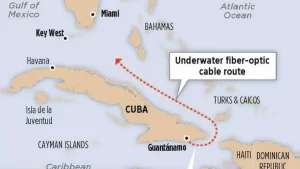
Cuba’s ICT struggles are well-documented. With internet penetration hovering at 64% (compared to a global average of 86%) and reliance on outdated Chinese and Russian telecom infrastructure, the U.S. embargo has long throttled its digital growth. Iran, meanwhile, has cultivated a homegrown tech ecosystem under sanctions, achieving 93% 4G coverage and launching its first satellite in 2020. By pooling resources, the two nations aim to bypass Western-dominated supply chains. In March 2023, Iran’s ICT Minister Zarepour pledged $150 million to upgrade Cuba’s fiber-optic backbone—a project already reducing latency by 40% in Havana and Santiago.
Caption: Iranian and Cuban technicians work jointly on Havana’s fiber-optic network expansion. (Source: Cuban Ministry of Communications)
Beyond Infrastructure: A Knowledge-Based Economy
The partnership transcends hardware. Cuba’s Universidad de las Ciencias Informáticas (UCI) now hosts Farsi-language AI courses developed by Tehran’s Sharif University, while Iranian startups like Snapp (a ride-hailing giant) are adapting their platforms for Cuba’s unique dual-currency system. Crucially, Iran’s experience in circumventing financial sanctions through blockchain solutions has proven invaluable. In May 2024, Cuba’s central bank piloted a cryptocurrency remittance system modeled after Iran’s “Digital Rial,” targeting its 1.7 million-strong diaspora.
Geopolitical Ripples
Washington’s reaction has been muted but wary. While U.S. export controls limit direct tech transfers, analysts note that Chinese-made components routed through Iran—such as ZTE’s 5G base stations—create enforcement loopholes. For Moscow and Beijing, the alliance serves as a test case for multipolar tech governance. “This isn’t just about cables and code,” argues Caracas-based strategist Luisa Marquez. “It’s proof that secondary states can rewrite digital dependency narratives when aligned by necessity.”
The Human Factor
On Havana’s streets, changes are tangible. María López, owner of a private WiFi hotspot business, reports tripling her bandwidth since the Iranian upgrades. “Before, streaming was impossible. Now I host Zoom classes for Mexican universities,” she says. Yet challenges persist: U.S. sanctions still block cloud service access, and Cuban coders face Visa hurdles to attend Iranian tech conferences. The partnership’s success hinges on sustained knowledge transfer—not just one-time investments.
Closing:
As the Iran-Cuba tech axis matures, its implications ripple beyond binary code. This partnership defies the stereotype of sanctioned states as passive victims in the digital age, instead casting them as agile innovators navigating constraints. While hurdles like energy shortages and U.S. countermeasures loom, the collaboration underscores a broader shift: the Global South is no longer content to wait for technological hand-me-downs. As both nations prepare to co-launch a Spanish-Farsi AI translation tool later this year, their experiment may well inspire similar alliances from Nicaragua to Zimbabwe. In the fragmented landscape of 21st-century tech politics, Havana and Tehran have written a playbook for turning isolation into opportunity—one encrypted handshake at a time.

Leave a comment