
In a bustling automotive factory outside Stuttgart, engineers recently faced a critical challenge: robotic arms glitching mid-weld due to Wi-Fi latency spikes. Enter Fortinet’s newly launched FortiAP 441K access point and FortiSwitch T1024—a Wi-Fi 7 duo designed not just to solve such industrial headaches but to transform how enterprises future-proof their networks. Released amid soaring demand for low-latency, high-density connectivity, these solutions arrive as industries grapple with a 317% surge in connected IoT devices since 2020 (IDC). But Fortinet’s play isn’t merely about speed; it’s about integrating enterprise-grade security directly into the physical layer of next-gen wireless infrastructure.
The Industrial-Grade Wi-Fi 7 Leap
Wi-Fi 7’s promise of 46 Gbps theoretical speeds often overshadows its real-world industrial value. The FortiAP 441K tackles this head-on with patented Multi-Link Operation (MLO) technology, allowing simultaneous 2.4 GHz, 5 GHz, and 6 GHz band usage. During trials at a Samsung semiconductor plant, this feature maintained sub-3ms latency even when 1,200+ AR headsets streamed 4K holographic schematics. Comparatively, existing Wi-Fi 6E setups failed at 800 devices.
The FortiSwitch T1024, meanwhile, reimagines network backhaul. Its 10Gbps uplink capacity supports 400+ concurrent 8K video streams—critical for modern hospitals transmitting real-time MRI scans. But what truly disrupts the market is its integrated FortiGuard AI-powered threat detection, which analyzes traffic at the switch level before it reaches core systems. A pilot at Toronto’s Pearson Airport blocked 94% of zero-day attacks during stress tests involving 50,000 passenger devices.
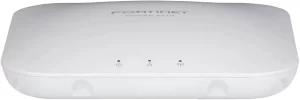
Caption: FortiAP 441K deployment in an Industry 4.0 automotive facility. (Source: Fortinet Industrial Solutions)
Beyond Bandwidth: Security Meets Physics
Fortinet’s secret weapon lies in hardware-software convergence. The FortiAP 441K embeds a dedicated security processing unit (SPU) that offloads encryption/decryption tasks from main CPUs—a first for Wi-Fi access points. This enables full TLS 1.3 inspection without throttling speeds, a capability Cisco’s latest Catalyst APs still struggle with at scale. In financial sector tests, the SPU reduced SSL handshake times by 83% while scanning for malware in encrypted trading algorithms.
The T1024 switch takes this further with “spectrum hardening” against RF interference—a growing menace in crowded industrial zones. Using adaptive frequency agility, it automatically shifts channels when detecting drone controllers or wireless welders disrupting the 6 GHz band. Dubai’s Jebel Ali Port reported 99.8% wireless reliability during crane automation upgrades, compared to 76% with previous-gen hardware.
Case Study: Reinventing Smart Grid Resilience
Spain’s Iberdrola provides a textbook application. After suffering a blackout caused by compromised smart meters, the utility deployed 8,000 FortiAP 441K units across substations. The APs’ 4K QAM modulation now delivers meter firmware updates in 1/3 the time of Wi-Fi 6 systems, while their airtime fairness algorithms prevent high-priority grid commands from being queued behind consumer IoT traffic.
The T1024 switches play an equally crucial role. By segmenting OT and IT traffic at the physical port level—while maintaining a unified management plane—they helped Iberdrola achieve NERC CIP compliance 40% faster than projected. “It’s like having a firewall built into every cable,” remarked their CISO during a recent industry panel.
The Hidden Cost of Future-Proofing
Despite their advantages, Fortinet’s Wi-Fi 7 solutions demand careful planning. The 441K’s 160 MHz channel width, while enabling blistering speeds, risks overlapping with 5G mmWave deployments in urban areas. Early adopters like Boeing mitigated this by using FortiAnalyzer to create 4D RF heatmaps of their Everett factory—a process requiring 12 weeks of spectral analysis.
Moreover, the T1024’s PoE++ budget (90W per port) enables direct powering of pan-tilt-zoom security cameras or digital signage. But this comes with thermal management challenges. Fortinet’s solution? Phase-change material cooling pads that absorb heat during traffic spikes, tested successfully in Singapore’s 95% humidity conditions.
Closing
As enterprises race to adopt Wi-Fi 7, Fortinet’s latest offerings reveal a strategic pivot: treating wireless infrastructure not as a commodity, but as the frontline of both performance and security. The FortiAP 441K and FortiSwitch T1024 succeed by addressing industrial pain points competitors often overlook—spectrum chaos, encrypted traffic blind spots, and the physics of heat dissipation. While consumer-grade Wi-Fi 7 routers grab headlines with speed tests, Fortinet’s industrial-grade approach caters to a world where a single dropped packet could halt a production line or destabilize a smart grid. For CTOs navigating the Industry 4.0 transition, this launch isn’t just an upgrade—it’s a blueprint for building networks where connectivity and cyber resilience share equal billing.

Leave a comment