
In the ever-evolving landscape of telecommunications, understanding specialized networking components becomes crucial for both professionals and enthusiasts. Two terms frequently popping up in fiber optic discussions – “jumper cables” and “tail lines” – often confuse even experienced technicians. This article dives into the practical applications, structural differences, and real-world scenarios where these two critical components play distinct roles in building efficient optical networks.
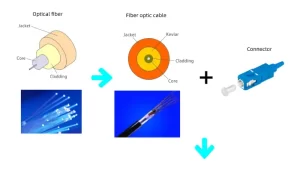
Illustration showing interconnected fiber optic components with labeled jumper and tail lines
Core Technical Breakdown:
Fiber optic jumpers serve as short-distance connectors between devices, typically spanning less than 3 meters. Engineered with precision-machined connectors, they enable quick equipment interchanges in data centers or network cabinets. Their compact design features ruggedized ferrules and protective jackets to withstand frequent.
Tail lines, on the other hand, function as extended network pathways. These longer cables (usually exceeding 30 meters) connect main distribution frames to terminal equipment in buildings or across campuses. Constructed with buffered fiber strands and reinforced armor, they prioritize durability over portability, often incorporating bend-resistant designs for complex installation environments.
Practical Application Comparison:
Data centers rely heavily on jumper cables for:
- Server rack-to-rack connections
- Patch panel terminations
- High-density switch configurations
- Equipment maintenance scenarios
Meanwhile, tail lines dominate in:
- Long-haul campus networks
- Industrial automation systems
- Telecommunication access networks
- Architectural lighting installations
| Feature | Fiber Optic Jumper | Tail Line |
|---|---|---|
| Maximum Length | 3m (9.8ft) | 30m (98ft) + |
| Connector Types | LC/SC/MPO | ST/FC/Armored |
| Bend Radius | 10mm | 25mm |
| Jacket Material | PVC/Nylon | LSZH/Armor |
| Typical Applications | Patching panels | Between buildings |
| Cost Per Unit | 15 | 300 |
As network architectures continue transitioning toward high-speed, scalable solutions, distinguishing between jumper cables and tail lines becomes essential for system optimization. While both serve critical connectivity roles, their design philosophies cater to different operational demands – jumpers prioritize convenience and speed, while tail lines emphasize endurance and distance. By understanding these nuances, network planners can make informed decisions that balance performance, cost, and future-proofing requirements. For customized fiber optic solutions, consulting certified professionals remains the best approach to ensure optimal network performance.

Leave a comment