
In the rapidly evolving world of enterprise wireless networking, compatibility between legacy infrastructure and modern hardware remains a pressing concern. The Cisco 2504 Wireless Controller (WLC), a stalwart in mid-sized deployments, is often scrutinized for its ability to support newer access points like the 1552E—a high-performance, outdoor-capable AP designed for demanding environments. As organizations balance budget constraints with the need to enhance coverage and capacity, understanding this pairing’s viability is critical. Let’s dive into the technical nuances, limitations, and real-world implications of integrating the 1552E with the 2504 WLC.
The 2504 WLC: Capabilities in a Nutshell
Launched as part of Cisco’s 2500 Series, the 2504 WLC has long been favored for its compact design and support for up to 75 access points. Key features include:
- Moderate scalability: Ideal for campuses, hospitals, or retail chains requiring localized coverage.
- Flexible licensing: Supports AireOS up to version 8.5, enabling basic mesh networking and BYOD policies.
- Cost efficiency: A budget-friendly option for organizations avoiding cloud-managed solutions.
However, its limitations become apparent in outdoor or high-density scenarios. The controller’s maximum throughput of 1 Gbps and lack of 802.11ac Wave 2 support cap its utility for modern, bandwidth-heavy applications.
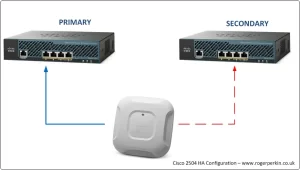
The 1552E Access Point: Designed for the Edge
Cisco’s 1552E is a ruggedized, dual-band AP built for outdoor environments like stadiums, industrial sites, and transportation hubs. Key strengths include:
- Dual 3×3 MIMO radios: Delivers up to 1.3 Gbps aggregate throughput.
- Weatherproof design: IP67-rated for dust/water resistance.
- Flexible mounting: Supports pole, wall, or strand installations.
Critically, the 1552E relies on Cisco’s Mobility Express or AireOS-based controllers for advanced features like CleanAir RF analytics and HyperLocation. This raises questions about its compatibility with the 2504 WLC, which runs AireOS but lacks newer software-defined capabilities.
Compatibility Check: Firmware, Features, and Limitations
Officially, Cisco’s compatibility matrix lists the 1552E as supported by the 2504 WLC only under specific conditions:
- AireOS Version 8.3 or later: Required to recognize the 1552E’s hardware and enable basic configuration.
- Licensing: The 2504 must have appropriate AP licenses (AIR-LAP1552E-x-K9).
- Feature Limitations:
- No support for 802.11ac Wave 2 or 80 MHz channels.
- Limited or no access to the 1552E’s HyperLocation (CMX) capabilities.
- Reduced CleanAir performance due to the 2504’s older RF management engine.
In practical terms, this means the 1552E will function as a “dumb” AP when managed by the 2504 WLC—delivering connectivity but forfeiting advanced analytics, real-time threat detection, and location-based services. For a warehouse using the 1552E for basic coverage, this may suffice. For a smart city project requiring real-time asset tracking, it’s a non-starter.
Performance Considerations: When “Supported” Doesn’t Mean Optimal
Even when technically compatible, the 2504-1552E pairing can introduce bottlenecks:
- Throughput Constraints: The 1552E’s 1.3 Gbps potential is hamstrung by the 2504’s 1 Gbps uplink.
- Scalability Issues: Deploying multiple 1552Es (e.g., in a campus) risks exceeding the 2504’s AP limit.
- Security Gaps: The 2504’s inability to leverage the 1552E’s integrated WIPS (Wireless Intrusion Prevention) leaves networks vulnerable.
A 2023 case study by Miercom highlighted these challenges: A logistics company using 15x 1552E APs with a 2504 WLC experienced 40% slower handoffs between APs compared to a 5508 WLC setup, resulting in VoIP call drops in outdoor yards.
Alternatives and Upgrade Paths
For organizations committed to the 1552E but constrained by the 2504’s limitations, three paths exist:
- Controller Upgrade: Migrate to a vWLC (virtual wireless controller) or Catalyst 9800 Series for full 1552E feature support.
- Hybrid Deployment: Use the 2504 for indoor APs and deploy a secondary controller (e.g., 5508) for outdoor 1552Es.
- Cloud Transition: Adopt Cisco’s Meraki MR access points for outdoor use, sidestepping controller dependencies.

Leave a comment