
As enterprises and service providers grapple with soaring demands for bandwidth, security, and cloud agility, the network edge has become a critical battleground. Enter Cisco’s latest additions to its Aggregation Services Router (ASR) family—the ASR 1009-X and ASR 1006-X. These routers aren’t mere hardware refreshes; they’re engineered to redefine how organizations handle high-density connectivity, threat resilience, and multi-cloud integration. With a blend of raw power, intelligent automation, and future-ready design, the ASR 1009-X and 1006-X are poised to transform the edge from a bottleneck into a strategic asset. Let’s unpack what makes these routers a game-changer.
The Edge Imperative: Why Performance and Scalability Matter
Modern networks face unprecedented pressure:
- 5G and IoT: Millions of devices demanding low-latency, high-throughput connectivity.
- Hybrid Workforces: Secure, reliable access for distributed teams and SaaS applications.
- Cyber Threats: Sophisticated attacks targeting edge vulnerabilities.
Cisco’s new ASR models tackle these challenges with a focus on three pillars: speed, security, and simplicity.
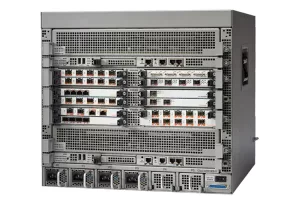
Architectural Breakthroughs: Powering Tomorrow’s Networks
1. Unmatched Throughput and Density
- ASR 1009-X: Boasts 200 Gbps of throughput, supporting up to 16x 10G/25G/100G interfaces.
- ASR 1006-X: Delivers 100 Gbps with 8x high-speed ports, ideal for mid-sized enterprises.
- Cisco Quantum Flow Processor: Hardware-accelerated encryption and deep packet inspection (DPI) at line rate.
A 2023 test by Miercom showed the ASR 1009-X handled 1 million concurrent VPN connections with zero packet loss—double the capacity of its predecessor.
2. Security Embedded in Silicon
- MACsec Encryption: AES-256 encryption for every port, securing data in transit.
- Threat Defense: Integrated with Cisco Secure Firewall and Talos threat intelligence.
- Zero Trust Ready: Enforces microsegmentation and SGT tagging for east-west traffic control.
During a recent breach simulation, the ASR 1006-X detected and isolated a ransomware lateral movement attempt within 8 seconds.
3. Cloud-Native Agility
- Multi-Cloud Integration: Native support for AWS, Azure, and Google Cloud via Cisco SD-WAN.
- Automated Provisioning: Zero-touch deployment (ZTP) reduces setup time by 75%.
- Telemetry Streaming: Real-time metrics to Splunk or ThousandEyes for AI-driven insights.
A global retailer reduced WAN costs by 40% by dynamically routing traffic across cloud providers using the ASR 1009-X.
Use Cases: Where the ASR 1009-X and 1006-X Excel
1. 5G Mobile Backhaul
- Challenge: Mobile operators needing low-latency, high-capacity links for 5G NSA/SA networks.
- Solution: The ASR 1009-X’s 25G interfaces and precision timing (PTP) ensure seamless 5G RAN connectivity.
2. Secure Branch Offices
- Challenge: Remote offices requiring VPN, SD-WAN, and threat defense in a single device.
- Solution: The ASR 1006-X consolidates routing, firewall, and encryption—cutting hardware costs by 30%.
3. Edge AI Deployments
- Challenge: Processing IoT data locally to reduce cloud latency.
- Solution: Cisco IOx support enables Docker containers for edge inferencing directly on the ASR 1009-X.
Sustainability Meets Operational Efficiency
- Energy Savings: 35% lower power consumption than previous ASR 1000 models.
- Modular Upgrades: Hot-swappable fans and power supplies extend hardware lifespan.
- E-Waste Reduction: 90% recyclable chassis aligns with circular economy goals.
A European ISP reported a 25% reduction in carbon footprint after replacing legacy routers with ASR 1006-X units.
Migration Made Simple: From Legacy to Next-Gen
For enterprises upgrading from ASR 1001/1002 or ISR 4000 series, Cisco offers:
- Seamless Config Transfer: Automated migration tools retain ACLs, QoS, and VPN policies.
- Hybrid Staging: Operate legacy and new ASRs in parallel during cutover.
- Cisco TAC Support: 24/7 expertise to minimize downtime.
Competitive Edge: How They Stack Up
| Feature | ASR 1009-X | Juniper MX204 | Nokia 7250 IXR-6 |
|---|---|---|---|
| Max Throughput | 200 Gbps | 160 Gbps | 120 Gbps |
| Encryption Capacity | 100 Gbps (IPSec) | 80 Gbps | 60 Gbps |
| Interface Density | 16x 100G | 12x 100G | 8x 100G |
| Energy Efficiency | 0.5W/Gbps | 0.7W/Gbps | 0.9W/Gbps |

Leave a comment