
It’s easy to get dazzled by the promise of PoE: a single Ethernet cable delivering both power and data to security cameras, Wi-Fi access points, and smart building sensors. Networks hum with wireless connectivity, LED lighting, and intelligent sensors – all powered cleanly over standard network cabling. But every network designer soon bumps against an unyielding physical constraint: Why can’t PoE reliably stretch beyond the classic 100-meter (328-foot) Ethernet limit? The answer lies in fundamental physics, engineering trade-offs, and the practical realities of delivering safe, usable power over twisted-pair copper. This limitation isn’t arbitrary; it’s a calculated boundary defined by voltage drop, resistance, safety, and the very design of PoE standards.
For network engineers deploying security cameras at the edge of a large campus or access points in remote warehouse corners, the 100-meter barrier is both familiar and frustrating. While PoE standards like 802.3af (PoE, 15.4W), 802.3at (PoE+, 30W), and 802.3bt (PoE++, 60W and 90W) provide incredible flexibility, they do not magically extend the reach of electricity. Power loss, primarily through voltage drop due to wire resistance, fundamentally governs the achievable distance.
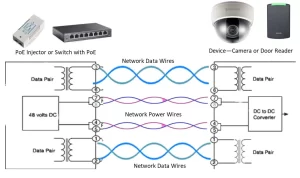
The Physics: Voltage Drop is Inevitable
- Ohm’s Law Reigns Supreme: PoE travels over copper conductors, primarily within Cat5e, Cat6, or better cables. Copper, while an excellent conductor, still has inherent resistance. According to Ohm’s Law (V = I * R), voltage drop (V drop) is directly proportional to both the current (I) flowing through the cable and the resistance (R) of the cable itself.
- Cable Resistance is Real: The resistance of standard copper cabling is significant over long distances. For example, solid conductor Cat6 cable typically has a resistance around 9 ohms per 305 meters (1000 ft) per loop (using both conductors in a pair). Over the entire 100-meter loop (the actual path electricity travels out and back), resistance accumulates.
- Power Demand Dictates Current: Higher power demands (driven by standards like PoE++ delivering up to 90W) require higher current. Voltage drop increases linearly with current. Delivering 90W (requiring significantly more current than delivering 15W) over the same distance results in a much larger voltage drop. For instance, a device needing 30W might draw 0.6A at 50V, while a device needing 90W could draw 1.9A at roughly 50V – leading to a voltage drop over 3 times larger at the higher power level for the same cable.
- The Minimum Voltage Cliff: PoE Powered Devices (PDs) like cameras and access points require a specific minimum input voltage to operate correctly. This is typically in the range of 37V to 57V for PoE, PoE+, and PoE++, depending on the negotiation during handshake (the actual operational range is narrower than this max span). The switch (PSE – Power Sourcing Equipment) injects power at a voltage high enough (usually 44-57V) to guarantee that after voltage drop occurs over 100 meters of cable under worst-case conditions, the device still receives at least its required minimum voltage. If the voltage drops below this minimum threshold, the device browns out, becomes unstable, or simply fails to power on.
The Trade-Offs: Balancing Power, Distance, and Safety
- Increasing Voltage Isn’t Simple: Why not just jack up the voltage from the switch to compensate for longer drops? Safety becomes the immediate concern. PoE operates within the Safety Extra Low Voltage (SELV) classification standard (under 60VDC). Exceeding this voltage pushes installations into stricter, more expensive electrical codes and introduces significant safety risks to installers and users working with cables. Maintaining SELV compliance is non-negotiable for broad PoE adoption.
- Thicker Wire Costs More: Lowering resistance requires thicker gauge copper wire (e.g., moving from standard 24 AWG to 22 AWG or even lower). While effective at mitigating voltage drop (Resistance decreases significantly with thicker wire), it dramatically increases cable cost and bulk. It also forces cable management challenges. The PoE standards rely on the resistance characteristics of readily available, cost-effective cable types like Cat5e/Cat6.
- Heat is the Hidden Enemy: Delivering higher currents to overcome resistance leads to power dissipation as heat within the cable (Power Loss = I² * R). Excessive heat can degrade cable performance over time, pose fire risks (especially in bundles), and even cause signal integrity problems for data transmission. The 100-meter limit, coupled with the thermal limitations defined by standards like TIA-568-C.2 and ISO/IEC 11801, helps ensure cables operate within safe temperature ranges, even when delivering maximum power. Extending the distance while keeping wattage high exponentially increases heat generation risk.
The Ethernet Standard: The Data Constraint
Crucially, the 100-meter limit wasn’t originally established for PoE; it was defined for reliable Ethernet data communication decades ago. This distance ensures:
- Signal Integrity: Electrical signals travelling over copper weaken (attenuate) and become distorted (jitter) over distance. Beyond roughly 100 meters for 100BASE-TX and 1000BASE-T, the risk of excessive errors, retransmissions, and unstable links becomes unacceptable. While techniques improve bandwidth over existing copper, the fundamental distance limitations remain largely tied to the physics of copper transmission.
- Collision Detection: Ethernet’s fundamental CSMA/CD (Carrier Sense Multiple Access with Collision Detection) mechanism, critical for shared media operation historically, had timing constraints demanding the maximum round-trip delay not exceed limits achievable within the 100-meter span. While less critical in today’s full-duplex switched networks, the timing parameters embedded within the standard persist.
PoE inherited and must operate within this foundational 100-meter data constraint. Exceeding the distance for power could potentially be engineered (with significant cost/safety compromises), but without reliable data transmission, the connection is useless. Therefore, the PoE standards were designed to deliver power within the existing, well-understood Ethernet cable distance envelope.
Why Not Just Go Further? Solutions and Their Costs
Workarounds exist, but they come with trade-offs:
- Powered Midspans / Active Extenders: These devices are installed inline, typically at or around the 100-meter point. They regenerate both data and power, effectively resetting the 100-meter clock. The downside? Additional cost, another point of failure requiring power, increased complexity, and potentially needing environmental protection if deployed remotely. They effectively break the single-cable simplicity of PoE.
- Fiber + Remote Power: For very long runs (hundreds of meters or kilometers), fiber optic cabling transmits data flawlessly over long distances. However, fiber can’t carry power. This requires placing a remote switch or injector near the device, supplied by local AC power. This adds complexity, deployment logistics, and significant expense compared to pure PoE.
- Alternative High-Voltage PoE (Non-Standard): Some vendors offer proprietary solutions utilizing voltages well above the SELV limit (e.g., 100-300V) transmitted over specialized cabling. These are primarily aimed at lighting applications. However, they require certified installers, special cabling and termination, and strict compliance with much more stringent electrical codes, significantly increasing cost and complexity compared to standards-based PoE. They are not a drop-in replacement for standard network PoE devices.
The 100-Meter Equation: A Calculated Compromise
The 100-meter PoE limit stands as a carefully engineered equilibrium. It balances the fundamental physics of voltage drop and resistance in copper cabling, the electrical safety constraints of SELV, the thermal limitations of managing power dissipation, the demands for reliable Ethernet data transmission, and the need for economical cabling. Increasing voltage, decreasing resistance, or transmitting higher power pushes against one or more of these boundaries.
Understanding this intricate interplay is vital for designing robust, reliable PoE networks. Recognize that while pushing beyond 100 meters for low-power devices might sometimes seem to work in ideal conditions (with thick cable and low ambient temperatures), it operates outside the guaranteed envelope defined by the standards and the underlying physics. The 100-meter line isn’t drawn lightly; it’s the invisible tether where power, data, physics, and safety converge to define the practical reach of this transformative technology. Planning within this boundary ensures predictable performance and avoids the frustrations of intermittent failures and unexpected shutdowns.

Leave a comment