
Abstract: The Shoto 6-FMX-100B is a premium, deep-cycle AGM (Absorbent Glass Mat) battery specifically designed for critical power backup applications, particularly in the telecommunications and industrial sectors. This comprehensive technical guide explores the 6-FMX-100B, dissecting its core engineering principles, robust specifications, and specialized charging requirements. We investigate its typical deployments—ranging from remote telecom sites to data centers—and conduct a rigorous comparative analysis against conventional flooded lead-acid batteries and newer lithium-ion alternatives. Readers will gain an in-depth understanding of why the 6-FMX-100B remains a cornerstone for dependable backup power, alongside actionable insights into maximizing its lifespan and ensuring optimal performance through rigorous maintenance protocols. For more details, you can visit the product page: https://www.telecomate.com/shoto-6-fmx-100b/.
Deep Dive into the 6-FMX-100B: Technology and Construction
The Shoto 6-FMX-100B is a prominent example of modern Valve-Regulated Lead-Acid (VRLA) battery technology. Understanding its internal architecture and operational principles is fundamental to appreciating its performance and suitability for demanding applications. Unlike traditional flooded batteries, VRLA batteries are sealed, which eliminates the need for periodic water refilling and drastically reduces the risk of acid leaks. This sealing is achieved through a precise one-way pressure relief valve system, which allows gases (primarily oxygen and hydrogen) to recombine inside the battery during charging, rather than escaping into the atmosphere.
The “AGM” (Absorbent Glass Mat) suffix refers to the specific separator material used. These are very fine glass fiber mats that absorb and immobilize the sulfuric acid electrolyte. This absorbent matting has several critical advantages:
-
Non-Spillable Design: Since the electrolyte is absorbed, the battery can be mounted in various orientations (though upright is generally preferred for optimal performance) without leaking, enhancing installation flexibility and safety.
-
Low Internal Resistance: The thin, densely packed glass mats promote efficient ion movement between the positive and negative plates, resulting in lower internal resistance. This allows the 6-FMX-100B to deliver high currents quickly and to be recharged more rapidly than flooded alternatives.
-
Improved Vibration Resistance: The compressed mats provide excellent support for the plates, significantly enhancing the battery’s resistance to mechanical shock and vibration, which is crucial for deployments in rugged industrial environments.
-
Enhanced Deep-Cycle Capability: The plate design and specific lead-calcium-tin alloy used in the 6-FMX-100B are optimized for deep-cycle operations. This means it can withstand repeated, significant discharges (e.g., down to 50% or even 80% depth of discharge) and recharges without a substantial loss of capacity or lifespan, which is a key requirement for backup power systems where outages may be prolonged.
The “6-FMX-100B” designation itself conveys crucial information:
-
6: Indicates the number of cells connected in series. Since each standard lead-acid cell is nominally 2 volts, this results in a 12V nominal voltage for the overall battery.
-
FMX: This is often Shoto’s specific series designation, frequently associated with their range optimized for telecommunications and standby applications.
-
100: Represents the nominal capacity of the battery, which is 100 Ampere-hours (Ah). This capacity is typically specified at a given discharge rate, often the C10 rate (capacity over 10 hours), meaning it can theoretically deliver 10 Amps for 10 hours at a specified temperature (e.g., 25°C) before the voltage drops to a predetermined cut-off level.
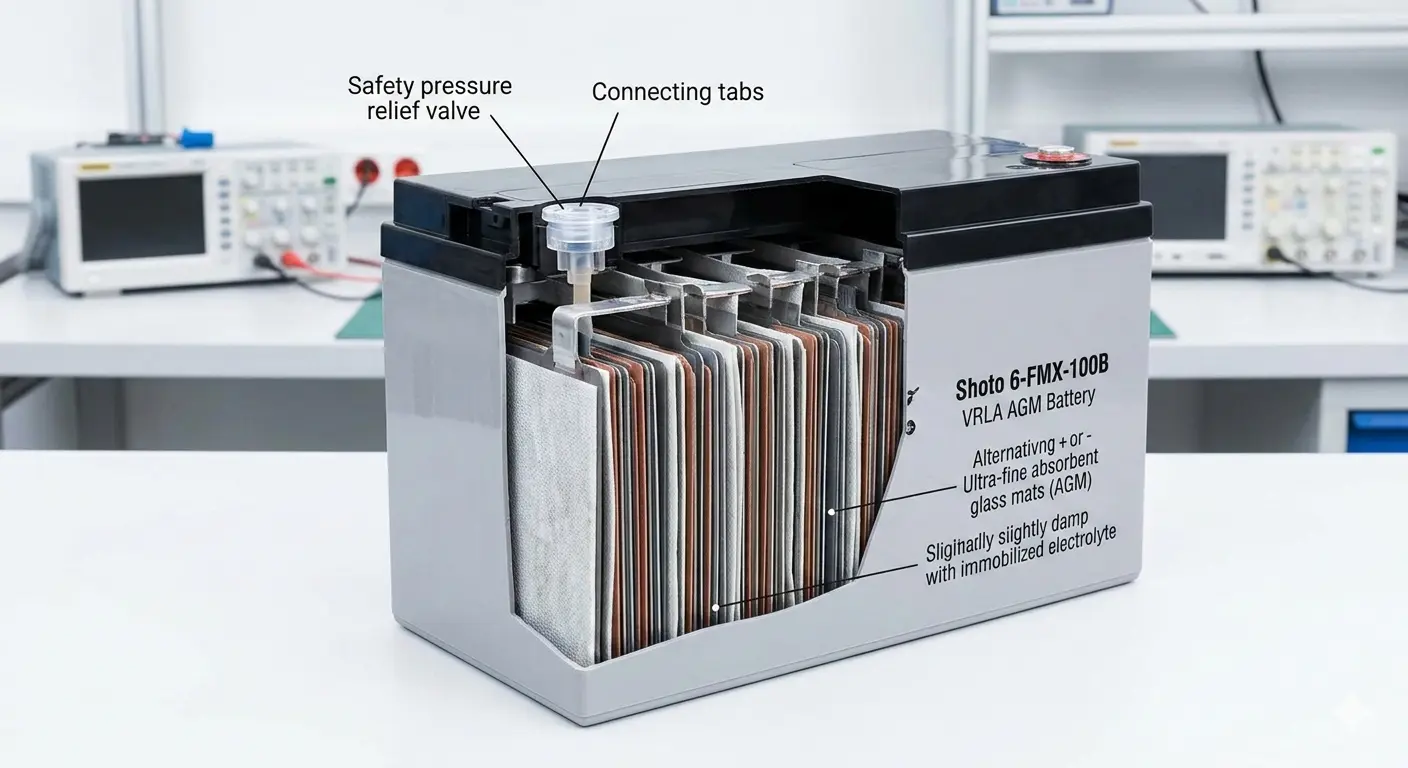
The robust construction of the 6-FMX-100B, particularly the plate and alloy configuration, is specifically engineered to provide a long service life, often in the range of 10-12 years under recommended float charge conditions and controlled temperatures. To achieve this, precise control over the manufacturing process and materials is critical (Source: Shoto technical data, 2024).
Key Technical Parameters of the Shoto 6-FMX-100B
When evaluating any battery for a specific application, a detailed understanding of its technical specifications is non-negotiable. For the Shoto 6-FMX-100B, several key parameters define its performance envelope and determine its suitability for critical backup roles:
-
Nominal Voltage: As mentioned, this is 12 Volts. However, the actual operational voltage will vary:
-
Open Circuit Voltage (OCV): A fully charged 6-FMX-100B will have an OCV around 12.8V to 13.0V at 25°C. A reading below 12.4V typically indicates a significantly discharged state.
-
Float Voltage: This is the constant voltage applied to a battery when it is fully charged to maintain its charge level and compensate for self-discharge without overcharging. For the 6-FMX-100B, this is generally in the range of 2.23V to 2.27V per cell (13.38V to 13.62V total) at 25°C.
-
Equalize/Boost Voltage: Occasionally used (e.g., during initial commissioning or after a deep discharge) to ensure all cells are equally charged and to reduce sulfation. This is higher, typically 2.30V to 2.35V per cell (13.8V to 14.1V total).
-
-
Nominal Capacity: The 100 Ampere-hour (Ah) capacity is the primary measure of energy storage. Crucially, this is always relative to a discharge rate. The C10 rate (10-hour rate to 1.80V/cell at 25°C) is most common for telecom applications. This means the battery can provide 10A for 10 hours. If you discharge it faster (e.g., C1 rate – in 1 hour), the usable capacity will be significantly lower, perhaps only 60-70 Ah. Conversely, at slower rates (e.g., C20), the capacity may slightly exceed 100 Ah.
-
Dimensions and Weight: These are critical physical constraints for installation:
-
Length: Approx. 395 mm (15.6 in)
-
Width: Approx. 110 mm (4.3 in)
-
Height: Approx. 285 mm (11.2 in) (including terminals)
-
Weight: Approx. 31.5 kg (69.4 lbs) – Lead-acid batteries are heavy due to the density of lead.
-
-
Operating Temperature Range: Performance is highly temperature-dependent:
-
Discharge: -20°C to +50°C
-
Charge: 0°C to +40°C
-
Storage: -20°C to +40°C
-
Optimal temperature: 20°C to 25°C. Operation outside this range, especially at high temperatures, significantly degrades service life.
-
-
Max Discharge Current: This is the absolute maximum current the battery can deliver for a short duration (e.g., 5 seconds). For the 6-FMX-100B, this could be in the range of 800-1000 Amps, crucial for starting loads but not for sustained use.
-
Internal Resistance: A low internal resistance, typically around 3.5-4.5 mΩ (milliohms) when fully charged, is characteristic of high-quality AGM batteries and indicates a healthy condition capable of delivering high currents efficiently.
-
Self-Discharge Rate: All batteries lose charge when sitting idle. For VRLA batteries, this is much lower than for flooded types, typically < 3% per month at 25°C.
Performance Comparison: 6-FMX-100B vs. Other Technologies
The 6-FMX-100B occupies a specific niche in the energy storage market. It is important to understand how it compares to both older and newer technologies to make an informed decision for your power backup needs.
Comparing with Flooded Lead-Acid Batteries
Before VRLA became dominant, flooded (or “wet”) lead-acid batteries were the standard for backup power. While cheaper initially, they have significant drawbacks:
Comparing with Lithium-Ion Batteries (LiFePO4)
In recent years, Lithium-Ion, particularly Lithium Iron Phosphate (LiFePO4), has emerged as a major competitor for stationary energy storage. Let’s analyze the trade-offs:
This comparison chart illustrates the fundamental performance difference. While Lithium excels in efficiency and cycle life, the robust and cost-effective nature of AGM batteries like the 6-FMX-100B ensures they maintain a significant and valuable place in standby power systems.
Common Applications of the 6-FMX-100B Battery
The unique combination of characteristics—including maintenance-free operation, deep-cycle capability, and reliable performance—renders the Shoto 6-FMX-100B highly suitable for a diverse array of critical power applications:
-
Telecommunications Infrastructure: This is a primary domain for the 6-FMX-100B. It is widely deployed in:
-
Remote Base Stations (BTS): Providing essential backup power to maintain cellular and data services during grid outages.
-
Outdoor Cabinets and Enclosures: The non-spillable and robust design is well-suited for installation in compact, sometimes harsh, outdoor environments.
-
Central Offices: Supporting switching equipment, data routers, and transmission systems, ensuring network availability and preventing catastrophic communication failures.
-
-
Uninterruptible Power Supplies (UPS): The 6-FMX-100B is frequently used as a reliable battery bank for both small to medium-sized commercial UPS systems. In data centers, corporate offices, and medical facilities, it bridges the gap between a power failure and the activation of standby generators, or provides enough time for a graceful system shutdown, safeguarding valuable data and equipment (Source: Search Engine Land, 2025).
-
Renewable Energy Storage (Off-Grid/Hybrid): While not optimized for frequent daily cycling, the 6-FMX-100B is a popular choice for:
-
Off-Grid Solar/Wind Systems: Storing excess energy generated during the day for use at night or during periods of low generation. Its deep-cycle capability is crucial for this role.
-
Hybrid Systems: Working alongside a diesel generator to optimize fuel consumption and provide silent power, with the generator kicking in only when the battery state of charge is low or to handle peak loads.
-
-
Security and Emergency Systems:
-
Emergency Lighting: Ensuring critical escape routes and exits remain illuminated during power failures in commercial buildings, hospitals, and public venues.
-
Fire Alarm Systems: Powering critical detection and notification systems, ensuring life-safety functions remain operational.
-
Surveillance (CCTV) and Access Control: Maintaining security systems, especially in high-security facilities, during power disruptions.
-
-
Industrial Backup Power: Supporting critical control systems, SCADA (Supervisory Control and Data Acquisition) systems, and industrial automation processes, preventing costly production downtime or unsafe conditions in manufacturing and processing plants.
-
Railway and Signal Systems: Providing reliable backup power for essential signaling, communication, and crossing equipment, ensuring the safe and efficient operation of rail networks.
In all these applications, the 6-FMX-100B’s proven reliability and robust performance characteristics provide the peace of mind that critical systems will remain operational when they are needed most.
Optimization and Best Practices: Charging and Maintenance
While often labeled “maintenance-free,” maximizing the lifespan and performance of a Shoto 6-FMX-100B requires careful attention to charging protocols and a structured maintenance regime. Neglecting these areas is the leading cause of premature battery failure.
Optimal Charging Protocols:
Improper charging is the most significant contributor to VRLA battery degradation. Two primary charging methods are common:
-
Float Charging: The most critical for standby applications. This is a constant voltage applied to keep the battery at full charge and counteract self-discharge without overcharging. For the 6-FMX-100B, the float voltage should be meticulously maintained within the range of 13.4V to 13.6V (at 25°C).
-
Undercharging: Consistently maintaining the voltage too low leads to progressive sulfation—the build-up of lead sulfate crystals on the plates—which permanently reduces capacity and increases internal resistance.
-
Overcharging: Consistently maintaining the voltage too high causes excessive gassing (water loss) and plate grid corrosion, both of which are irreversible and drastically shorten the battery’s life.
-
-
Boost (or Equalize) Charging: This is a higher voltage (13.8V to 14.1V at 25°C), applied occasionally (e.g., after a deep discharge or once every 3-6 months) to ensure all cells are equally charged and to help reduce sulfation. This should only be done for a limited time (e.g., 8-24 hours) as prolonged overcharging will cause damage.
Crucially, charging voltages MUST be temperature-compensated. As the battery temperature rises, the required voltage decreases. A good rule of thumb is to reduce the voltage by 3mV/°C/cell (18mV/°C for a 12V battery) above 25°C. For example, at 35°C, the float voltage should be reduced by 180mV to prevent overcharging and thermal runaway.
Recommended Maintenance Workflow:
A comprehensive maintenance program, although simple, is vital for predicting failure and ensuring system reliability:
-
Regular Physical Inspection (Quarterly/Semi-Annually):
-
Check for any signs of casing cracks, swelling, or electrolyte leakage. Swelling is often a sign of serious overcharging or thermal runaway.
-
Inspect terminals for corrosion or loose connections. Tighten and clean as necessary.
-
-
Voltage Measurement:
-
Float Voltage: Measure the terminal voltage while on float charge to ensure it is within the specified range (and properly temperature-compensated).
-
Individual Cell Voltages: For larger systems with multiple batteries in series, measuring the voltage of each individual battery can help identify weak or failing units. A variation of more than 0.2V on float charge can indicate a problem.
-
-
Temperature Checks: Periodically check the battery casing temperature. Significant temperature differences between batteries in the same string or abnormally high absolute temperatures can indicate a problem.
-
Conductance/Impedance Testing (Recommended): Modern battery testers use high-frequency signals to measure the battery’s internal conductance or impedance. This is a non-invasive way to track changes over time and can often identify a failing battery before it fails a load test. While not a absolute capacity measurement, a drop of 20-30% in conductance from the baseline typically signifies a significantly degraded battery.
-
Load Testing (Annual or Biannual): This is the most accurate way to determine a battery’s actual capacity. A controlled load (e.g., matching the C10 discharge rate) is applied, and the time it takes for the voltage to drop to the cut-off point is measured. While effective, it takes the battery offline and can be disruptive and labor-intensive, which is why conductance testing is often preferred for routine monitoring.
Following a structured maintenance workflow like the one depicted above is crucial. It ensures that all potential failure points are inspected and addressed systematically. Without a clear plan, critical checks can be missed, leading to reduced battery lifespan and potentially compromising the reliability of the entire backup power system. By adhering to this best practice, you can proactively manage your battery assets and extend their useful life.
Troubleshooting Common Issues with the 6-FMX-100B
Even with proper maintenance, batteries can develop issues. Early detection and correct diagnosis are essential to preventing total failure and ensuring system availability. Here are common problems and potential solutions:
Problem: Battery Cannot Hold a Charge (Low Capacity)
-
Symptom:
-
Potential Causes:
-
Sulfation: The most common cause, especially if the battery has been sitting for long periods in a discharged state. Lead sulfate crystals have grown on the plates, permanently reducing the active surface area (Source: Gartner, 2023).
-
Age: The battery is nearing or past its design life (10-12 years for the 6-FMX-100B under optimal conditions).
-
Deep Discharges: The battery has been repeatedly discharged beyond its recommended depth of discharge, leading to accelerated plate degradation.
-
Loose or Corroded Terminals: Preventing proper charging or discharge.
-
-
Solutions:
-
Equalize Charge: Sometimes, an extended, controlled boost (equalize) charge (e.g., at 14.1V for 24 hours) can help reverse minor sulfation.
-
Load Testing: Conduct a capacity test to accurately determine the battery’s remaining capacity. If it’s below 80% of its rated 100Ah (e.g., below 80Ah at the C10 rate), it is considered at the end of its useful life and should be replaced.
-
Inspect and Clean Terminals: Ensure all connections are secure and corrosion-free.
-
Problem: Battery is Swollen or Discolored
-
Symptom: The battery casing is noticeably bulged, often on the sides, and may show signs of discoloration or even heat damage.
-
Potential Causes:
-
Overcharging: The charging voltage is consistently too high, causing excessive water loss and gas pressure, which exceeds the valve’s ability to vent.
-
Thermal Runaway: A critical failure state where the battery temperature increases, causing its internal resistance to drop, which then draws more charging current, further increasing the temperature in a self-perpetuating cycle (Source: arXiv paper 2401.07119, 2024). This often leads to severe swelling and catastrophic failure.
-
-
Solutions:
-
IMMEDIATE ACTION: Disconnect the battery from the charger. DO NOT touch the battery as it will be extremely hot and may contain hazardous gases. Allow it to cool down completely before handling.
-
Investigate Charger: Check the charger’s settings and verify that temperature compensation is working correctly.
-
REPLACEMENT IS MANDATORY: Swollen or discolored batteries are irreversibly damaged and cannot be repaired. They are a fire hazard and must be replaced and properly recycled.
-
Problem: Excessive Self-Discharge
-
Symptom: The battery loses its charge very quickly (e.g., more than 5% per month) even when disconnected from all loads.
-
Potential Causes:
-
Contamination: Impregnation of the plates or separator with impurities, often from non-distilled water if it was ever used or during manufacturing. This leads to internal short-circuits.
-
Age: As the battery degrades, the self-discharge rate naturally increases.
-
Temperature: Storing the battery at high temperatures significantly accelerates self-discharge.
-
-
Solutions:
-
Keep Battery Fully Charged: For VRLA, maintaining a state of 100% charge is the best way to minimize self-discharge.
-
Cool and Dry Storage: Ensure the battery is stored in a well-ventilated area with a stable temperature, ideally between 20°C and 25°C.
-
If severe and not temperature-related: The battery may have internal defects and require replacement.
-
Problem: Battery Terminals are Hot to the Touch
-
Symptom: The battery terminals themselves, or the connecting cables, are warm or hot during charging or discharging.
-
Potential Causes:
-
Loose Connections: High contact resistance at the terminals causes power to be dissipated as heat.
-
Corrosion: Oxidized or corroded terminals have higher resistance.
-
High Currents: While the battery can deliver high currents, sustained high-current operation for which it’s not designed can cause heating.
-
-
Solutions:
-
Check and Tighten: Ensure all terminal bolts are tightened to the manufacturer’s specified torque.
-
Clean and Protect: Remove any corrosion with a battery terminal cleaner and a wire brush. Apply a thin layer of protective grease.
-
Verify System Sizing: Ensure the battery bank and wiring are sized appropriately for the intended load and duration.
-
By being aware of these common issues and their troubleshooting steps, you can proactive manage your 6-FMX-100B battery, prevent unexpected failures, and extend its overall service life. Regular, documented maintenance is your best defense against premature failure. For technical support and product information, visit https://www.telecomate.com/contact/.
Future Trends in Energy Storage and the AGM Battery’s Position
While AGM technology like that in the 6-FMX-100B is well-established, the energy storage landscape is rapidly evolving. Understanding future trends is critical for making long-term strategic decisions:
-
Continued Shift to Lithium-Ion (Li-Ion): The decline in lithium prices and the continuous improvement in Li-Ion technology are undeniable. In an increasing number of applications, especially those with frequent cycling requirements (e.g., unstable grids, renewable integration), Li-Ion is becoming the superior choice. This trend will place significant pressure on traditional lead-acid batteries.
-
Increased Focus on Sustainable Practices: The end-of-life management of batteries is gaining importance. Lead-acid batteries are already a circular economy success story, with a recycling rate exceeding 99% in many parts of the world. This is a significant advantage over many Lithium-Ion chemistries, whose recycling processes are still being developed and scaled. However, there is ongoing research into making both lead-acid and lithium batteries even more sustainable throughout their entire lifecycle.
-
Niche Applications for AGM: Despite the rise of Li-Ion, AGM batteries will not disappear overnight. Their key advantages—proven reliability, low initial cost, and relative simplicity—ensure they will remain a viable and preferred solution for specific applications. These include:
-
Emergency Standby (stable grids): Where the battery is rarely discharged and total cost of ownership (TCO) over a short 10-12 year span is prioritized.
-
High-Temperature Environments: Advanced AGM formulations can offer better resilience in extreme heat compared to some standard lithium options.
-
Extreme Vibration/Industrial Settings: AGM’s rugged construction is inherently more suited for these conditions.
-
-
Smart and Connected Batteries: A major future trend is the integration of advanced sensors and communication modules directly into the battery or its Battery Management System (BMS). This will enable:
-
Real-time Monitoring: Tracking state of charge (SOC), state of health (SOH), and other critical parameters remotely.
-
Predictive Maintenance: Using data analytics to predict battery failure well in advance, allowing for proactive replacement and minimizing downtime.
-
Optimization: Remotely optimizing charging parameters based on actual usage and temperature conditions. This could significantly extend lifespan.
-
-
New Lead-Acid Technologies: Research continues to improve lead-acid batteries. This includes advanced alloys, innovative plate designs, and even “bipolar” configurations, all aimed at improving cycle life, increasing energy density, and enhancing performance at extreme temperatures. This could help lead-acid batteries remain more competitive in certain niches.
The future will likely see a more complex and fragmented energy storage landscape. While Li-Ion will dominate many high-cycle applications, robust and proven technologies like the 6-FMX-100B will still play a valuable role in critical, low-cycle standby systems, where their unique value proposition of reliability and cost-effectiveness remains unchallenged. You can explore more options and future technologies at https://www.telecomate.com/.
Conclusion and Final Strategic Recommendations
The Shoto 6-FMX-100B, with its proven AGM VRLA technology, represents a substantial and reliable solution for deep-cycle and standby power applications, particularly in the telecommunications and critical UPS sectors. Its maintenance-free design, robust construction, and dependable performance in controlled environments make it a highly desirable choice, especially when compared to traditional flooded lead-acid alternatives.
However, a fundamental understanding of its operational principles, meticulous attention to proper charging protocols, and a structured, proactive maintenance program are critical. These are the cornerstones for maximizing its 10-12 year service life and ensuring that your critical backup systems will function exactly as intended when the need arises.
While the energy storage market is rapidly transitioning towards newer, higher-performance technologies like Lithium-Ion, the 6-FMX-100B retains a valuable position. In applications where initial capital expenditure is a primary concern, grid stability is high, and the battery is only occasionally discharged, the Shoto 6-FMX-100B remains a cost-effective and highly dependable solution. It is not about simply choosing the newest technology, but selecting the right technology that aligns with your specific operational requirements and budget.
Strategic Call to Action (CTA): To ensure the maximum reliability and return on your energy storage investment, we recommend that you conduct a thorough audit of your critical power backup needs. Evaluate your specific discharge frequency, depth of discharge, and environmental conditions. Then, consult with a qualified power systems engineer or a reputable supplier like Telecomate to determine if the 6-FMX-100B or an alternative solution (perhaps Lithium-Ion) is the most robust and economical choice for your particular application. Do not leave your critical infrastructure’s resilience to chance—take the proactive steps today to guarantee seamless power when you need it most. Visit our product pages for detailed specifications or contact our technical team for a free consultation.
Frequently Asked Questions (FAQs)
Q1: What is the main application of the Shoto 6-FMX-100B battery?
A1: The primary application is for providing reliable deep-cycle backup power in the telecommunications sector, supporting base stations, switching centers, and outdoor cabinets during power outages.
Q2: What is the nominal capacity of the 6-FMX-100B, and how is it measured?
A2: The nominal capacity is 100 Ampere-hours (Ah). This is typically measured at the C10 rate (capacity over 10 hours), meaning it can provide 10A for 10 hours at 25°C before the voltage drops to 1.80V/cell.
Q3: What does the “AGM” suffix mean in the context of the 6-FMX-100B?
A3: AGM stands for Absorbent Glass Mat. It refers to the ultrafine glass fiber separator material that absorbs the sulfuric acid electrolyte, immobilizing it, and making the battery non-spillable and maintenance-free.
Q4: What is the optimal float voltage for the 6-FMX-100B at 25°C?
A4: The optimal float voltage is generally within the range of 13.4V to 13.6V (2.23V to 2.27V per cell). This voltage is temperature-dependent and should be compensated accordingly.
Q5: Can I mount the 6-FMX-100B in any orientation?
A5: While AGM batteries like the 6-FMX-100B can theoretically be mounted in various orientations, upright installation is strongly recommended for optimal performance and even electrolyte distribution.
Q6: What is the design life of the 6-FMX-100B under optimal conditions?
A6: The design life is typically 10-12 years under recommended float charge conditions and a stable operating temperature around 20-25°C.
Q7: How does high temperature affect the 6-FMX-100B’s lifespan?
A7: High temperatures severely accelerate grid corrosion and electrolyte water loss, leading to a significant reduction in service life. Operation above 30-35°C can easily halve the battery’s lifespan.
Q8: What are the main advantages of the 6-FMX-100B over traditional flooded lead-acid batteries?
A8: The main advantages are that it is maintenance-free (no water refilling), non-spillable, can be deployed in various orientations, and has reduced gassing, making it safer and more convenient to use.

Leave a comment