
Abstract
As the global demand for high-speed fiber-to-the-home (FTTH) and enterprise broadband networks exponentially increases, the physical layer infrastructure must evolve to support greater distances and higher user densities. This whitepaper explores the core technology behind the ZTE GPON OLT C+ optical transceiver, detailing its internal architecture and operational advantages. You will learn what distinguishes the Class C+ Small Form-factor Pluggable (SFP) module from its predecessors, particularly its integration of advanced Distributed Feedback (DFB) lasers and Avalanche Photodiode (APD) receivers. We will examine why upgrading your Optical Line Terminal (OLT) infrastructure to Class C+ is a critical strategic move to overcome optical link budget limitations, reduce CapEx, and improve overall network reliability. Finally, you will discover how to leverage these transceivers to maximize split ratios, execute precise link budget calculations, and optimize your passive optical network (PON) deployments for maximum return on investment. By mastering the technical specifications of the C+ module, network architects can seamlessly transition to high-density, future-proof telecommunications networks.
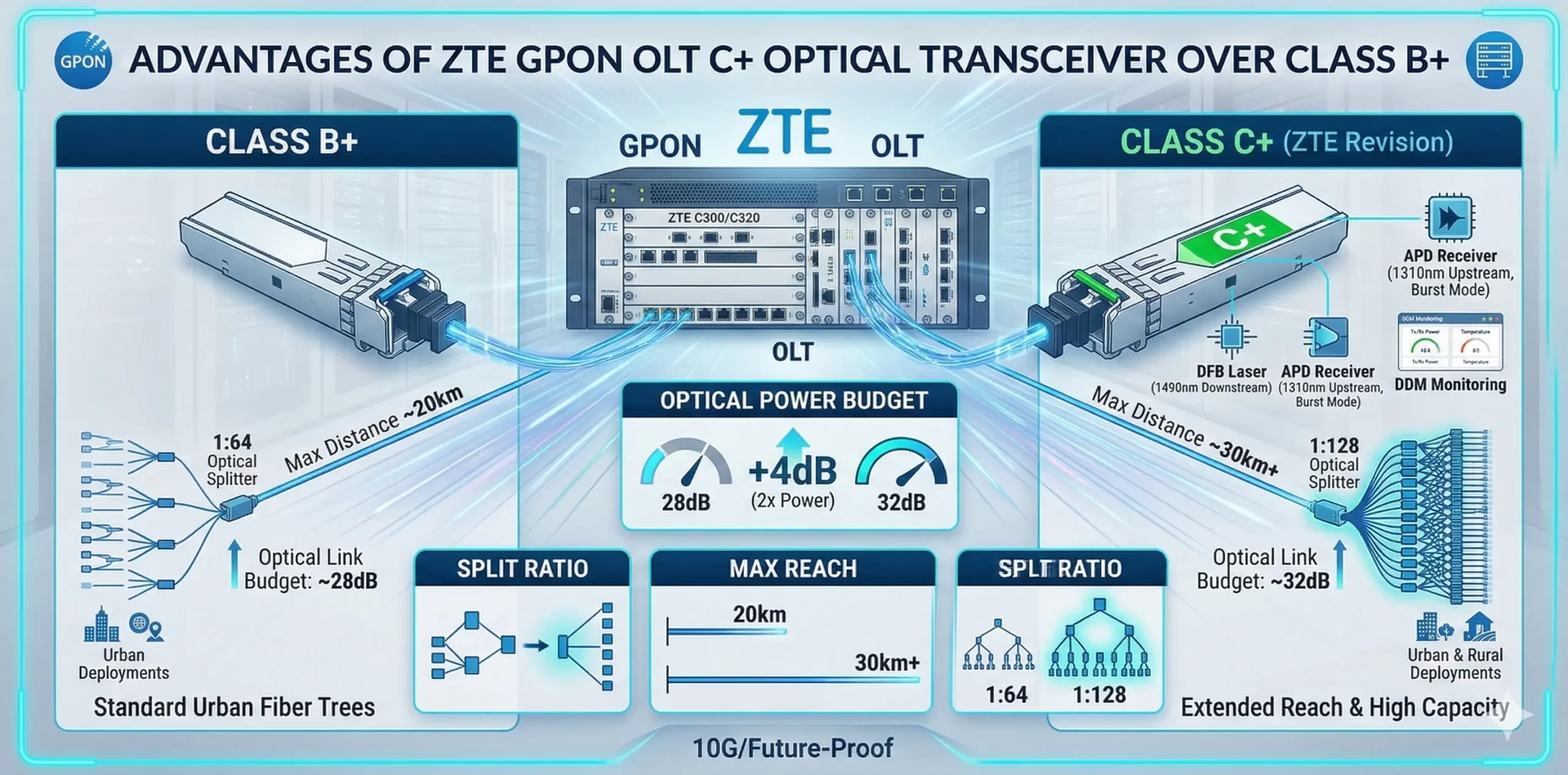
1. Understanding the ZTE GPON OLT C+ SFP Module Architecture
The fundamental building block of any Gigabit Passive Optical Network (GPON) is the optical transceiver. The ZTE GPON OLT C+ optical transceiver is an industry-leading SFP module specifically engineered to plug into ZTE’s line of OLT boards, such as the GTGO (8-port) and GTGH (16-port) cards. It operates at the physical layer of the OSI model, transforming electrical data payloads generated by the OLT’s internal Application-Specific Integrated Circuits (ASICs) into highly focused optical signals.
At a granular level, the ZTE Class C+ module operates over a single strand of single-mode optical fiber utilizing Wavelength Division Multiplexing (WDM). It transmits downstream data traffic to the Optical Network Units (ONUs) using a continuous-mode 1490nm wavelength. Conversely, it receives upstream data from the subscribers via a burst-mode 1310nm wavelength. The burst-mode capability of the receiver is a critical engineering feat; because multiple ONUs transmit data upstream on the identical 1310nm wavelength using Time Division Multiple Access (TDMA), the C+ receiver must rapidly adjust its sensitivity thresholds within nanoseconds to accurately read alternating strong and weak optical bursts from ONUs located at vastly different physical distances.
What elevates the ZTE C+ optical transceiver above standard networking optics is its rigorous compliance with the ITU-T G.984.2 specification. The module relies on a precision-calibrated Distributed Feedback (DFB) laser diode for transmission. DFB lasers are renowned for their narrow spectral width, which significantly mitigates chromatic dispersion—a phenomenon where different light frequencies travel at slightly different speeds, causing signal degradation over long distances. For the receiving end, the module employs a highly sensitive Avalanche Photodiode (APD) combined with a Transimpedance Amplifier (TIA). Unlike standard PIN photodiodes, an APD utilizes an internal photoelectric multiplication effect, exponentially amplifying weak incoming light signals. This advanced architecture allows the ZTE GPON OLT C+ optical transceiver to reliably decode data even when the incoming optical power is drastically attenuated.
2. Optical Link Budget: Why Upgrading to Class C+ is Critical for FTTH
In fiber optic network engineering, the optical link budget is the paramount metric. It represents the maximum allowable decibel (dB) loss a light signal can endure between the OLT transmitter and the ONU receiver before the data becomes unreadable. This loss is a combination of fiber attenuation (typically 0.35 dB/km for 1310nm and 0.25 dB/km for 1490nm), connector mating losses, splice losses, and, most significantly, the massive insertion loss generated by passive optical splitters.
Historically, telecommunications operators relied on Class B+ optical modules, which offer a typical optical link budget of approximately 28 dB. While sufficient for dense urban environments with relatively short fiber runs and maximum split ratios of 1:64, the 28 dB limit becomes a critical bottleneck when ISPs attempt to expand into suburban or rural territories. A single 1:64 passive optical splitter inherently introduces roughly 20.5 dB of signal loss. When combined with a 15-kilometer fiber run (adding another 5 dB of attenuation) and a few connector losses, a Class B+ network is pushed to the absolute brink of optical failure.
This is precisely where the ZTE GPON OLT C+ optical transceiver becomes indispensable. By generating a higher transmit power (+3.0 dBm to +7.0 dBm) and maintaining a significantly deeper receiver sensitivity (-32 dBm), the Class C+ module yields a robust 32 dB optical link budget. This additional 4 dB of headroom is mathematically transformative for network topology. Because decibels are a logarithmic scale, an additional 3 dB effectively doubles the optical power.
This enhanced budget empowers network engineers to push fiber runs up to 20 to 30 kilometers while maintaining a 1:64 split ratio, entirely eliminating the need to build intermediate central offices or install active repeater cabinets. According to industry analyses, extending the reach of an existing OLT infrastructure rather than building new central offices can reduce physical deployment CapEx by over 38%.
3. Comparison of GPON SFP Modules: Class B+ vs. Class C+ vs. Class C++
To make informed hardware procurement decisions, B2B network architects must understand the precise technical deltas between available SFP classes. The following comparative matrix highlights the critical optical parameters that differentiate the market-standard GPON transceivers.
Note: While Class C++ offers a 35 dB budget, it generates significantly more heat, consumes more electrical power, and carries a much higher unit cost. The ZTE GPON OLT C+ optical transceiver represents the industry’s optimal “sweet spot,” perfectly balancing cost, thermal efficiency, and network performance for 95% of global deployment scenarios.
4. Maximizing GPON Split Ratios and Network Reach
The economic viability of a Passive Optical Network is directly correlated to its split ratio. The ability to serve more paying subscribers from a single OLT chassis port dramatically lowers the Total Cost of Ownership (TCO) per user.
Standard GPON architecture supports varying split ratios, typically 1:32, 1:64, and 1:128. As discussed, a Class B+ module struggles to reliably support a 1:128 split due to the massive ~24 dB insertion loss generated by a 1:128 passive optical splitter. When an ISP upgrades to the ZTE GPON OLT C+ optical transceiver, the 32 dB link budget easily absorbs this 24 dB loss, leaving 8 dB of headroom. This remaining 8 dB is more than sufficient to cover 15 kilometers of fiber attenuation, connector losses, and a standard safety margin for future fiber degradation.
By transitioning from a 1:64 split to a 1:128 split utilizing C+ optics, an ISP essentially doubles its network capacity without purchasing additional OLT line cards, without increasing central office rack space, and without consuming more power at the core. Furthermore, the robust receiver sensitivity of the C+ module (-32 dBm) plays a crucial role in mitigating the effects of macrobends. In real-world FTTH deployments, installation technicians often bend fiber optic drop cables tightly around corners inside a subscriber’s home. These tight bends cause light to escape the fiber core, leading to localized attenuation. The highly sensitive APD receiver inside the ZTE C+ SFP module can reliably decode these severely degraded signals, drastically reducing customer complaint tickets and expensive maintenance truck rolls.
5. Deployment Strategies for ZTE ZXA10 OLT Chassis
The physical host of the optical transceiver dictates the overall throughput and management capabilities of the network. The ZTE GPON OLT C+ optical transceiver is specifically designed for seamless integration into ZTE’s globally deployed ZXA10 series platforms, particularly the large-capacity C300 and the compact, edge-focused C320 chassis.
To achieve maximum port density, telecommunications providers insert these transceivers into specialized line cards. For example, populating a entirely with Class C+ SFP modules yields an incredibly powerful access node. In a fully loaded ZXA10 C300 chassis containing 14 GTGH boards, the system can support 224 GPON ports. If every port leverages the C+ module’s ability to support a 1:128 split, a single rack unit can provision high-speed internet to 28,672 individual subscribers.
For decentralized, rural, or edge computing deployments where space is at an absolute premium, the is the industry standard. Standing at only 2U high, it supports two service slots. Utilizing the same C+ equipped line cards, an ISP can deliver robust services to over 4,000 users from a small, environmentally hardened outdoor street cabinet. Because the C+ transceivers support high link budgets, the OLT cabinet can be placed centrally in a rural town, utilizing passive splitters to radiate fiber out to distant farms and remote residential clusters.
For engineers and procurement teams looking to source genuine, guaranteed-compatible hardware, navigating to verified B2B distributors is critical. You can explore exact technical specifications and procure the directly to ensure your physical layer meets carrier-grade compliance standards.
6. Forward Error Correction (FEC) and Coding Gains
Optical power is not the only mechanism for ensuring data integrity over long distances; software-driven error correction plays an equally vital role. The ZTE GPON system relies heavily on Forward Error Correction (FEC), utilizing the Reed-Solomon (RS 255, 239) algorithm mathematically defined by ITU-T standards.
When FEC is enabled globally on the OLT PON port, the system appends redundant parity bytes to the GPON Transmission Convergence (GTC) downstream frames. If the optical signal drops close to the -32 dBm sensitivity limit of the C+ module, the physical light wave becomes noisy, and bit errors occur. The receiver inside the ONU utilizes the redundant parity bytes to mathematically reconstruct the corrupted bits without requiring the OLT to retransmit the data.
In upstream transmission, the powerful ASIC inside the ZTE OLT line card performs this same Reed-Solomon decoding. Because the ZTE GPON OLT C+ optical transceiver accurately captures even the weakest upstream burst signals, the FEC algorithm can effectively process the data. Implementing FEC mathematically provides an equivalent “coding gain” of approximately 2 to 3 dB in the overall optical link budget. When you combine the physical 32 dB hardware budget of the C+ module with the 3 dB software coding gain of FEC, the network operator effectively wields a 35 dB operational budget, creating an incredibly resilient, virtually unshakeable broadband connection.
7. Digital Diagnostic Monitoring (DDM) and Network Intelligence
In modern telecommunications, reactive maintenance is a massive drain on operational expenditure (OpEx). Network Operation Centers (NOCs) require real-time, granular visibility into the physical health of their fiber networks. The ZTE GPON OLT C+ optical transceiver addresses this requirement through comprehensive Digital Diagnostic Monitoring (DDM), as defined by the SFF-8472 Multi-Source Agreement (MSA).
The DDM micro-controller integrated into the SFP module continuously monitors five critical physical parameters:
Transceiver Temperature: Ensures the module is operating within its commercial (0°C to 70°C) or industrial (-40°C to 85°C) thermal limits.
VCC Voltage: Monitors the 3.3V electrical supply from the OLT backplane.
Tx Bias Current: A vital metric for predicting laser lifespan. As the DFB laser ages, it requires more bias current to emit the same amount of light. The system can trigger a predictive alarm before the laser physically fails.
Tx Output Power: Ensures the module is transmitting between +3.0 dBm and +7.0 dBm.
Rx Input Power: The most critical metric, allowing the OLT to precisely measure the strength of the light arriving from the ONUs.
Through ZTE’s NetNumen U31 Network Management System (NMS), network administrators can set custom threshold alarms for these DDM parameters. If a backhoe damages an underground fiber cable, causing an immediate 5 dB attenuation spike, the Rx power on the C+ module will instantly register the drop. The NMS will immediately generate an SNMP trap (Simple Network Management Protocol alarm), allowing technicians to proactively dispatch repair crews before the subscribers even notice a service interruption.
8. Rogue ONU Detection and Physical Layer Security
A “Rogue ONU” is one of the most severe layer-1 threats in a GPON environment. In standard operation, an ONU only turns on its 1310nm upstream laser for a tiny fraction of a microsecond when the OLT grants it a specific timeslot (via Dynamic Bandwidth Allocation). If a malicious or malfunctioning ONU becomes “rogue,” its laser remains permanently active, continuously emitting light into the PON tree. Because GPON utilizes a shared passive splitter, this continuous light wave completely jams the upstream 1310nm frequency, disconnecting every single user on that specific PON port.
The ZTE GPON OLT C+ optical transceiver is engineered with ultra-fast Receive Signal Strength Indicator (RSSI) capabilities to combat this. The SFP module can detect unassigned continuous light outside of scheduled TDMA timeslots. When anomalous upstream light is detected, the OLT’s hardware algorithms isolate the exact logical ONU identifier causing the interference. The OLT then issues a standardized Physical Layer OAM (PLOAM) message commanding the rogue device to permanently disable its optical transmitter. If the ONU is physically broken and ignores the software command, the detailed Rx power data provided by the C+ SFP module allows field technicians to isolate the rogue signal branch by branch, dramatically accelerating the troubleshooting process.
9. Thermal Management and Power Efficiency
As global telecom operators face stringent environmental regulations and rising energy costs, the power efficiency of Central Office (CO) equipment is heavily audited. High-powered optical modules, particularly Class C++ variants, are notorious for generating excessive heat, which requires powerful, energy-consuming chassis fans to dissipate.
The ZTE GPON OLT C+ optical transceiver strikes an elegant balance. Despite providing a massive 32 dB link budget, the internal chipset is highly optimized for power efficiency. A single C+ module typically consumes less than 1.5 watts of direct current power under full traffic load. Furthermore, when deployed in ZTE ZXA10 OLTs, the system supports Automatic Laser Shutdown (ALS). If a specific PON port has no active ONUs connected, or if an administrator logically disables the interface, the OLT cuts the electrical power to the C+ transceiver’s transmit laser. Across a large central office housing thousands of GPON ports, these microscopic thermal and electrical optimizations culminate in a massive reduction of carbon footprint and cooling costs, aligning with modern green-energy telecom initiatives.
10. People Also Ask: FAQs on ZTE C+ Transceivers
What is the maximum distance a ZTE GPON C+ module can reach?
A Class C+ module offers a 32 dB optical link budget. Under ideal fiber conditions (0.35 dB/km loss) with a standard 1:64 split ratio, it can reliably transmit data up to 20 kilometers. In point-to-point test scenarios without splitters, distances can exceed 60 kilometers.
Can I use a Class C+ SFP in an older Class B+ OLT board?
Yes. ZTE’s GPON boards, such as the GTGO and GTGH, utilize standardized SFP cages. You can safely remove an older Class B+ module and plug in a new Class C+ module without upgrading the entire line card, immediately boosting that port’s optical budget.
Does the ZTE GPON OLT C+ transceiver support third-party ONUs?
Yes. The C+ SFP module operates strictly at the physical layer (Layer 1). As long as the connected third-party ONU (such as Huawei, FiberHome, or Nokia) complies with ITU-T G.984 GPON standards, the optical communication will function perfectly.
What is the difference between SC/UPC and SC/APC connectors on SFPs?
GPON SFP modules typically use SC/UPC (Ultra Physical Contact) connectors, noted by a blue plastic housing. UPC connectors are flat-polished. Customer premises equipment (ONUs) often use SC/APC (Angled Physical Contact, green housing) to minimize reflection. You must use the correct patch cord to avoid signal loss.
Why is my Rx power showing as -33 dBm on the OLT?
An Rx power of -33 dBm indicates critical signal attenuation, falling below the -32 dBm sensitivity threshold of the C+ module. This causes high packet loss. You must inspect the fiber path for severe bends, dirty connectors, or degraded splitters.
Does the C+ module support 10G XG-PON speeds?
No. The ZTE GPON OLT C+ module strictly supports standard GPON speeds (2.5 Gbps downstream, 1.25 Gbps upstream). To achieve 10G speeds, you must deploy an XG-PON or XGS-PON SFP+ transceiver in a compatible 10G OLT board (like the ZTE GTXO).
How do I clean the optical interface of the ZTE SFP module?
Never look directly into the SFP laser. Use a specialized 1.25mm/2.5mm one-click fiber optic cleaning pen. Insert the pen into the SFP aperture and click to remove microscopic dust particles that can cause severe decibel insertion loss.
What does “Burst-Mode” mean in the C+ SFP receiver?
In GPON, the OLT receiver must accept data from dozens of ONUs positioned at different distances. “Burst-mode” means the C+ APD receiver can dynamically reset its sensitivity thresholds within nanoseconds between each ONU’s transmission burst, preventing signal overlapping and errors.
11. Conclusion
The transition from legacy fiber infrastructure to high-density, high-efficiency architectures is no longer optional for competitive Internet Service Providers. The ZTE GPON OLT C+ optical transceiver serves as the critical lynchpin in this evolution. By upgrading to Class C+ modules, network operators unlock a superior 32 dB optical link budget, enabling unprecedented 1:128 split ratios and vastly expanding geographical network reach without the need for additional central office construction. From its ultra-sensitive APD receiver capable of mitigating severe fiber macrobends, to its seamless integration within the ZTE ZXA10 ecosystem, the C+ transceiver reduces operational overhead while drastically improving the end-user broadband experience.
For network architects, CTOs, and telecom procurement managers aiming to build resilient, carrier-grade FTTH networks, standardizing your physical hardware is the first step toward long-term profitability.

Leave a comment