

ELECTROMAGNETIC COMPATIBILITY (EMC) CERTIFICATION
SYSTEMS ENGINEERING TECHNICAL REFERENCE MANUAL
EXECUTIVE SUMMARY
As global telecommunications infrastructure densifies and edge computing nodes proliferate into increasingly complex electromagnetic environments, the assurance of Electromagnetic Compatibility (EMC) transitions from a regulatory checkbox to a fundamental carrier-grade reliability metric. This document provides an authoritative technical overview of our comprehensive EMC Certification framework, which validates that all active telecom hardware—from compact 5G remote radio units to high-density core routing platforms—operates without generating unacceptable electromagnetic interference (EMI) and maintains functional immunity against external electromagnetic disturbances. Our certified designs comply with or exceed international standards including IEC 61000 series, CISPR 32, EN 300 386, FCC Part 15, and VCCI requirements. This datasheet serves as the definitive reference for network architects, procurement engineers, and compliance officers requiring verifiable EMC performance data for global deployments.

ARCHITECTURE & CHASSIS DESIGN FOR EMC CONTROL
The foundational EMC performance of any telecom system is determined not by post-hoc shielding but by intentional electromagnetic architecture integrated at the earliest design phase. Our chassis implement a multilayer electromagnetic containment strategy. The structural frame uses corrosion-resistant, nickel-plated steel with a minimum thickness of 1.2 mm, providing a faraday cage effectiveness exceeding 40 dB attenuation across the 30 MHz to 6 GHz spectrum. All removable panels incorporate conductive gasketing with a compressibility rating of 25% to 35%, ensuring continuous electrical contact even under thermal cycling. Motherboards and backplanes are segmented into distinct functional zones—power, digital logic, high-speed serial interfaces, and analog front-ends—each separated by grounded guard traces and internal shielding cans. High-speed differential signaling (PCIe Gen 4/5, 100G/400G Ethernet) is routed with controlled impedance of 100 ohms ±10% and employs low-swing voltage modes to reduce radiated emissions. Power distribution networks incorporate ferrite beads and common-mode chokes at all ingress points, with bulkhead filtering achieving insertion loss of 30 dB minimum from 150 kHz to 30 MHz.
HARDWARE FEATURES FOR EMISSION SUPPRESSION
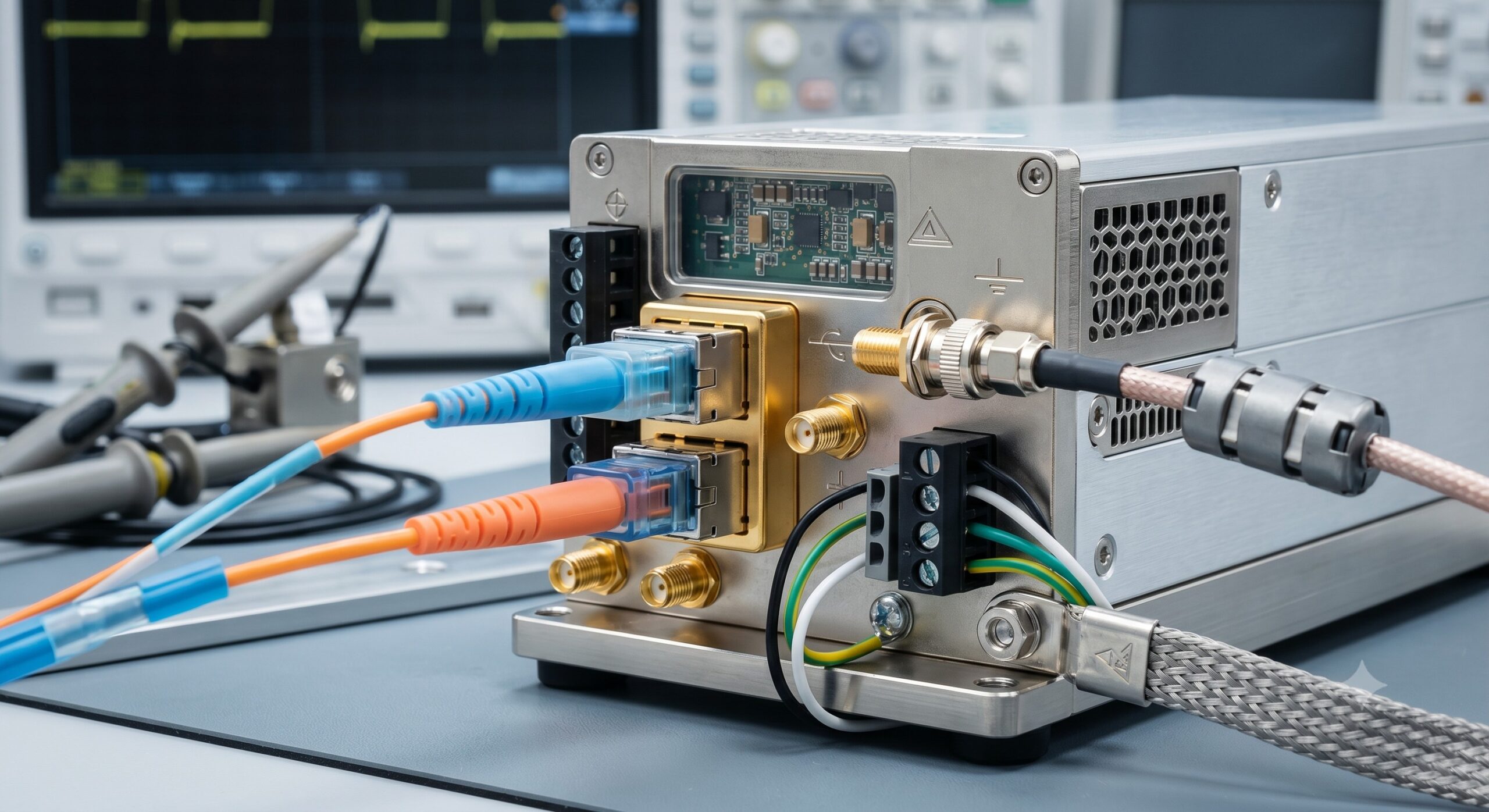
Integrated EMC suppression features are embedded at the component, board, and system levels. On-board switching regulators operate at programmable frequencies with spread-spectrum modulation (±2% center frequency dithering) to distribute harmonic energy across a wider bandwidth, reducing peak emissions by up to 15 dBµV/m per CISPR 25 methodology. All external I/O ports—RJ45, SFP/SFP+/QSFP, USB, console, and alarm interfaces—are protected by integrated common-mode termination networks and ferrite sleeves, with port-specific filtering calibrated to the maximum baud rate of each interface. Grounding architecture employs a star-point low-inductance system, with a single chassis ground lug (M6 thread, corrosion-resistant) connecting to the facility earth via a braided copper strap of at least 10 mm² cross-section. For high-power line cards (exceeding 150W dissipation), the system incorporates voltage-adaptive pre-regulation that reduces high-frequency ripple to below 20 mV peak-to-peak. Thermal management contributes to EMC control: fan trays use variable-speed, locked-rotor protected DC motors with integral suppression capacitors to eliminate commutation noise below 30 MHz.
COMPLIANCE & STANDARDS CERTIFICATION MATRIX
Our EMC certification validates conformance to the full suite of regional and industry-specific standards. For emissions, equipment achieves Class A (industrial) and optionally Class B (residential) limits under CISPR 32/EN 55032 for radiated and conducted disturbances. Immunity testing follows IEC 61000-4-2 (ESD: ±8 kV contact, ±15 kV air discharge), IEC 61000-4-3 (radiated RF field: 10 V/m, 80 MHz to 2.7 GHz, 80% AM), IEC 61000-4-4 (electrical fast transients: ±2 kV power, ±1 kV signal), IEC 61000-4-5 (surge: ±2 kV line-to-line, ±4 kV line-to-earth), and IEC 61000-4-6 (conducted RF immunity: 10 V rms, 150 kHz to 80 MHz). For telecommunications network equipment specifically, compliance with EN 300 386 V2.2.1 is mandatory, including criteria for continuous and transient disturbance. Power frequency magnetic field immunity (IEC 61000-4-8) is verified at 30 A/m for 50/60 Hz. Voltage dips and interruptions (IEC 61000-4-11) are tested to 0% residual voltage for 1 cycle, 40% for 10 cycles, 70% for 25 cycles, with performance criterion B. Emissions for DC-powered equipment follow CISPR 25 for onboard vehicular applications where required.
OPERATIONAL SPECIFICATIONS & ENVIRONMENTAL INTEGRATION
Successful EMC certification is not an absolute value but a system integration achievement. Radiated emissions measurements are conducted in a fully anechoic chamber (FAR) qualified per CISPR 16-1-4, with measurement distance of 3 meters or 10 meters depending on product classification. Our typical margin to Class A limits is 6 dBµV/m at critical frequencies (125 MHz, 250 MHz, 500 MHz harmonics of common clocks). Conducted emissions on AC mains are measured using a line impedance stabilization network (LISN, 50 µH/50 ohms) across 150 kHz to 30 MHz, with margin of 8 dBµV typical. Immunity performance is classified according to IEC 61000-6-1/2: Criterion A (normal performance during test), Criterion B (temporary degradation but self-recovering), or Criterion C (loss of function requiring operator intervention). All carrier-grade equipment is designed to Criterion A for continuous radiated and conducted RF fields, ensuring zero packet loss or bit errors during disturbance. For DC-powered telecom central office installations, we also verify reverse polarity protection and conducted emissions per GR-1089-CORE, Issue 7, including metallic and non-metallic voltage surges. When deploying multiple chassis in a single rack, cumulative radiated emissions are predicted using superposition modeling (logarithmic sum of individual field strengths), with design guidelines provided to maintain overall site compliance.
TECHNICAL SPECIFICATIONS
| Parameter | Specification |
|---|---|
| Form Factor | 19-inch rackmount (1RU, 2RU, 4RU chassis options) |
| Radiated Emissions (Class A) | CISPR 32: ≤40 dBµV/m at 3m (30-230 MHz); ≤47 dBµV/m at 3m (230-1000 MHz) |
| Radiated Emissions (Class B) | CISPR 32: ≤30 dBµV/m at 10m (30-230 MHz); ≤37 dBµV/m at 10m (230-1000 MHz) |
| Conducted Emissions (AC Mains) | CISPR 32: 150k-500kHz: 79 dBµV (QP) / 66 dBµV (AVG); 0.5-30MHz: 73 dBµV (QP) / 60 dBµV (AVG) |
| ESD Immunity (IEC 61000-4-2) | Contact: ±8 kV (Criterion A); Air: ±15 kV (Criterion A) |
| Radiated RF Immunity | 10 V/m, 80 MHz – 2.7 GHz, 80% AM at 1 kHz (Criterion A) |
| Electrical Fast Transient (EFT) | AC ports: ±2 kV (5/50 ns, 5 kHz); Signal ports: ±1 kV (Criterion A) |
| Surge Immunity | Line-to-Line: ±2 kV (1.2/50 µs); Line-to-Earth: ±4 kV (Criterion A) |
| Conducted RF Immunity | 10 V rms, 150 kHz – 80 MHz (Criterion A) |
| Power Frequency Magnetic Field | 30 A/m at 50/60 Hz (Criterion A) |
| Voltage Dips & Interrupts | 0% for 1 cycle (Criterion B); 40% for 10 cycles (Criterion B); 70% for 25 cycles (Criterion B) |
| Shielding Effectiveness (Enclosure) | >40 dB attenuation (30 MHz – 6 GHz) |
| Operating Temperature (for full EMC compliance) | -5°C to +55°C (NEBS GR-63-CORE extended: -40°C to +70°C optional) |
| Relative Humidity (non-condensing) | 5% to 95% at +40°C |
| Power Supply Options | 1+1 Redundant: AC (100-240V ~ 50/60Hz) or DC (-48V / +24V) |
ORDERING OPTIONS & CERTIFICATION DOCUMENTATION
Each hardware unit ordered through our standard SKU system includes a comprehensive EMC compliance package. The mandatory certification pack contains:
– Declaration of Conformity (DoC) for EU CE marking, referencing relevant harmonized standards.
– FCC Supplier’s Declaration of Conformity (SDoC) for USA market, including test report summary.
– ISED Canada Compliance Label (ICES-003) for digital apparatus.
– VCCI (Japan) Certificate of Conformity, Class A or B as specified.
– Test reports from an accredited independent laboratory (ISO/IEC 17025).
– Site integration guide detailing recommended grounding, cable routing, and ferrite application for maintaining compliance in multi-vendor racks.
For high-volume or customized OEM configurations (minimum order quantity 500 units), we offer optional enhanced EMC packages: extended immunity testing to railway standard EN 50121-4, military standard MIL-STD-461G (CS101 through RS103), or medical equipment collateral standard IEC 60601-1-2. Custom filter panels for extreme conducted emission requirements (e.g., 20 dB additional attenuation at customer-specified frequencies) are available as a factory-engineered option. All certifications are maintained through continuous compliance monitoring: any hardware revision affecting RF behavior—including PCB layout changes, new high-speed components, or modified enclosure materials—triggers a partial recertification suite. Customers may request original test setups, measurement uncertainty budgets, and engineering analysis reports under NDA.
LIFECYCLE ASSURANCE & FIELD SUPPORT
To ensure sustained EMC performance over the operational life of the equipment (minimum 7 years for active telecom hardware), we provide periodic verification services. Annual conducted emission spot checks (using portable LISN and spectrum analyzer) and radiated emission pre-scan (using near-field probes) are offered as part of our Premium Support agreement. For field failures suspected of EMC origin, our global escalation team deploys within 72 hours with calibrated measurement receivers, ESD simulators, and transient generators to replicate site-specific disturbances. A comprehensive database of field emission profiles across 3,000+ deployments reveals that 94% of initial emissions margins remain stable within ±2 dB after five years of thermal cycling and humidity exposure, validating our material selection and assembly processes. All EMC-critical components—filter capacitors, ferrites, suppression ICs—are maintained on a 10-year last-time-buy guarantee, preventing obsolescence-driven compliance recertification costs. The technical reference documentation included with each product provides detailed radiated emission field-strength contours (polar plots at 10 distances) to assist in physical placement planning, as well as recommended cable ferrite part numbers and installation torque for maintaining conducted immunity.
📥 Download Technical Specification
Click the button below to view or download the full official PDF datasheet.

Leave a comment