
The telecommunications landscape is undergoing a monumental shift. Driven by the exponential growth of 5G, the proliferation of the Internet of Things (IoT), and the insatiable demand for ultra-low latency edge computing, network operators are facing unprecedented challenges. Traditional, hardware-centric network infrastructures—characterized by proprietary, monolithic chassis and rigid scaling limitations—are no longer agile enough to keep pace with modern digital demands. To survive and thrive, Communications Service Providers (CSPs) and large-scale enterprises must pivot toward highly flexible, software-driven architectures.
This necessity has accelerated the adoption of Network Functions Virtualization (NFV) and Software-Defined Networking (SDN). By decoupling network functions from proprietary hardware appliances and running them as software on Commercial Off-The-Shelf (COTS) servers, operators can achieve unparalleled agility. At the absolute forefront of this technological revolution is the ZTE ZXR10 V6000.
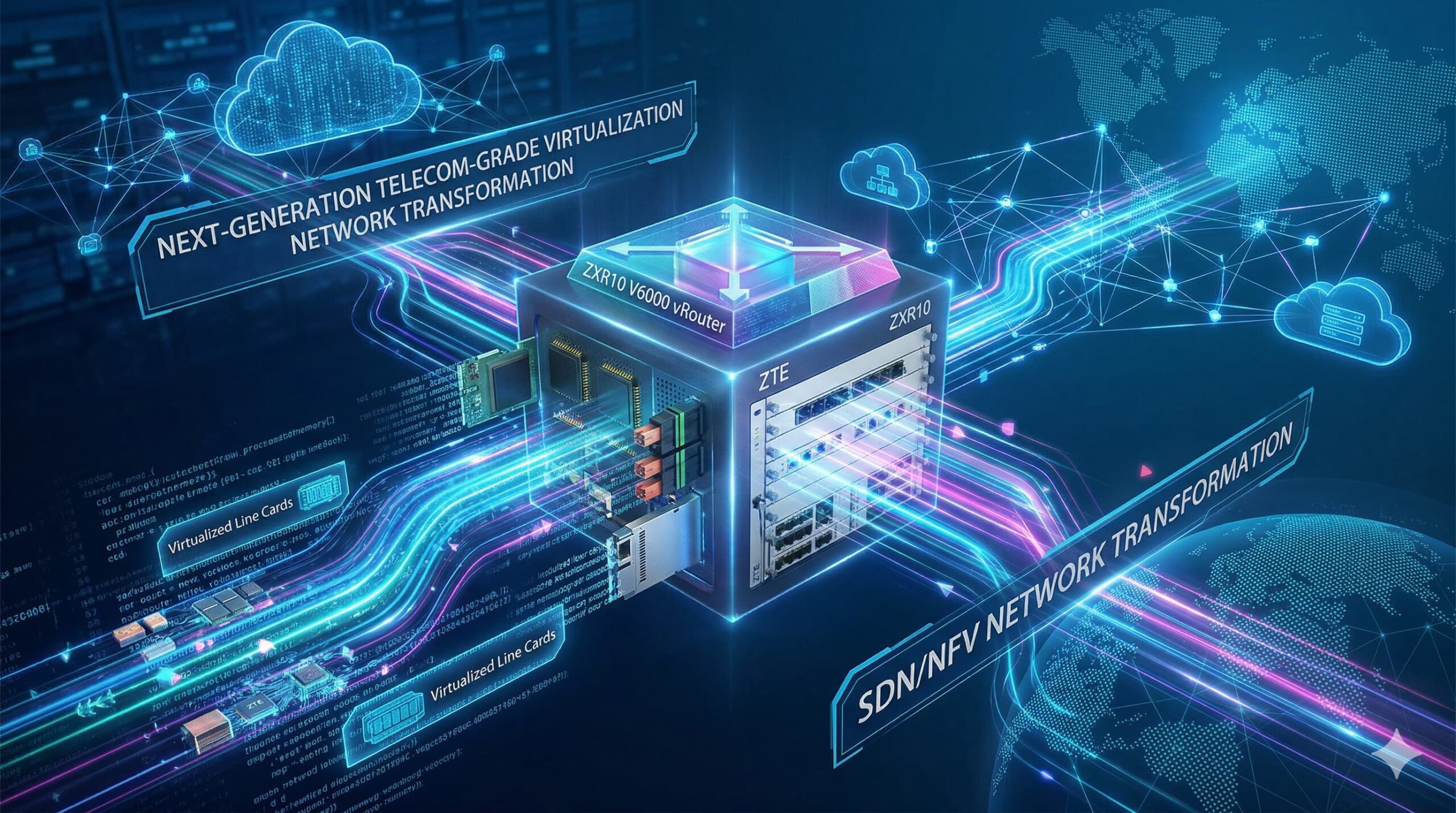
As a premier telecom-grade virtualized router, the ZXR10 V6000 is not merely an incremental upgrade; it is a foundational pillar for modern network architecture. It successfully inherits the robust, battle-tested features of traditional hardware routers while fully leveraging advanced NFV technologies to enable diverse service delivery, open API capabilities, and intelligent network operations.
This comprehensive technical whitepaper explores the intricate architecture, major functionalities, and strategic business value of the ZXR10 V6000, illustrating how it serves as the ultimate catalyst for operators executing a rapid, seamless SDN/NFV network transformation.
The Paradigm Shift: Why Virtualization is Non-Negotiable
Before dissecting the specific capabilities of the V6000, it is crucial to understand the macroeconomic and technological pressures driving the industry toward vRouters (virtual routers).
Historically, scaling a network meant purchasing, shipping, racking, and configuring heavy physical hardware. This process required massive Capital Expenditure (CapEx), high power consumption, and significant physical footprint. Furthermore, the Time-to-Market (TTM) for launching new services could take months. If a sudden surge in traffic occurred, operators were often caught off guard, unable to provision new hardware in time.
Network virtualization fundamentally rewrites this operational playbook. By abstracting the routing intelligence away from the underlying silicon, virtualization allows network functions to be spun up, scaled out, or torn down in minutes using standard x86 or ARM-based servers. This agility is the lifeblood of modern telecom operations, enabling rapid service deployment, elastic scaling, and massive reductions in Total Cost of Ownership (TCO).
Introducing the ZTE ZXR10 V6000 vRouter
The ZXR10 V6000 is ZTE’s flagship response to the demands of the cloud-native era. Engineered specifically for carrier-grade environments, it bridges the historical gap between the high-performance reliability of specialized ASICs (Application-Specific Integrated Circuits) and the dynamic flexibility of cloud computing.
Unlike lightweight virtual routers designed purely for basic enterprise edge routing, the V6000 is built to handle the rigorous demands of the telecom core and high-traffic aggregation points. It supports a vast array of complex routing protocols, comprehensive security features, and intelligent traffic management capabilities, making it one of the most versatile ZTE vRouter solutions available in the global market today.
Deconstructing the Core Architecture: Built for Reliability and Scale
The structural foundation of the ZXR10 V6000 is engineered to eliminate single points of failure while maximizing computational efficiency.
1. Modular and Reliable Architecture
At the heart of the V6000 is a deeply modular, highly reliable software architecture. Unlike legacy monolithic operating systems where a single failing process could crash the entire router, the V6000 utilizes a microservices-inspired, multi-process design.
This architecture rigorously separates the Control Plane (which makes routing decisions) from the Forwarding Plane (which moves the actual data packets). This concept, known as Control and User Plane Separation (CUPS), is critical for elastic scaling. It allows operators to scale control plane resources independently of forwarding resources. If routing table calculations become intensely complex due to a massive BGP (Border Gateway Protocol) update, the control plane can be allocated more CPU cores without interrupting the high-speed data forwarding plane.
Furthermore, this modularity enables hitless software upgrades and In-Service Software Upgrades (ISSU). Individual software modules can be updated, restarted, or patched without bringing down the entire routing instance, ensuring the 99.999% (Five Nines) carrier-grade availability that telecommunications providers legally and operationally require.
2. High Availability (HA) Mechanisms
To achieve carrier-grade reliability in a virtualized environment, the V6000 implements multi-tiered HA mechanisms. These include:
-
1+1 Control Plane Redundancy: Active and standby control nodes synchronize state in real-time.
-
N+M Forwarding Plane Redundancy: Multiple virtual forwarding engines operate simultaneously. If one virtual machine (VM) or container fails, traffic is instantly rerouted to healthy forwarding nodes without session drops.
-
Virtual Route Redundancy Protocol (VRRP) and Bidirectional Forwarding Detection (BFD): Ensuring millisecond-level failover for critical network paths.
Deep Dive: Major Functions and Technological Innovations
The ZXR10 V6000 separates itself from competitors through a combination of proprietary software intelligence and aggressive optimization of standard hardware.
Elastic Capacity Expansion
One of the most profound limitations of physical routers is the “hard ceiling” of their backplane capacity or line card slots. When a physical router is full, the only solution is a costly forklift upgrade to a larger chassis.
The V6000 completely eliminates this physical constraint through dynamic virtual router elastic capacity. It interfaces seamlessly with cloud orchestration platforms (such as OpenStack, VMware, or Kubernetes). When network telemetry detects a sustained surge in traffic—for example, during a major live streaming event or a sudden shift to remote work—the orchestrator can dynamically assign additional CPU cores, memory, and network interfaces to the V6000 instance.
This horizontal and vertical scaling allows the router to dynamically increase its throughput from a few gigabits per second (Gbps) to hundreds of Gbps on demand. Conversely, during off-peak hours, these computing resources can be released back into the cloud resource pool for other applications, optimizing system performance and drastically improving overall data center resource utilization.
The Power of the ROSng Software System
The engine driving the V6000 is ZTE’s self-developed ROSng operating system (Routing Operating System next generation). ROSng represents decades of routing protocol development optimized for the cloud era.
What makes ROSng exceptional is its absolute feature parity with ZTE’s physical hardware routers. Operators do not have to sacrifice functionality when moving to the cloud. ROSng supports a massive suite of features, including:
-
Advanced Routing Protocols: Comprehensive support for BGP-4, OSPFv2/v3, IS-IS, and RIP.
-
MPLS and VPN Services: Full support for LDP, RSVP-TE, L2VPN (VPLS/VPWS), and L3VPN, allowing operators to offer secure, isolated enterprise network slices.
-
IPv6 Transition: Native dual-stack capabilities, NAT64, DS-Lite, and advanced SRv6 (Segment Routing over IPv6) for next-generation traffic engineering.
-
Multicast Capabilities: PIM-SM/SSM, IGMP, and MLD for efficient distribution of video and streaming media.
By running ROSng, the V6000 offers identical management interfaces, Command Line Interfaces (CLI), and SNMP/NETCONF operational procedures as traditional ZTE Enterprise Routers. This uniformity drastically reduces the learning curve for network engineering teams, allowing them to manage physical and virtual routers through a single pane of glass.
Virtualized Line Cards and Data Plane Acceleration
A persistent historical criticism of software routers was their inability to match the raw packet-forwarding speed of hardware ASICs. The ZXR10 V6000 shatters this limitation by virtualizing high-performance transponders from hardware routers and applying advanced data plane acceleration technologies.
When operating in standard x86 server environments, the V6000 utilizes DPDK (Data Plane Development Kit) and SR-IOV (Single Root I/O Virtualization).
-
DPDK allows the router software to bypass the traditional, slow Linux kernel networking stack, reading packets directly from the Network Interface Card (NIC) into user-space memory.
-
SR-IOV allows a single physical NIC to appear as multiple virtual NICs, granting the V6000 direct hardware access to the physical network ports without the overhead of a hypervisor virtual switch.
These technologies effectively create “Virtualized Line Cards.” This allows the V6000 to preserve all traditional service capabilities, including handling highly complex, overlapping services (such as deep packet inspection, IPsec encryption, and Carrier Grade NAT) at near-line-rate speeds. It ensures that the transition to x86 environments does not incur a penalty in throughput or latency.
Strategic Deployment Scenarios
The versatility of the ZXR10 V6000 allows it to be deployed across a multitude of network locations, solving diverse engineering challenges.
1. Virtual Customer Premises Equipment (vCPE) / SD-WAN Edge
For enterprise service providers, shipping and maintaining complex physical routers at customer branch offices is a logistical nightmare. The V6000 can be deployed as a vCPE on a universal x86 white-box at the customer site, or hosted in the provider’s edge cloud. This allows operators to instantly provision routing, firewall, and VPN services to enterprise customers via software, accelerating revenue generation.
2. Virtual Route Reflector (vRR)
In large-scale BGP networks, Route Reflectors are essential for managing routing table scalability. Traditional hardware RRs are expensive and often underutilized. Deploying the V6000 as a vRR on a centralized cloud server provides massive control-plane scalability, easily handling millions of BGP routes without requiring custom silicon.
3. Virtual Broadband Network Gateway (vBNG)
As residential fiber (FTTH) networks expand, terminating subscriber sessions requires immense scalability. The V6000 can act as a vBNG, handling PPPoE/IPoE termination, subscriber authentication, and QoS (Quality of Service) enforcement. Its elastic capacity allows operators to spin up new vBNG instances dynamically in response to subscriber growth in specific geographical regions.
Hardware vs. Virtualization: A Strategic TCO Analysis
While ZTE continues to produce world-class physical core hardware, such as those detailed in the Ultimate Guide To ZXR10 T8000, the V6000 offers a fundamentally different financial model for operators.
Hardware routers require a massive upfront CapEx investment. You must provision hardware for your projected maximum capacity three to five years in the future, meaning you are paying for resources that sit idle for years.
The V6000 shifts network economics from CapEx to OpEx (Operational Expenditure). Operators only pay for the software licenses and standard COTS server hardware they need today. As traffic grows, they simply add more standard servers to their data center pool. Furthermore, power, cooling, and physical space requirements are drastically minimized, as routing functions can be consolidated alongside other IT workloads on shared cloud infrastructure.
Future-Proofing with Intelligent O&M and Telemetry
The SDN/NFV trend is not just about virtualization; it is about intelligence. The ZXR10 V6000 is built for closed-loop automation. It supports streaming telemetry (via gRPC), pushing real-time, microsecond-level data regarding network state, CPU utilization, and packet drops directly to centralized AI-driven analytics platforms.
This telemetry allows operators to move from reactive troubleshooting to proactive network healing. If the analytics engine detects a degraded path, the SDN controller can automatically interact with the V6000 via standard NETCONF/YANG models to reroute traffic instantly, ensuring zero disruption to the end-user experience.
Frequently Asked Questions (FAQs)
1. What exactly is a telecom-grade virtualized router? A telecom-grade virtualized router is a software-based routing solution designed to run on standard commercial servers (like x86 architectures) rather than proprietary hardware. “Telecom-grade” means it meets strict industry standards for 99.999% reliability, high throughput, and supports complex protocols required by internet service providers, unlike basic software routers meant for small offices.
2. How does the ZXR10 V6000 support the SDN/NFV network transformation? It acts as a Virtualized Network Function (VNF). Instead of buying a closed hardware box, an operator installs the V6000 software onto their existing cloud infrastructure. It integrates fully with SDN controllers via open APIs (like NETCONF/YANG), allowing centralized, programmable control over the entire network flow.
3. What is the ROSng operating system and why is it important? ROSng (Routing Operating System next generation) is ZTE’s highly matured proprietary routing software. It is important because it provides the exact same comprehensive feature set, stability, and command-line interface as ZTE’s high-end physical hardware routers, ensuring a seamless transition for network engineers moving to virtualized environments.
4. How does the V6000 achieve high performance on standard x86 servers? It utilizes advanced data plane acceleration technologies, specifically DPDK (Data Plane Development Kit) and SR-IOV. These technologies allow the routing software to bypass the server’s standard operating system kernel, enabling direct, high-speed access to the network interface cards, mimicking the performance of physical line cards.
5. What does “virtual router elastic capacity” mean in practical terms? It means the router can automatically resize itself based on traffic demand. If a network experiences a sudden spike in data (e.g., during a major sports broadcast), the cloud orchestrator can instantly assign more CPU and memory to the V6000, increasing its bandwidth capacity on the fly. When the spike ends, the resources are released.
6. Can the V6000 handle complex overlapping services without crashing? Yes. Through its modular architecture and virtualized line cards, the V6000 is designed to handle heavy, overlapping services—such as deep packet inspection, Carrier Grade NAT (CGN), and complex IPsec VPN encryption—simultaneously, without degrading basic routing performance.
7. In what scenarios should an operator choose the V6000 over a physical router like the ZXR10 T8000? The V6000 is ideal for edge deployments, vCPE, vBNG, Route Reflectors, and scenarios where rapid deployment, dynamic scaling, and hardware consolidation are the primary goals. A physical core router like the T8000 is typically reserved for the absolute core backbone of the internet where multi-terabit, brute-force optical switching is required.
8. Is the ZXR10 V6000 difficult to manage compared to legacy equipment? No. Because it runs the ROSng system, the management interfaces, CLI, and operational logic remain identical to traditional ZTE physical routers. Furthermore, its integration with centralized SDN controllers makes bulk configuration and monitoring significantly easier and more automated than managing individual physical boxes.
Conclusion & Core Value Summary
The telecommunications industry can no longer afford the rigidity of traditional hardware silos. The future of networking demands intelligence, agility, and unprecedented scalability. The ZTE ZXR10 V6000 vRouter delivers exactly that.
By perfectly merging the rugged, feature-rich reliability of the ROSng operating system with the dynamic, elastic scaling capabilities of cloud computing, the V6000 empowers operators to break free from hardware vendor lock-in. Its highly modular architecture, robust support for complex virtualized line cards, and seamless integration into automated, AI-driven environments make it the definitive tool for executing a successful SDN/NFV transformation.
The core value of the V6000 is simple: it transforms the network from a static, capital-intensive bottleneck into a dynamic, highly profitable engine for rapid service innovation. It reduces physical footprint, slashes operational expenditures, and ensures that telecommunications providers are architecturally prepared for whatever data demands the future holds.

Leave a comment