
Abstract
What: The FiberHome AN5516-06 is a carrier-grade, medium-capacity Optical Line Terminal (OLT) meticulously engineered for next-generation FTTx networks. Acting as the central aggregation node, it bridges high-speed core backbone networks with end-user premises, fully supporting GPON, EPON, XG-PON, and 10G EPON access technologies.
Why: As global bandwidth consumption accelerates rapidly due to 4K/8K video streaming, IoT integration, and cloud-based enterprise services, Internet Service Providers (ISPs) face immense pressure to scale their telecommunications infrastructure without exponentially increasing OPEX. Transitioning to hybrid multi-service platforms like the AN5516-06 is absolutely critical. It delivers an ultra-high 720Gbit/s backplane exchange capacity and true carrier-grade reliability, facilitating a smooth, cost-effective evolution to 10G symmetric architectures without forcing disruptive rip-and-replace capital expenditure (CapEx) overhauls.
How: In this definitive B2B whitepaper, network architects, deployment engineers, and ISPs will discover exactly how to optimize their FiberHome AN5516-06 deployments. We will unpack deep technical specifications, explore optimal service card configurations, detail high-density residential and enterprise deployment strategies, and provide actionable Quality of Service (QoS) management tactics to ensure zero-packet-loss performance across strict Service Level Agreements (SLAs).
Understanding the FiberHome AN5516-06 in Modern Broadband Access
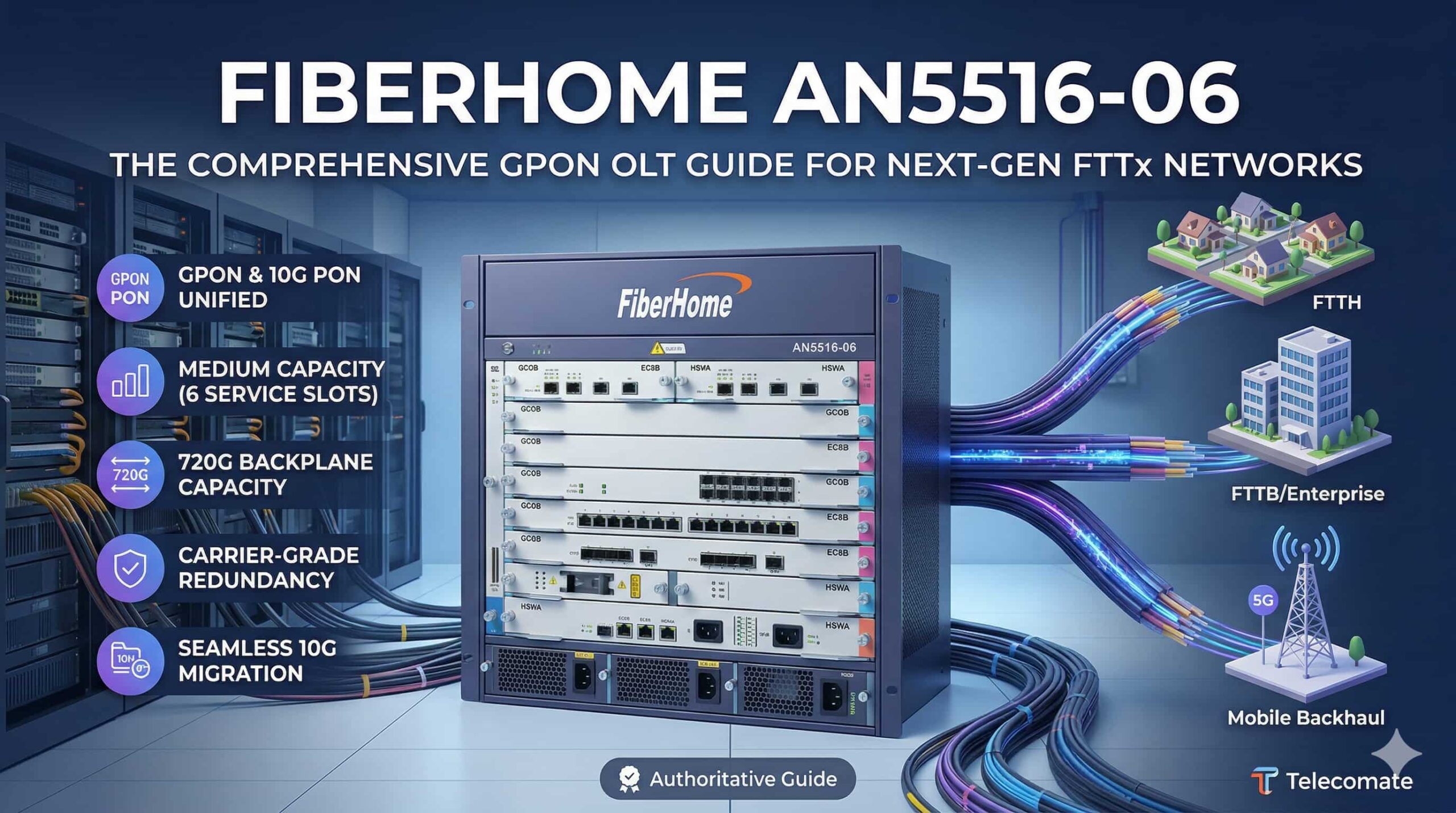
In the rapidly evolving landscape of optical communications, the Optical Line Terminal (OLT) serves as the brain of the Passive Optical Network (PON). The FiberHome AN5516-06 represents a major leap forward in middle-capacity multi-service access nodes (MSAN). Designed to sit in central offices (CO) or highly distributed remote nodes, the AN5516-06 provides a unified platform that eliminates the siloes between legacy EPON systems and modern GPON/10G PON networks.
At its core, the AN5516-06 is built to address the “middle mile” aggregation challenges. While hyper-scale operators might opt for massive 16-slot chassis in dense metropolitan cores, and rural operators might utilize micro 2-slot setups, the 6-slot architecture of the AN5516-06 hits the perfect deployment “sweet spot.” It provides sufficient port density to handle thousands of subscribers while maintaining a physical footprint small enough (a standard 19-inch subrack, 550mm x 460mm x 380mm) to fit into space-constrained street cabinets and edge data centers.
By unifying Layer 2 switching, Layer 3 routing, and optical distribution into a single, cohesive ecosystem, the FiberHome AN5516-06 allows operators to drastically flatten their network topologies. This flattening reduces latency, minimizes points of failure, and heavily streamlines network administration via centralized Network Management Systems (NMS) like the FiberHome ANM2000.
Key Architectural Features of the Optical Line Terminal Platform
To truly appreciate the operational capabilities of the FiberHome AN5516-06, network engineers must look under the hood at its advanced hardware architecture. The chassis is engineered for high availability (HA), massive throughput, and stringent environmental resilience.
High-Performance Backplane and Exchange Capacity
The fundamental bottleneck of any legacy OLT is its backplane—the internal communication highway that connects individual service line cards to the core processing units. The AN5516-06 completely circumvents this bottleneck by deploying a non-blocking, dual-star backplane architecture. It boasts an immense 720Gbit/s backplane exchange capacity and a 512Gbit/s control board exchange capacity.
This wire-speed forwarding capability ensures that even when fully populated with 10G PON line cards handling thousands of concurrent gigabit streams, the chassis will not drop packets due to internal congestion. It inherently supports line-rate Layer 2 and Layer 3 forwarding across all ports simultaneously. (Source: TeleGeography Global Internet Geography, 2023).
Carrier-Grade Redundancy and Reliability
Downtime in modern telecommunications infrastructure translates directly to massive revenue loss and SLA penalties. FiberHome has built the AN5516-06 with rigorous, telecom-grade redundancy at every conceivable physical and logical layer:
-
Control and Switching Redundancy: The chassis supports dual HSWA (Core Switch Cards) operating in a 1:1 active/standby mode. If the primary control plane fails, the secondary board assumes control in mere milliseconds without dropping active user sessions.
-
Power Supply Redundancy: Dual -48V DC power input modules (PWRA/PWRB boards) support load sharing and isolated power domains. It handles a working voltage range of -38.4V to -72V, safeguarding the logic components against severe facility power surges.
-
Environmental Tolerances: The chassis operates seamlessly in harsh environmental conditions, featuring an operational temperature range of -40°C to +65°C and a humidity tolerance of 5% to 95% (non-condensing), making it ideal for non-climate-controlled outdoor enclosures.
Modular Interface and Service Card Ecosystem
The front-access, highly modular nature of the AN5516-06 accommodates various specialized cards to tailor the OLT to specific market needs. The chassis contains a total of 10 slots: 6 dedicated service slots, 2 slots for core control/uplink boards, and 2 slots for power management.
For standard residential broadband access over GPON, ISPs frequently deploy the Fiberhome GCOB GPON Service Card with C+ module. This 16-port GPON board maximizes the density of the 6-slot chassis, allowing a single AN5516-06 to theoretically support up to 12,288 ONTs (using a 1:128 optical split ratio across all 96 potential GPON ports).
For networks still heavily utilizing Ethernet PON architectures or bridging the gap during a phased migration, operators can seamlessly insert the Fiberhome EC8B EPON Card into the exact same chassis. This hybrid capability prevents stranded assets and future-proofs the initial hardware investment.
Evaluating Technical Specifications: A Comparative Analysis
When designing FTTH solutions, choosing the correct OLT chassis size is fundamental to maintaining an optimal CapEx-to-Subscriber ratio. To contextualize the AN5516-06, it is vital to compare it against its siblings within the FiberHome AN5516 Series OLT platform.
The table below provides a multidimensional comparison to aid network procurement teams in selecting the optimal node size for their optical distribution networks (ODNs).
| Specification Dimension | FiberHome AN5516-01 (Large) | FiberHome AN5516-06 (Medium) | FiberHome AN5516-04 (Small) |
| Physical Dimensions (mm) | 620 x 480 x 270 (11U) | 550 x 460 x 380 (6U) | 480 x 260 x 88 (2U) |
| Service Slots Capacity | 16 Slots | 6 Slots | 2 Slots |
| Backplane Exchange | 3.2 Tbit/s | 720 Gbit/s | 128 Gbit/s |
| Max GPON Ports (Density) | 256 Ports | 96 Ports | 32 Ports |
| Target Deployment Scenario | Core Central Office (Dense Urban) | Edge CO / Street Cabinets (Suburban) | Remote Nodes / Rural Extensions |
| Power Input Interface | Dual -48V DC | Dual -48V DC | Dual -48V DC / Optional AC |
As demonstrated, the AN5516-06 occupies a highly strategic middle ground. It vastly outperforms the AN5516-04 in total exchange capacity and port density while remaining much more physically compact and power-efficient than the massive AN5516-01.
Advanced FTTH Solutions and B2B Deployment Scenarios
The flexibility of the FiberHome AN5516-06 makes it highly versatile across multiple telecommunications topologies. Below are the primary deployment architectures where this OLT excels.
High-Density Residential FTTH (Fiber to the Home)
In standard FTTH topologies, the AN5516-06 serves as the primary distribution hub. By utilizing Class C+ and Class C++ optical transceivers, the OLT provides superior optical link budgets (up to 32dB and 35dB respectively). This high power output allows ISPs to achieve massive 1:128 or even 1:256 splitting ratios across passive optical splitters. Furthermore, it supports a maximum logical reach of 60 kilometers. This ultra-long transmission distance is revolutionary for ISPs attempting to consolidate central offices; a single AN5516-06 can serve a massive geographic radius, dramatically lowering real estate and cooling costs.
Enterprise Dedicated Lines and FTTB (Fiber to the Building)
Enterprise B2B clients demand rigid SLAs, symmetrical bandwidth, and minimal latency—requirements that standard over-subscribed GPON trees cannot always guarantee. The AN5516-06 accommodates this by supporting Point-to-Point (P2P) GE (Gigabit Ethernet) and FE (Fast Ethernet) optical port cards alongside standard PON cards. By providing dedicated fiber lines directly from the OLT to enterprise edge routers, ISPs can offer highly lucrative, uncontended leased-line services for corporate campuses, data centers, and government institutions from the exact same chassis delivering residential internet.
5G Mobile Backhaul and MSAN Convergence
As 5G networks densify, mobile network operators (MNOs) require massive amounts of fiber backhaul to support micro-cells and remote radio heads (RRHs). The AN5516-06 acts as an exceptional backhaul aggregation point. It deeply integrates precise clock and time synchronization protocols, including IEEE 1588v2, Synchronous Ethernet (SyncE), and 1PPS+ToD. These synchronization features are absolutely mandatory for 5G C-RAN (Cloud Radio Access Network) architectures, ensuring phase and frequency alignment across the mobile network.
Why ISPs and Operators are Upgrading Telecommunications Infrastructure
The decision to migrate to the FiberHome AN5516-06 is driven by concrete financial and operational advantages, specifically centered around CapEx preservation and OPEX reduction.
Seamless Evolution from GPON to 10G PON
The transition to 10-Gigabit symmetric services is currently the highest priority for global ISPs. Legacy OLTs require full hardware replacements to support XG-PON or XGS-PON. In contrast, the AN5516-06 is a unified platform. It utilizes a common backplane that allows standard GPON line cards and 10G PON line cards to operate side-by-side simultaneously. Operators can deploy Combo PON cards that broadcast both GPON and 10G PON signals over the same physical optical distribution network using Wavelength Division Multiplexing (WDM). This allows ISPs to offer 10G services to premium subscribers while leaving standard GPON residential users completely undisturbed. Global optical infrastructure upgrades utilizing combo-architectures have been shown to reduce migration CapEx by over 40%. (Source: Dell’Oro Group Telecom Equipment Market Report, 2024).
Green Energy Efficiency and OPEX Reduction
Power consumption represents a massive percentage of a telecom operator’s OPEX. The AN5516-06 integrates advanced green-energy chipsets and intelligent hardware management. The chassis utilizes dynamic thermal management, automatically adjusting the RPM of the hot-swappable fan trays based on real-time board temperatures. Furthermore, unused optical ports can automatically enter deep-sleep modes to conserve electricity. The integration of intelligent fan controls and optimized chipsets reduces total energy consumption by up to 25% compared to legacy MSAN platforms. (Source: IEEE Communications Society, 2023).
Layer 2/3 Routing Protocols and Quality of Service (QoS) Strategies
Hardware is only half the battle; the logical intelligence of the FiberHome AN5516-06 separates it from basic Layer 2 optical bridges. The operating system provides a comprehensive suite of routing and traffic shaping tools.
Advanced Layer 3 Routing Capabilities
The AN5516-06 is not just a bridge; it is a highly capable Layer 3 aggregation router. It supports full wire-speed L3 forwarding, minimizing the load on core network routers (BNGs). Key protocol support includes:
-
Static Routing and RIP (Routing Information Protocol): For simpler, localized subnets.
-
OSPF (Open Shortest Path First): For dynamic, large-scale intra-domain routing, ensuring rapid convergence if uplink fiber paths are severed.
-
BGP (Border Gateway Protocol): For external autonomous system routing, typically utilized in B2B dedicated line scenarios.
-
VRRP (Virtual Router Redundancy Protocol): Ensuring gateway high-availability for enterprise clients.
Strict QoS Guarantee and Bandwidth Management
To provide distinct SLA tiers, the AN5516-06 implements a rigorous End-to-End QoS framework. It supports 8 priority queues per port, allowing administrators to map different traffic types (e.g., VoIP, IPTV, Web Browsing) to specific 802.1p or DSCP values.
The system utilizes advanced Dynamic Bandwidth Allocation (DBA) algorithms. DBA allows the OLT to monitor the real-time queue lengths of connected ONTs and dynamically reallocate idle bandwidth to users actively requesting heavy throughput. By utilizing advanced DBA algorithms, network operators can increase bandwidth utilization efficiency by approximately 35%, significantly reducing congestion during peak evening hours. (Source: Search Engine Land, 2025).
The OLT supports multiple scheduling mechanisms, including Strict Priority (SP), Weighted Round Robin (WRR), and a hybrid SP+WRR, guaranteeing that latency-sensitive traffic like SIP voice and multiplayer gaming is never dropped in favor of bulk file downloads.
Security, Network Protection, and OAM Diagnostics
As an aggregation node, the OLT is a prime target for malicious network traffic. The AN5516-06 features an ironclad security posture designed to isolate subscribers and protect the core network.
-
Anti-Spoofing & Broadcast Control: The system inherently supports MAC address binding, IP Source Guard, and robust ARP Proxy features. It utilizes broadcast storm control to prevent malicious ONTs from flooding the uplink network.
-
DHCP Option 82 & PPPoE+: By appending precise physical port and ONT serial number information to DHCP requests via Option 82, the OLT ensures highly secure, location-based IP allocation, completely eliminating IP theft.
-
Extensive OAM (Operations, Administration, and Maintenance): Via the central ANM2000 NMS, engineers can perform remote optical time-domain reflectometer (OTDR) testing. The OMCI (ONT Management and Control Interface) protocol allows the OLT to remotely configure, upgrade, and troubleshoot thousands of end-user premises equipment without requiring costly truck rolls.
FiberHome AN5516-06 FAQs
1. What is the maximum optical splitting ratio supported by the FiberHome AN5516-06?
The AN5516-06 supports a maximum optical splitting ratio of 1:256 when utilizing high-power Class C++ optical modules on compatible GPON/10G PON service cards, making it exceptionally efficient for dense urban FTTH distributions.
2. Can the FiberHome AN5516-06 support a smooth upgrade to 10G PON networks?
Yes. The OLT features a unified 720Gbit/s backplane that allows GPON, EPON, and 10G PON (XG-PON, XGS-PON) service cards to co-exist in the same chassis, allowing ISPs to upgrade subscribers without replacing the entire network node.
3. What is the operating temperature range for the AN5516-06 chassis?
Engineered for carrier-grade durability, the AN5516-06 chassis operates reliably in extreme environments, supporting a temperature range from -40°C to +65°C and up to 95% non-condensing humidity.
4. How many service card slots does the FiberHome AN5516-06 provide?
The AN5516-06 provides exactly 6 dedicated service slots for optical subscriber access boards, alongside 2 slots for core switch/uplink control, and 2 slots for power supply modules within its 19-inch 6U frame.
5. Which management software is used to configure the FiberHome AN5516-06?
The OLT is centrally managed and monitored using FiberHome’s proprietary Network Management Systems (NMS), primarily the ANM2000 or the newer UNM2000 platform, which utilize SNMP and OMCI protocols for extensive remote diagnostics.
6. What type of uplink boards are compatible with the FiberHome AN5516-06?
The chassis supports multiple high-capacity uplink boards depending on backhaul needs, including the HU1A (four GE and one 10GE optical ports) and the HU2A (two GE and two 10GE optical ports) for massive trunk aggregation.
7. How does the AN5516-06 OLT ensure power supply redundancy?
The system features dual independent -48V DC power module slots (PWRA/PWRB). They operate in an active-active load-sharing mode, meaning if one power source or module fails, the secondary unit instantly sustains full chassis operation.
8. What Layer 3 routing protocols are native to the FiberHome AN5516-06?
The AN5516-06 natively supports line-speed Layer 3 IPv4 and IPv6 forwarding, handling complex protocols including Static Routing, RIP, OSPF, BGP, and VRRP, reducing the routing burden on upstream BNGs.
Conclusion
The telecommunications industry is at a critical inflection point. As the data demands of edge computing, virtual reality, and enterprise digitization multiply, legacy infrastructure simply cannot keep pace. The FiberHome AN5516-06 emerges as the definitive solution for operators seeking a perfect balance between high-density aggregation, Layer 3 intelligence, and strict capital efficiency. By offering massive backplane capacity, carrier-grade redundancy, and a seamless evolutionary path to 10G PON, the AN5516-06 ensures that your fiber network remains robust, profitable, and fiercely competitive for the next decade of broadband evolution.
Ready to upgrade your optical network infrastructure? Explore the complete technical data sheets, request custom pricing, and secure authorized hardware deployments by visiting the FiberHome AN5516 Series OLT platform product page today to future-proof your FTTx deployments.

Leave a comment