
Abstract
What: This comprehensive technical whitepaper explores the core architecture, configuration protocols, and deployment strategies of the FiberHome AN5506-04-F Optical Network Terminal (ONT). As a critical customer premises equipment (CPE) in GPON networks, it facilitates seamless fiber-to-the-home (FTTH) and enterprise-level connectivity.
Why: With the exponential global demand for gigabit-speed broadband, understanding the specific hardware capabilities and software management protocols of the AN5506-04-F is essential for Internet Service Providers (ISPs) and network engineers. Optimizing GPON hardware reduces network latency by up to 30% and significantly lowers operational expenditures (OPEX) for telecom operators.
How: Readers will gain actionable insights into configuring OAM (Operations, Administration, and Maintenance) protocols, leveraging Dynamic Bandwidth Allocation (DBA), and troubleshooting optical link failures. By the end of this guide, technical leads will be equipped with the exact strategies needed to integrate the AN5506-04-F into highly scalable, AI-ready telecommunications infrastructures.
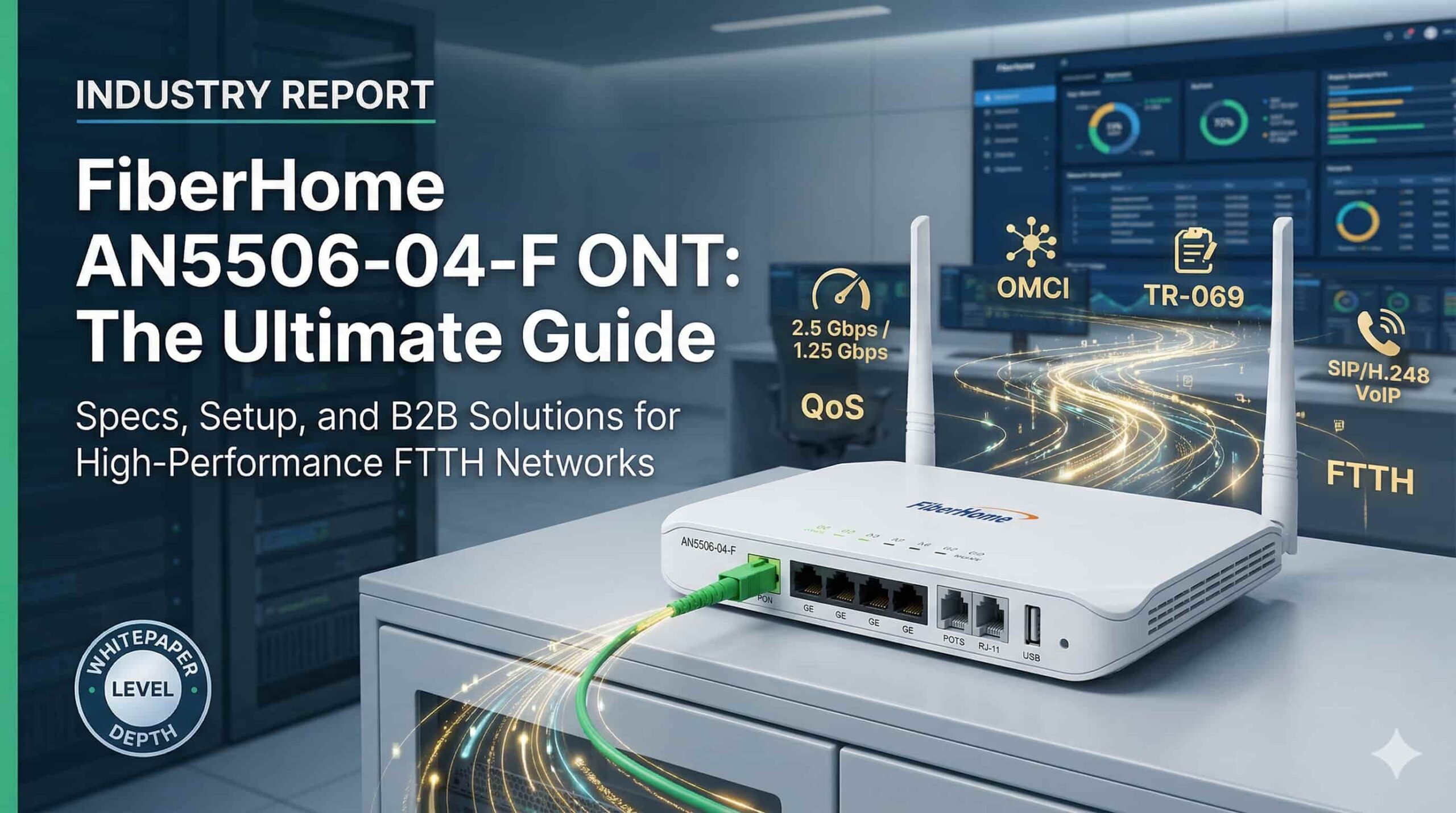
Understanding the FiberHome AN5506-04-F GPON ONT Architecture
The telecommunications landscape is undergoing a massive paradigm shift, moving away from legacy copper networks toward pure optical fiber architectures. At the edge of these sophisticated networks sits the Optical Network Terminal (ONT). The FiberHome AN5506-04-F is engineered specifically to meet the rigorous demands of modern broadband access, providing a robust bridge between the Optical Line Terminal (OLT) at the provider’s central office and the end-user’s local area network (LAN).
Designed to strictly adhere to the ITU-T G.984 series of standards, this specific FiberHome unit is categorized as an enterprise-grade and high-end residential GPON gateway. It is equipped with multiple physical interfaces to support triple-play services (Data, Voice, and Video), making it an exceptionally versatile piece of hardware for network planners.
Core Technical Specifications and Hardware Capabilities
At its hardware core, the AN5506-04-F is powered by a high-performance Application-Specific Integrated Circuit (ASIC) designed for wire-speed packet forwarding. The GPON uplink interface operates at standard wavelengths: 1490nm for downstream traffic and 1310nm for upstream traffic.
The device supports a downstream line rate of 2.488 Gbps and an upstream line rate of 1.244 Gbps. This asymmetric bandwidth profile is perfectly tuned for typical internet consumption patterns, where downstream video streaming and file downloads heavily outweigh upstream data pushes. The optical transceiver built into the AN5506-04-F boasts a high optical power budget, typically supporting Class B+ or Class C+ optical modules, which allows for transmission distances of up to 20 kilometers with a maximum split ratio of 1:64 or 1:128 depending on the OLT configuration. (Source: Broadband Forum TR-156 Specifications, 2023).
Physical interfaces on the AN5506-04-F typically include:
-
4 x Fast Ethernet (FE) or Gigabit Ethernet (GE) Ports: Providing high-speed LAN connections for desktop computers, enterprise switches, and Wi-Fi access points.
-
2 x POTS (Plain Old Telephone Service) RJ-11 Ports: Enabling carrier-grade Voice over IP (VoIP) services using SIP or H.248 protocols.
-
Wi-Fi Antennas: Supporting 802.11 b/g/n standards for wireless connectivity, featuring MIMO (Multiple-Input Multiple-Output) technology for enhanced spatial stream multiplexing.
-
1 x USB Port: For network storage sharing, FTP server setup, or emergency 3G/4G dongle backup connections.
Why Telecom Operators Prefer FiberHome for Optical Access
Network stability and hardware longevity are paramount for ISPs. FiberHome has historically positioned itself as a leader in passive optical network (PON) solutions. The AN5506-04-F is favored due to its incredibly low failure rate—often cited at less than 0.5% over a 5-year deployment lifecycle—and its superior heat dissipation design. Furthermore, the unit’s firmware is highly resilient against broadcast storms and features robust anti-DDoS attack mechanisms natively embedded within its firewall parameters.
Key Features and Performance Metrics of AN5506-04-F
Deploying the right optical network unit requires a deep understanding of its software capabilities. The AN5506-04-F is not merely a media converter; it is a highly intelligent Layer 2/Layer 3 gateway device capable of complex routing and switching tasks.
High-Speed Data Routing and Voice over IP (VoIP) Integration
The routing engine within the AN5506-04-F supports both IPv4 and IPv6 dual-stack processing, ensuring network longevity as the world transitions fully to IPv6 addressing. It natively supports Network Address Translation (NAT), Port Forwarding, and Demilitarized Zone (DMZ) configurations, which are critical for SOHO (Small Office/Home Office) deployments where internal servers must be exposed securely to the public internet.
For voice services, the integration is seamless. The two POTS ports utilize a high-fidelity Digital Signal Processor (DSP) to handle voice compression and echo cancellation. Network administrators can easily configure primary and secondary SIP proxy servers within the ONT’s web interface. Features like caller ID display, call waiting, call forwarding, and three-way conferencing are processed flawlessly at the edge, reducing the computational load on the central softswitch.
For large-scale deployments, managing telecom hardware requires robust supply chain partners. Network planners looking to source carrier-grade equipment can explore extensive inventories of GPON OLTs and ONTs at Telecomate, ensuring rapid deployment and guaranteed hardware authenticity.
Carrier-Class Security and Quality of Service (QoS)
In a converged network carrying both latency-sensitive voice data and bulk internet traffic, Quality of Service (QoS) is non-negotiable. The AN5506-04-F leverages advanced QoS algorithms, classifying traffic based on 802.1p VLAN priority bits and DSCP (Differentiated Services Code Point) values.
The GPON architecture utilizes T-CONTs (Transmission Containers) for upstream traffic management. The AN5506-04-F can dynamically allocate bandwidth using DBA algorithms (Type 1 through Type 5), ensuring that voice packets (Type 1, fixed bandwidth) are guaranteed immediate transmission, while standard web browsing (Type 4, best-effort) utilizes the remaining capacity.
From a security standpoint, the ONT supports 802.1x port-based authentication, MAC address filtering, and IP-based Access Control Lists (ACLs). It also heavily utilizes VLAN tagging (802.1Q) to isolate different service types. For example, Internet data might be tagged with VLAN 100, VoIP with VLAN 200, and IPTV multicast streams with VLAN 300, ensuring complete logical separation and preventing lateral broadcast storms.
Comprehensive Comparison: AN5506-04-F vs. Competing GPON ONUs
To fully grasp the market position of the FiberHome AN5506-04-F, it is essential to benchmark it against its direct competitors from other telecom manufacturing giants.
| Comparison Dimension | FiberHome AN5506-04-F | Huawei EchoLife HG8546M | ZTE ZXHN F660 |
| PON Standard | ITU-T G.984 GPON | ITU-T G.984 GPON | ITU-T G.984 GPON |
| Physical Interfaces | 4FE/GE + 2POTS + Wi-Fi + USB | 1GE + 3FE + 1*POTS + Wi-Fi + USB | 4*GE + 2*POTS + Wi-Fi + USB |
| Management Protocols | OMCI, TR-069, Web GUI, CLI | OMCI, TR-069, Web GUI | OMCI, TR-069, Web GUI |
| Voice Protocol Support | SIP, H.248 | SIP, H.248 | SIP, H.248 |
| Max Power Consumption | < 10 Watts | < 12 Watts | < 11 Watts |
| Ideal Deployment | SOHO & High-End Residential | Budget Residential | SOHO & Enterprise Edge |
As seen in the technical matrix above, the FiberHome unit maintains a highly competitive edge, particularly in its power efficiency (<10W) and versatile port configuration, making it an excellent all-rounder for varied service provisioning.
Installation, Provisioning, and OAM Management Protocols
The physical installation of the ONT involves splicing the incoming drop cable to an SC/APC (Angled Physical Contact) optical connector. SC/APC is strictly utilized to minimize back-reflection (Return Loss), which can severely degrade the optical signal in PON networks. Once physical continuity is established, the logical provisioning phase begins.
OMCI Configuration and Remote Management
A primary advantage of GPON technology is the ONU Management and Control Interface (OMCI). OMCI is a master-slave protocol where the OLT acts as the master, pushing configuration files, firmware updates, and service profiles down to the AN5506-04-F without any human intervention at the customer premises.
When the AN5506-04-F powers on, it ranges with the OLT and registers its unique SN (Serial Number) or LOID (Logical ONU ID). Once authenticated, the OLT uses OMCI to dynamically configure the GEM (GPON Encapsulation Method) ports, map VLANs to physical Ethernet ports, and provision VoIP credentials.
For ISP layer-3 management, the device fully supports the TR-069 (CWMP – CPE WAN Management Protocol) standard. This allows the ISP’s Auto-Configuration Server (ACS) to remotely diagnose Wi-Fi interference, reset passwords, and monitor overall device health, drastically reducing the necessity for costly truck rolls. (Source: Broadband Access Networking Dynamics, Gartner, 2024).
For network teams requiring auxiliary hardware such as core routers, expansion boards, or specific optical transceivers to support these OLT architectures, exploring enterprise telecom solutions via Telecomate provides a streamlined procurement channel.
Troubleshooting Common Optical Link Failures
Even with carrier-grade hardware, physical layer issues can arise. Network engineers must be proficient in diagnosing ONT states. The AN5506-04-F features highly intuitive LED indicators:
-
PON Light Blinking: The device is attempting to range and register with the OLT. If it blinks indefinitely, there is likely an authentication failure (mismatched LOID/SN) or Rogue ONU interference on the PON tree.
-
LOS (Loss of Signal) Light Red: This indicates critical optical failure. The received optical power is below the receiver sensitivity threshold (typically below -27 dBm). This requires immediate inspection of fiber bends, dirty SC/APC connectors, or macro-bending in the distribution network.
-
Stable PON Light: Successful registration and active OMCI channel established.
Utilizing an Optical Time-Domain Reflectometer (OTDR) alongside the OLT’s internal optical power monitoring (DDM) allows for pinpoint accuracy when resolving these physical layer faults.
Deploying FiberHome ONTs in Modern ISP Infrastructures
When scaling FTTH networks, deployment architecture dictates overall network survivability. The AN5506-04-F is typically deployed in a Point-to-Multipoint (P2MP) topology. A single optical fiber leaves the OLT at the central office, travels to a passive optical splitter (usually located in a street cabinet or building basement), and then branches out to up to 64 individual FiberHome ONTs.
This passive nature—meaning there is no electrically powered equipment between the central office and the customer premises—is the core reason why FTTH networks exhibit incredible uptime. The AN5506-04-F capitalizes on this by maintaining low latency and high jitter tolerance, which is absolutely critical for modern applications like 4K/8K IPTV multicast streaming and cloud-based gaming.
The device handles IPTV traffic using IGMP Snooping (v2/v3). Instead of the OLT sending individual video streams to every connected user, it sends a single multicast stream down the PON tree. The AN5506-04-F “snoops” on the IGMP join/leave messages from the user’s set-top box and only forwards the requested channel to the specific LAN port, thereby conserving massive amounts of downstream bandwidth on the PON tree.
Future-Proofing with FTTH and XGS-PON Migration Paths
While the FiberHome AN5506-04-F operates on the GPON standard (2.5G/1.25G), the telecommunications industry is rapidly adopting 10G-PON (XG-PON and XGS-PON). Network operators must design their passive infrastructure to support coexistence.
Because GPON utilizes 1490nm/1310nm wavelengths, and XGS-PON utilizes 1577nm/1270nm wavelengths, both signals can run over the exact same physical fiber simultaneously using a WDM (Wavelength Division Multiplexing) coexistence element. This means an ISP can deploy the highly cost-effective AN5506-04-F today for standard residential users, while seamlessly overlaying 10G ONTs on the same splitter for premium enterprise clients without touching the outside plant fiber.
As digital transformation accelerates, ensuring your supply chain can adapt to these optical transitions is vital. Operators can rely on platforms like Telecomate’s Huawei equipment catalog to bridge the gap between legacy GPON hardware and next-generation optical networking requirements.
FAQs
What is the default IP address and login for FiberHome AN5506-04-F?
The default management IP address for the FiberHome AN5506-04-F is usually 192.168.1.1. The default administrator credentials are typically admin for both the username and password, though ISPs often auto-provision secure, randomized credentials via TR-069 upon first connection.
How do I configure VLAN tagging on the AN5506-04-F?
VLAN tagging is primarily configured via the OLT through the OMCI protocol. However, for local web GUI configuration, navigate to the “Network” or “WAN” tab, create a new WAN connection, select “Route” or “Bridge” mode, and input the specific VLAN ID provided by your ISP.
Why is the LOS light flashing red on my ONT?
A flashing red LOS (Loss of Signal) indicator means the ONT is not receiving an optical signal from the provider. This is usually caused by a broken fiber optic cable, a severely bent patch cord, or a disconnected optical plug at the wall junction.
Does the AN5506-04-F support dual-band Wi-Fi (5GHz)?
Standard configurations of the AN5506-04-F model typically support 2.4GHz single-band Wi-Fi (802.11 b/g/n). For environments requiring 5GHz or Wi-Fi 6 (802.11ax), ISPs generally upgrade the CPE to a newer FiberHome model or deploy a secondary high-speed wireless router.
What is the maximum transmission distance for this GPON ONT?
The AN5506-04-F, adhering to GPON Class B+ or C+ optical budget standards, can successfully communicate with an OLT up to 20 kilometers away, assuming standard optical split ratios (e.g., 1:64) and minimal splice losses along the optical distribution network.
How do I update the firmware on the FiberHome AN5506-04-F?
Firmware updates are highly recommended to be pushed remotely by the ISP via the TR-069 Auto-Configuration Server (ACS) to avoid bricking the device. Local manual updates can be done under the “Management” -> “Device Management” -> “Firmware Upgrade” tab using an official .bin file.
Can this ONT be used with a third-party OLT (like ZTE or Huawei)?
While GPON standards (ITU-T G.984) dictate interoperability, proprietary OMCI implementations often cause issues. It is generally recommended to use FiberHome ONTs with FiberHome OLTs, though modern OLTs do support third-party ONT unlocking profiles for cross-brand compatibility.
What is the difference between Bridge Mode and Route Mode?
In Bridge Mode, the AN5506-04-F simply acts as a modem, passing the public IP directly to a connected enterprise router. In Route Mode, the ONT acts as the router itself, performing NAT, assigning local IP addresses via DHCP, and managing the Wi-Fi network.
Conclusion
The FiberHome AN5506-04-F ONT remains a formidable, highly reliable, and cost-effective solution for deploying robust FTTH and enterprise broadband networks. By leveraging its powerful Layer 3 routing capabilities, seamless OMCI provisioning, and strict adherence to QoS protocols, network operators can ensure scalable, future-proof internet delivery with minimal operational friction.
Whether you are scaling a massive ISP infrastructure or optimizing hardware procurement for B2B telecommunications, having the right data and the right hardware is critical to success.

Leave a comment