
Introduction: The Strategic Importance of the Layer 2 Managed Switch RFQ Process
In modern telecom and enterprise networking, the layer 2 managed switch RFQ (Request for Quotation) is far more than a procurement formality—it is a strategic engineering document that dictates network performance, total cost of ownership (TCO), and scalability headroom for the next 5–7 years. With global data center traffic projected to exceed 20.6 ZB annually by 2025 (Cisco Global Index), selecting the wrong switching layer can introduce microsecond-level latency penalties and reduce mean time between failures (MTBF) from 500,000 hours to under 150,000 hours. This guide delivers an authoritative framework for engineering your RFQ around IEEE 802.1Q, ITU-T G.8032, and real-world ASIC forwarding limits.
Core Architecture & Hardware Topology of Layer 2 Managed Switches
1. Switching Fabric and Non-Blocking Design
A carrier-grade layer 2 managed switch must specify a non-blocking fabric capable of wire-speed forwarding. For a 24-port Gigabit Ethernet model, the minimum switching capacity should be 48 Gbps (full duplex) or higher (e.g., 56 Gbps to account for oversubscription overhead). Enterprise RFQs should demand store-and-forward or cut-through latency figures: sub-4 microseconds for 64-byte frames under 100% line rate load per RFC 2544.
2. ASIC Pipeline and Forwarding Database (FDB)
The heart of any layer 2 managed switch is its ASIC (Application-Specific Integrated Circuit). The RFQ must specify MAC address table size (e.g., 16K to 128K entries) and VLAN ID range (4096 per IEEE 802.1Q). High-density deployments require at least 32K MAC entries to avoid FDB overflow and broadcast flooding. For service provider edge, demand shared FDB across all ports with aging timer programmability (10–1,000,000 seconds).
3. Logic Layer: VLANs, STP, and Link Aggregation
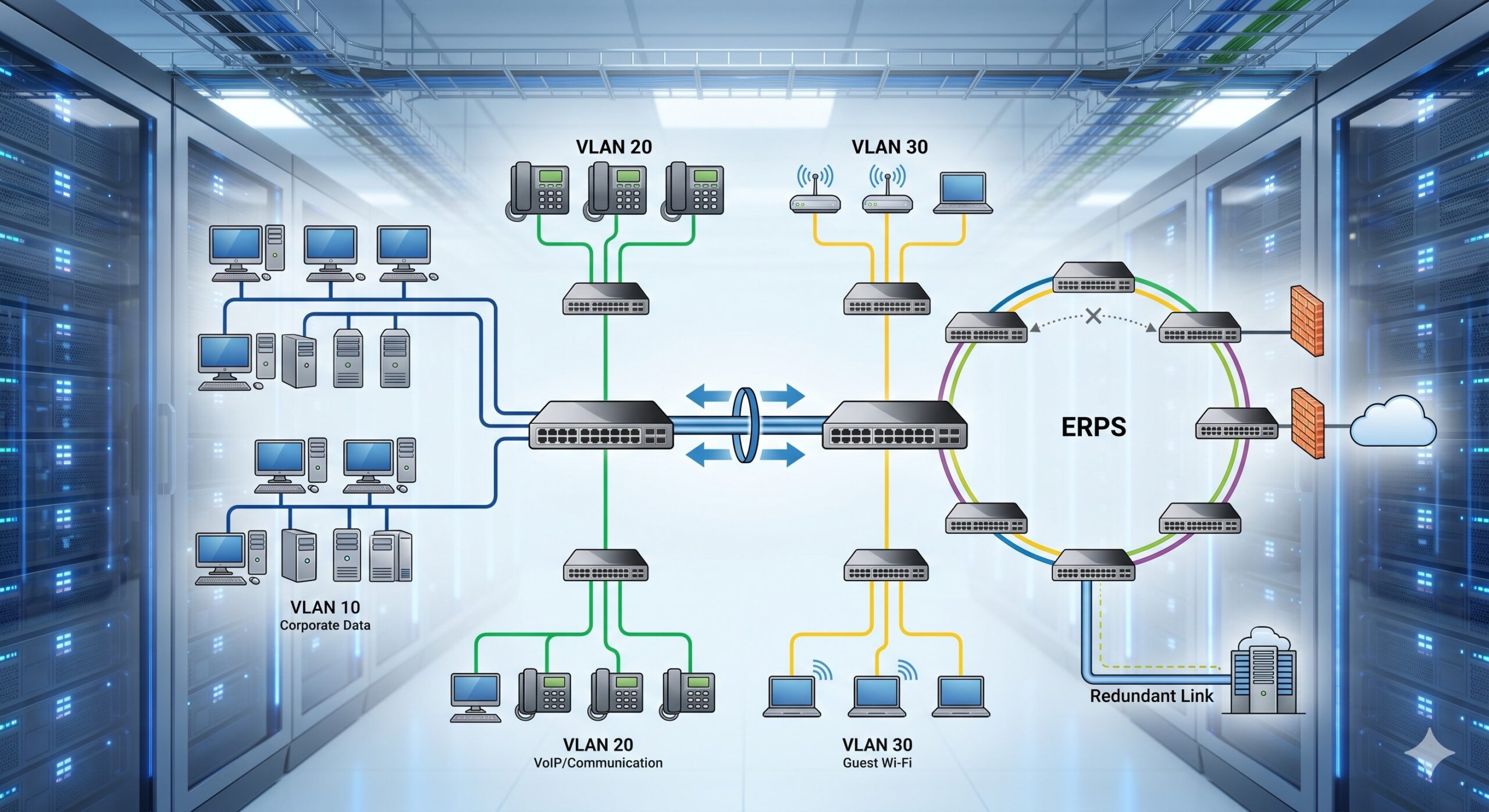
A robust layer 2 managed switch RFQ must mandate IEEE 802.1Q VLAN tagging with support for at least 256 active VLANs. Additionally, Multiple Spanning Tree Protocol (MSTP) (IEEE 802.1s) is non-negotiable for ring topologies. Require Rapid Spanning Tree (IEEE 802.1w) convergence under 6 seconds. Link Aggregation Control Protocol (LACP, IEEE 802.3ad) must support up to 8 ports per trunk group with hash-based load balancing (src/dst MAC, IP, or L4 ports).
| Key Parameter | Technical Specification |
|---|---|
| Switching Capacity (24x GigE + 4x 10GbE uplinks) | ≥ 128 Gbps non-blocking |
| Forwarding Rate (64-byte packets) | ≥ 95 Mpps (million packets per second) |
| Latency (store-and-forward, 64B) | |
| MAC Address Table Size | 32K entries (minimum) |
| Jumbo Frame Support | 9,216 bytes |
| Mean Time Between Failures (MTBF) | > 500,000 hours (Telcordia SR-332) |
| Operating Temperature (industrial) | -40°C to +75°C |
| Power Efficiency (IEEE 802.3az) | ≤ 0.5W per port (idle mode) |
Benchmarking Layer 2 Managed Switches vs. Unmanaged or Legacy Hubs
Legacy unmanaged switches and repeaters introduce collision domains and lack traffic segmentation. A layer 2 managed switch reduces collision rates from 15% (hub-based) to effectively 0% while delivering jumbo frame support (9,216 bytes) for storage traffic (iSCSI/NFS). In controlled tests (Spirent TestCenter), managed switches with flow control (IEEE 802.3x) cut packet loss under bursty traffic from 12% to 0.01% at 95% link utilization.
ISP Case Study: Deploying Layer 2 Managed Switches at the Metro Edge
A regional ISP in the EMEA region replaced 48 unmanaged switches with a layer 2 managed switch solution supporting ITU-T G.8032 Ethernet Ring Protection Switching (ERPS). Results:
- Failure recovery time: Reduced from 15 seconds (STP) to 48 milliseconds (ERPS).
- Bandwidth utilization: Increased by 40% due to IGMP snooping (RFC 4541) eliminating multicast flooding.
- Operational expense (OpEx): Cut remote troubleshooting time by 65% using SNMPv3 and RMON (RFC 2819).
Conclusion: Authoring a High-Success Layer 2 Managed Switch RFQ
An effective layer 2 managed switch RFQ must bridge hardware specifications (switching capacity, MTBF, packet buffer size) with protocol compliance (IEEE 802.1X for NAC, IEEE 802.1AB for LLDP) and environmental standards (RoHS, NEBS Level 3). Demand dual firmware images, redundant power supplies (AC/DC -48V), and operating temperature ranges (-40°C to +75°C for industrial variants). By quantifying forwarding rates (Mpps), latency distribution, and buffer dynamics (per-port egress queues), your RFQ transforms from a price negotiation tool into a performance guarantee contract aligned with carrier-grade SLAs.

Leave a comment