
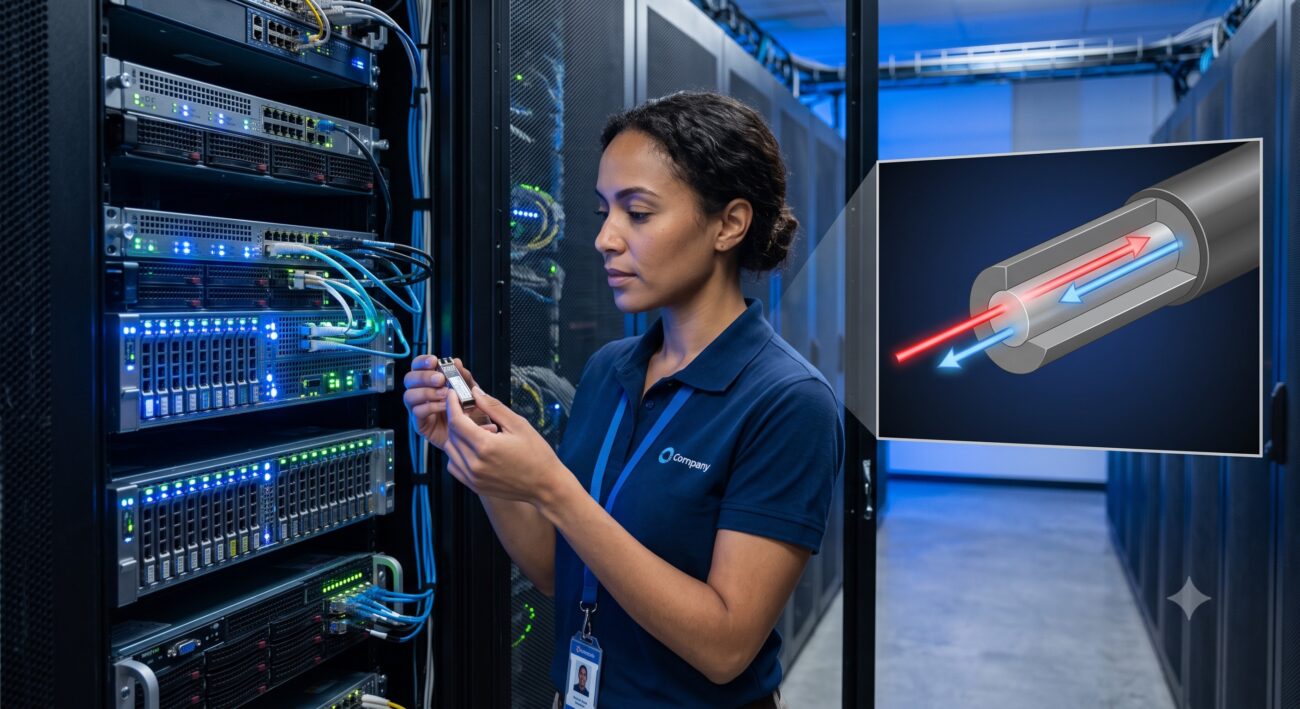
Overview & Thematic Scope
Welcome to our comprehensive technical FAQ on Bidirectional (BIDI) transceivers. This resource is designed for network engineers, IT procurement specialists, and data center architects who need to understand the function, benefits, and operational nuances of BIDI optics. We cover everything from basic operational principles to compatibility, troubleshooting, and procurement considerations to help you make informed decisions for your fiber optic network infrastructure.
Frequently Asked Questions
- Q1: What is a BIDI transceiver and how does it work?
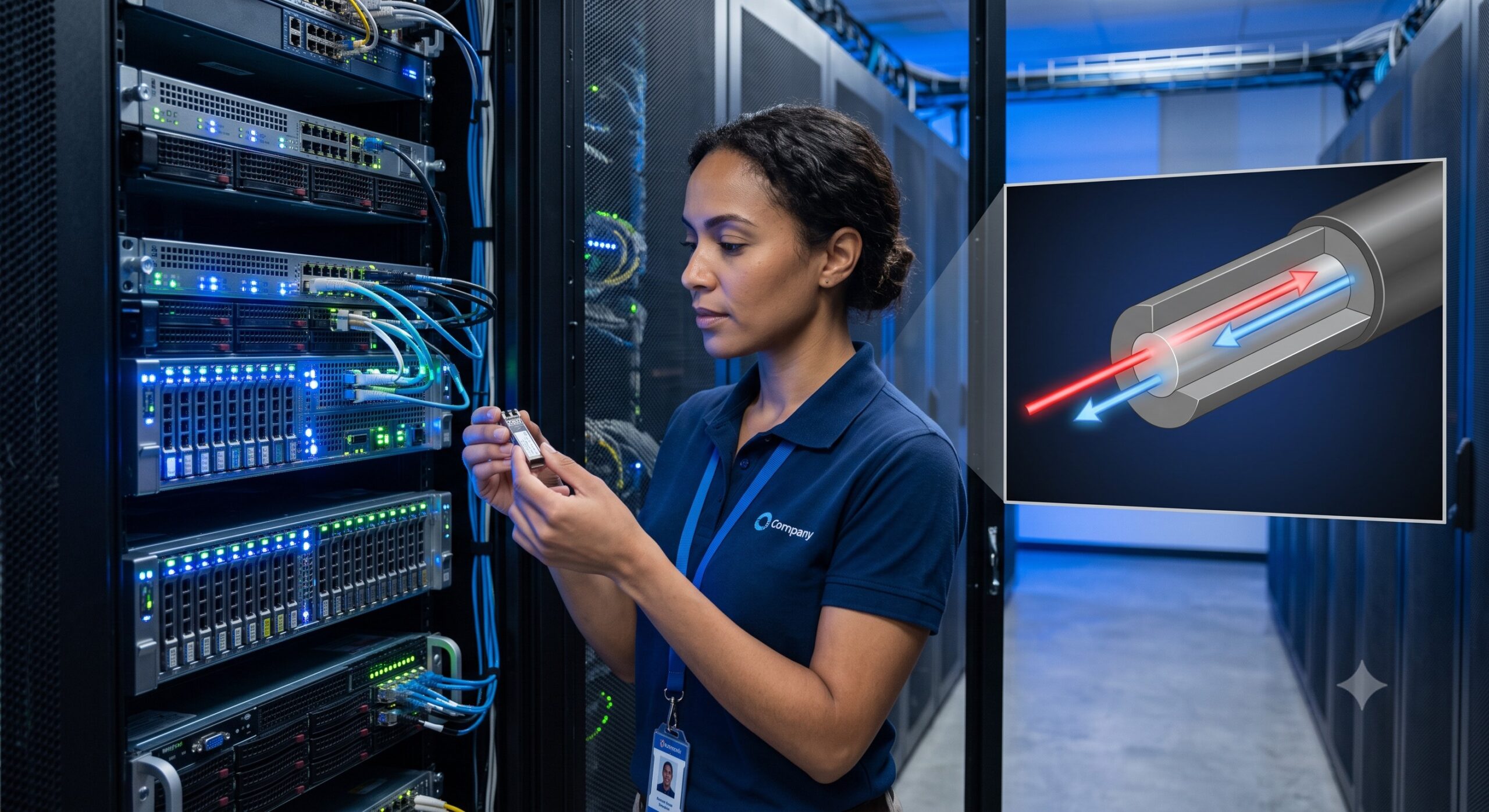
- A BIDI (Bidirectional) transceiver is an optical module that transmits and receives data over a single strand of fiber optic cable, effectively doubling the capacity of existing fiber infrastructure. Unlike standard transceivers that require two fibers (one for transmit and one for receive), a BIDI transceiver uses Wavelength Division Multiplexing (WDM) to combine and separate signals at different wavelengths. For example, a typical 1G or 10G BIDI SFP might transmit at 1310nm and receive at 1550nm; the paired transceiver on the other end does the opposite.
- Q2: What are the main benefits of using BIDI transceivers in a network?
- The primary benefit of using BIDI transceivers is the significant reduction in fiber optic cabling costs, effectively doubling the capacity of your existing physical infrastructure. By utilizing a single fiber strand for full-duplex communication, you can maximize the return on investment (ROI) of your dark fiber or leased lines. Additional benefits include simplified cable management in high-density environments and reduced space requirements in fiber trays and patch panels.
- Q3: How do I ensure BIDI transceiver compatibility with my existing network hardware?
- Ensuring compatibility requires verifying the transceiver’s form factor (e.g., SFP, SFP+, QSFP), the data rate, and the MSA (Multi-Source Agreement) compliance against your specific switch or router vendor’s supported optics list. BIDI transceivers are inherently wavelength-paired, so you must purchase them in matched pairs. For example, a transceiver with a TX 1310nm / RX 1550nm wavelength must be paired with a transceiver operating at TX 1550nm / RX 1310nm at the other end. Always check your equipment’s specifications for supported optical parameters and use coded EEPROMs to avoid locking issues.
- Q4: What are the distance limitations and optical power budgets for BIDI transceivers?
- Distance and power budget depend entirely on the transceiver’s specific optics and the type of fiber (SMF or MMF). BIDI transceivers are available for a wide range of distances, from 100 meters over multimode fiber to 10km, 20km, 40km, and even up to 120km over single-mode fiber. The optical power budget, measured in dB, is the difference between the transmitter output power and the receiver sensitivity. A higher power budget is required for longer distances to compensate for attenuation and connector losses. Always consult the datasheet’s link budget calculations and factor in a margin for connector and splice losses.
- Q5: What should I do if I encounter a link loss or high bit error rate (BER) with a BIDI transceiver?
- To troubleshoot link loss or high BER, first clean the fiber optic connectors and inspect the transceiver’s optical ports for contamination. Then, verify the DDM (Digital Diagnostic Monitoring) values to check transmit and receive power levels against the specified thresholds. Ensure you are using the correct wavelength pair and that the fiber is not looped back incorrectly. Check the cable for excessive bending, and if possible, use an OTDR (Optical Time-Domain Reflectometer) to test the integrity of the link. Replacing the transceiver with a known-good unit can help isolate the issue.
- Q6: How do I choose between a BIDI transceiver and a standard dual-fiber transceiver?
- Choosing between BIDI and standard transceivers depends on whether your primary constraint is fiber availability or transceiver cost. Opt for BIDI transceivers when you have limited fiber pairs and need to maximize the utilization of existing cabling infrastructure, which is common in campus backbones and leased line environments. Standard dual-fiber transceivers are generally more affordable and simpler to manage from a wavelength perspective, making them suitable for new greenfield deployments where fiber is plentiful.
- Q7: Are there specific installation or handling precautions for BIDI transceivers?
- BIDI transceivers require careful handling to prevent electrostatic discharge (ESD) damage. Always use an ESD wrist strap when handling modules and ensure optical ports are covered with a dust plug when not in use. Crucially, do not bend the fiber optic cable tightly, as this can increase attenuation and cause signal degradation. Ensure the transceiver is fully inserted and latched into the port and avoid looking directly into the optical aperture, as it emits invisible laser radiation.
- Q8: What is the typical lifespan and warranty for BIDI transceivers?
- The typical lifespan of a BIDI transceiver is between 5 to 10 years, though this can be affected by environmental factors like temperature and humidity. Most reputable third-party and OEM manufacturers offer a standard warranty period of 1 to 3 years. For procurement, it is advisable to inquire about advanced replacement (AR) options and end-of-life (EOL) support policies to ensure long-term network stability and uptime.

Leave a comment