

Introduction: The Imperative of ‘Five-Nines’ Reliability in Modern Transport Networks
In the current landscape of 5G rollouts, edge computing, and hyperscale data center interconnect (DCI), the transport network is no longer simply a ‘pipeline’ but the foundational fabric of digital service delivery. For network architects and infrastructure leads, the selection of transport nodes hinges on a single, uncompromising metric: carrier-grade reliability. This deep-dive technical analysis evaluates the ZTE ZXMP series of transport nodes, dissecting the architecture, redundancy mechanisms, and quantifiable metrics such as MTBF (Mean Time Between Failures) that underpin their performance in mission-critical environments. We move beyond theoretical maximums to explore the hardware-level resilience that ensures 99.999% availability, safeguarding revenue and user experience in the most demanding scenarios.

Core Architecture and Hardware Topology for High Availability
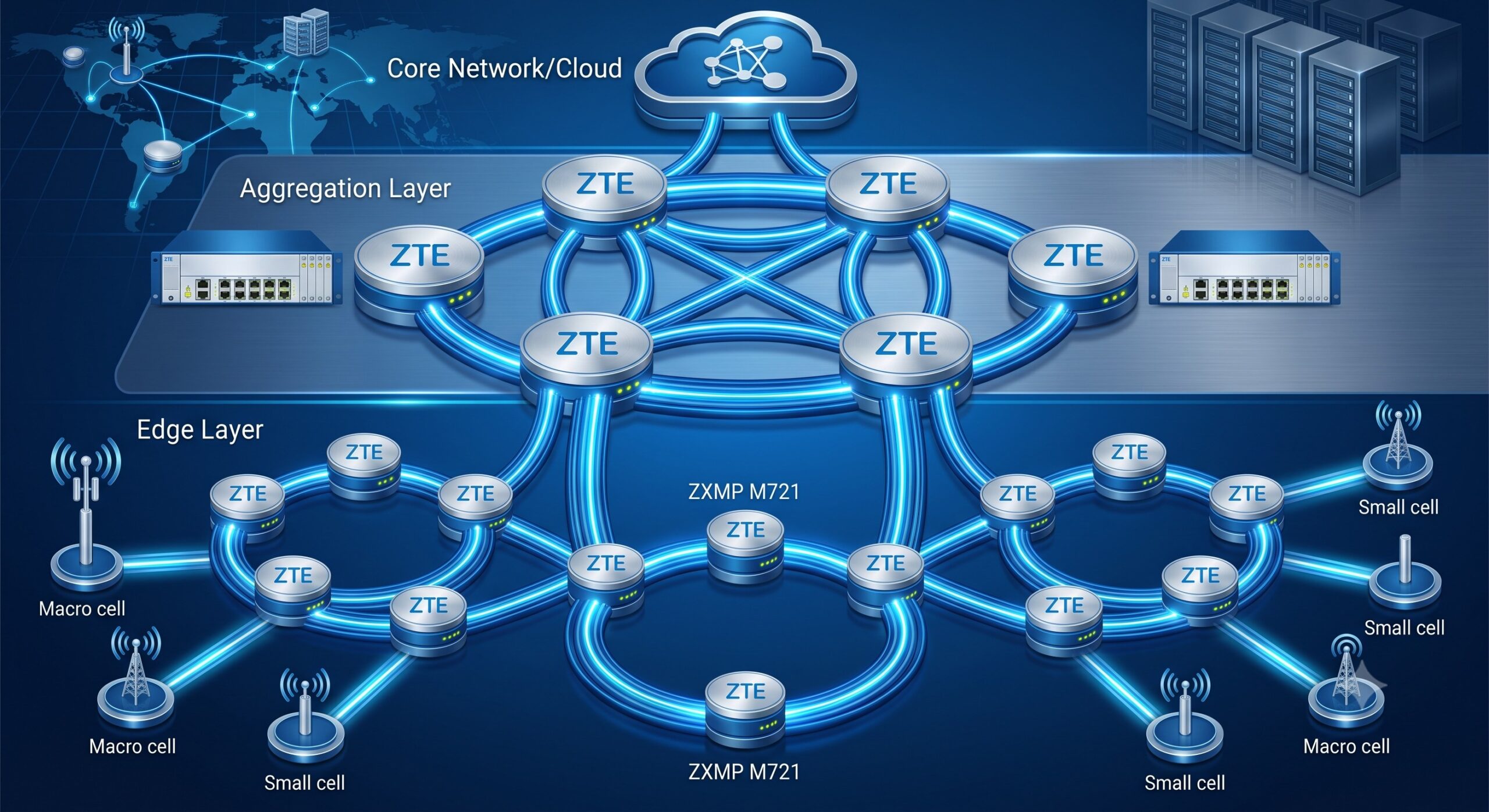
The foundation of any carrier-grade platform is its hardware architecture. The ZXMP M721 series, a pivotal component of ZTE’s transport portfolio, integrates OTN, WDM, TDM, and IPRAN/PTN technologies into a unified platform, showcasing a modular design philosophy focused on redundancy and scalability . The hardware topology is built to eliminate single points of failure. A prime example of this is the support for 2+2 backup for switching fabric components, a feature historically seen in high-end systems like the ZXR10 M6000 series, which utilizes 1:1 MPU redundancy and N+1 power supply redundancy .
Chassis Design and Protection Schemes
The ZXMP M721 product family is available in multiple form factors—from the compact 1U (CX61A) to the 6U (CX66A) chassis—to support diverse deployment scenarios from access to aggregation layers . Each chassis is engineered to house a rich set of interface types, including E1, STM-1/4/16/64, FE/GE/10GE/40GE/50GE/100GE/400GE, and Fibre Channel interfaces, ensuring compatibility with legacy and next-generation infrastructure .
To maintain service continuity, the ZXMP series offers comprehensive device-level and network-level protection. This includes 1:N redundancy for tributary boards (E1/T1/E3/T3/FE) and sophisticated optical layer protection with support for 2-9 dimensional optical add/drop multiplexing (ROADM), featuring wavelength/direction independent and flex-grid capabilities, allowing for the creation of highly resilient mesh topologies .
Quantifying Resilience: MTBF, MTTR, and Operational Parameters
Reliability is not an abstract concept but a quantifiable engineering metric. The data available for ZTE’s carrier-class platforms provides critical insight into the expected operational lifespan and service availability. Drawing from the rigorous specifications of the ZXR10 M6000-S series—which share design philosophies with the ZXMP transport nodes—we can benchmark reliability expectations.
| Parameter | Specification / Value |
|---|---|
| MTBF (Mean Time Between Failures) | >400,000 hours |
| MTTR (Mean Time To Repair) | |
| System Reliability | >99.999% |
| MPU Redundancy | 1:1 |
| SFU Redundancy (M6000-18S model) | 7+1 |
| Power Supply Redundancy (M6000-18S model) | DC: 11+1, AC: 8+8 |
Specifically, the ZXR10 M6000-S series routers, which serve as a testament to ZTE’s engineering in high-availability scenarios, boast an MTBF of >400,000 hours and a MTTR of , contributing to a system reliability of >99.999% . This is supported by a highly resilient hardware foundation featuring dual 1:1 MPU (Main Processing Unit) redundancy and N+1 SFU (Switch Fabric Unit) redundancy, with the M6000-18S, for example, supporting a 7+1 SFU configuration .
The ZXMP M721 series takes these principles further in the optical domain. It supports advanced features like quantum encryption and national cryptographic algorithms (e.g., SM series), ensuring data integrity and security alongside high availability . For operational simplicity, the systems support hot-swappable boards and fan trays, with subframes capable of automatic temperature control to adjust fan speed based on thermal conditions, directly impacting system longevity and reducing energy consumption .
Mission-Critical Deployments: 5G Fronthaul and Ultra-Low Latency
The true test of a transport node’s reliability is its performance in ultra-demanding scenarios like 5G fronthaul. The ZXMP M721 series, and specifically the ZXMP M721 OD62, is engineered to meet the stringent requirements of next-generation mobile networks. It supports 200G bandwidth and employs Flex-O technology to restrict end-to-end latency to less than 1 microsecond, a critical requirement for URLLC (Ultra-Reliable Low-Latency Communications) services .
Further validation of the platform’s reliability came from a joint test with Telefonica, where the ZXMP M721 CX66A demonstrated an equipment processing latency of just 5µs—an order of magnitude lower than traditional OTN equipment . In the same test, the ZXCTN 609, part of the broader ZTE transport ecosystem, achieved a forwarding latency of less than 0.5µs per node and a protection switching time of under 1ms, demonstrating the capability to support 99.9999% reliability through innovative technologies like FlexE Tunnel .
Intelligent Operations: SDN and AI-driven Reliability
Modern reliability extends beyond hardware redundancy to intelligent software and automation. ZTE’s ZENIC ONE management and control system leverages a combination of SDN, AI, and big data analytics to enhance network reliability and operational efficiency . Key features enabling proactive reliability include:
- Simplified Operations: Supports one-click service provisioning, reducing service deployment from days to minutes and minimizing human error .
- Enhanced Maintenance: Features like OTDR (Optical Time-Domain Reflectometer), APO (Automatic Power Optimization), and optical performance monitoring are integrated, simplifying troubleshooting and proactive maintenance .
- Automated Fault Resolution: AI-driven fault analysis can reduce fault localization time by up to 85%, minimizing service downtime .
Conclusion: The Architectural Verdict on Carrier-Grade Reliability
The ZTE ZXMP series of transport nodes represents a mature, highly resilient solution for the demands of modern telecommunications infrastructure. The hardware architecture, with its emphasis on multi-dimensional redundancy (1:1 MPU, N+1 power, 1:N tributary protection) and compliance with industry standards like IEEE 802.1ag, ITU-T Y.1731, and RoHS, provides a solid foundation for achieving 99.999% availability . When coupled with intelligent automation and AI-driven operations, these nodes are not just passive hardware but active participants in a self-optimizing, self-healing network. For network architects, the quantifiable metrics—MTBF >400,000 hours, sub-1µs latency, and sub-1ms protection switching—provide the data-driven assurance required to build a future-proof, resilient transport network capable of supporting the most demanding services from 5G to hyperscale DCI.

Leave a comment