
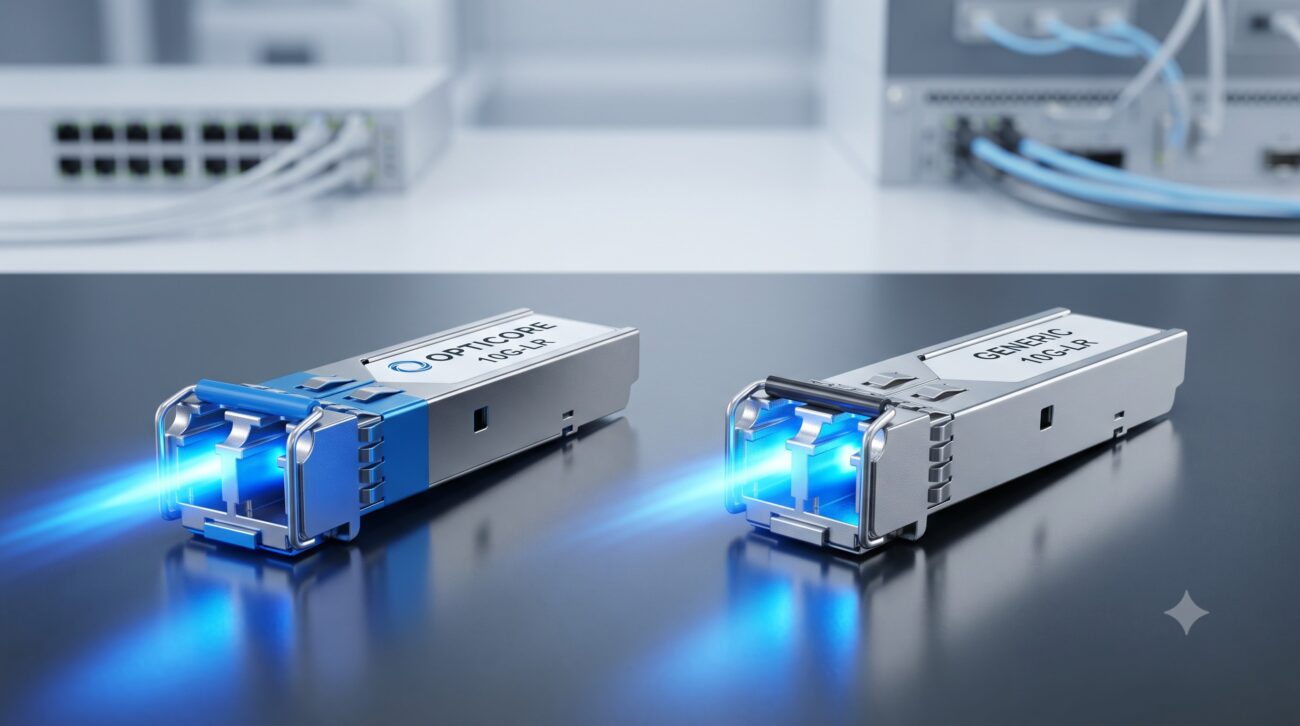
The Economic Imperative: Rethinking Optical Transceiver Procurement in the Modern Datacenter
Network architects and IT financial planners face a persistent challenge: balancing relentless bandwidth growth against stringent capital and operational budgets. Optical transceivers, the ubiquitous SFP, SFP+, and QSFP modules, represent a significant and often overlooked operational expenditure. Industry analysis indicates that networking optics can consume as much as 15% of an enterprise’s network capital spending . This financial pressure forces a critical evaluation of sourcing strategies, bringing the debate between Original Equipment Manufacturer (OEM) and third-party optical transceivers into sharp focus. For the discerning network professional, the decision transcends simple component selection; it is a strategic financial and architectural choice with long-term implications for Total Cost of Ownership (TCO) and network agility.
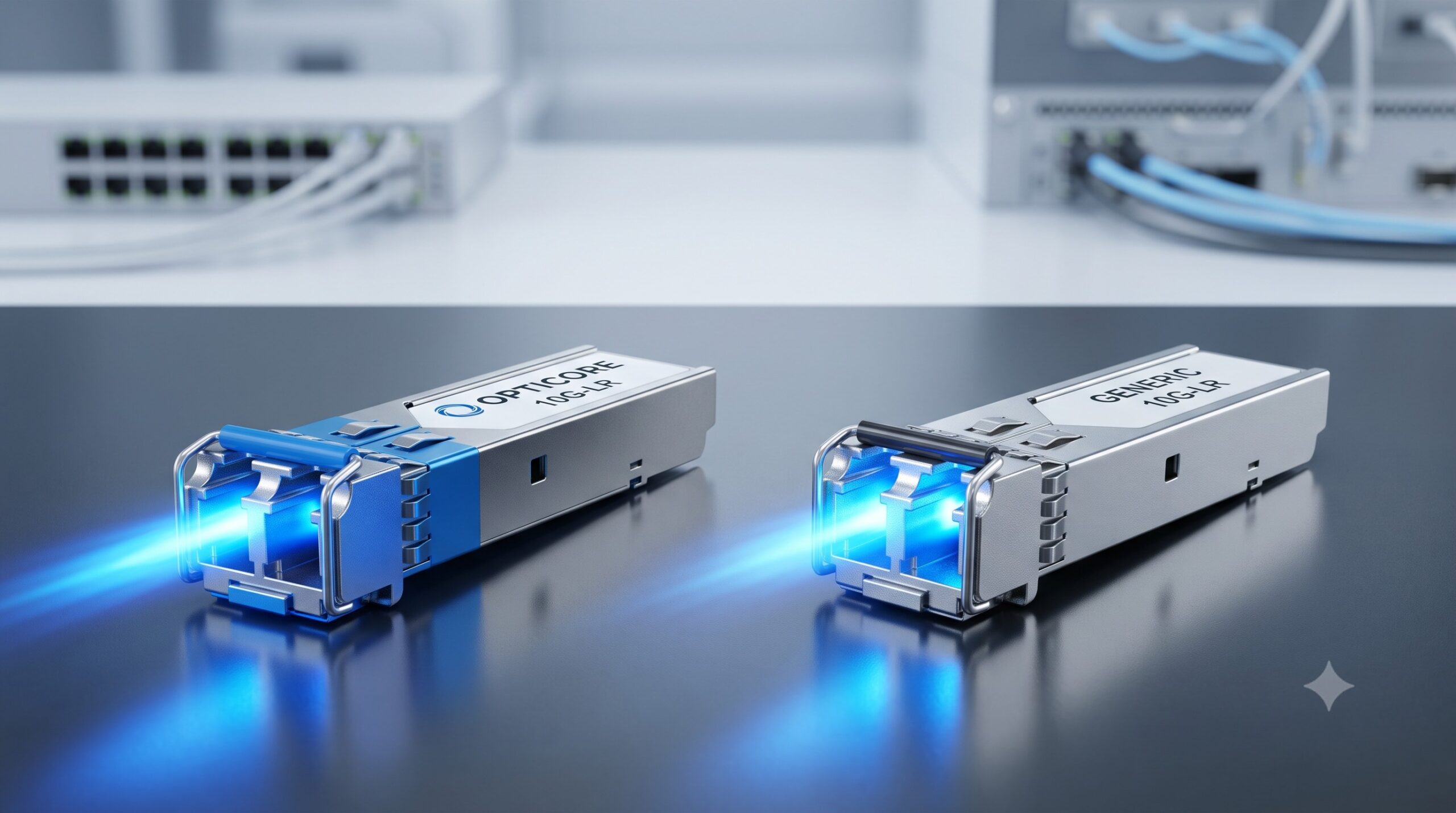
Deconstructing the Hardware: Understanding OEM and Third-Party Sourcing
To accurately assess TCO, one must first understand the supply chain. A pervasive industry reality is that the majority of major OEMs—including Cisco, Juniper, and Arista—do not manufacture optical transceivers themselves. Instead, they source these modules from a small pool of tier-one contract manufacturers, who are also the primary suppliers for reputable third-party vendors . This means that the hardware within an OEM-branded SFP and a high-quality compatible SFP often originates from the same production lines, utilizing identical components and adhering to the same Multi-Source Agreement (MSA) specifications for form, fit, and function .
The primary difference, therefore, is not the underlying technology but the Electronic Erasable Programmable Read-Only Memory (EEPROM) programming. OEM modules are coded with a vendor-specific ID that is recognized without issue by their proprietary operating systems. Third-party vendors, in turn, program their modules to mimic these signatures, ensuring seamless interoperability . This codification process is the crux of compatibility and a key factor in selecting a reliable third-party supplier.
Total Cost of Ownership (TCO): A Multi-Faceted Analysis
A comprehensive TCO analysis of third-party vs OEM optics must consider several dimensions: direct procurement costs, operational risks (including supportability and failure rates), and indirect costs such as vendor lock-in and deployment agility.
Direct Procurement Costs: The Immediate Savings
The most compelling argument for third-party optics is the substantial upfront savings. Pricing analyses consistently demonstrate that third-party modules cost 30% to 90% less than their OEM-branded counterparts . For example, a 10G SFP+ module from a major OEM can list for $200-$300, while a compatible equivalent is often available for $70-$150 . At scale, for a large service provider or hyperscaler deploying thousands of ports, this delta translates directly into millions of dollars in capital expenditure (CapEx) savings . This allows network operators to reallocate budget towards higher-value initiatives like network automation or security enhancements.
Warranty and Support: Mitigating Operational Risk
A persistent myth suggests that using third-party optics voids OEM hardware warranties. This is legally false. In the United States, the Magnuson-Moss Warranty Act prohibits tie-in sales provisions that condition warranty coverage on the use of specific branded parts . Similarly, EU competition law (TFEU Articles 101 and 102) enforces this principle .
While OEMs cannot void a warranty solely for using third-party parts, their support policies typically stipulate that they will withhold support for a specific issue if it is demonstrably caused by the third-party module . In practice, this means a support engineer may ask a customer to swap in an OEM optic for diagnostic purposes. For mission-critical core systems, maintaining a small inventory of OEM spares for troubleshooting can be a prudent operational hedge that preserves a frictionless path to vendor technical support .
Furthermore, many leading third-party providers offer superior warranty terms compared to OEMs, including lifetime warranties and advanced replacement programs . This level of support often outstrips the standard 1-5 year warranty offered by OEMs, reducing operational expenditure (OpEx) and replacement cycle costs.
Performance and Reliability: A Data-Driven Perspective
Because they are manufactured to the same MSA standards, the optical performance of third-party modules is virtually identical to OEM units. Technical specifications such as wavelength (e.g., 850nm for SR, 1310nm for LR), data rate (10Gbps, 25Gbps, 40Gbps, 100Gbps), transmit power, and receiver sensitivity are equivalent . Reputable third-party suppliers implement rigorous testing frameworks that include Digital Optical Monitoring (DOM) calibration, bit error rate (BER) testing, and temperature burn-in, often publishing comprehensive test reports to validate their quality . Field deployment data and case studies have shown that high-quality third-party modules demonstrate consistent performance across thousands of ports, matching the reliability and MTBF (Mean Time Between Failures) of OEM optics in real-world environments .
Avoiding Vendor Lock-in and Enhancing Agility
Reliance on a single OEM for transceivers creates technological lock-in, limiting an organization’s flexibility to adopt best-of-breed solutions or adapt to changing vendor landscapes . Third-party optics provide supply chain diversification and multi-vendor compatibility. This freedom allows network architects to standardize on a single transceiver SKU that can be deployed across heterogeneous environments, simplifying inventory management and reducing the risk associated with OEM end-of-sale or end-of-life announcements .
| Cost & Value Metric | OEM Optical Transceivers | Third-Party Optical Transceivers |
|---|---|---|
| Unit Cost (e.g., 10G SFP+) | Typically $200 – $300+ | Typically $70 – $150 |
| Overall Savings Potential | N/A | 30% – 90% vs. OEM list price |
| Module Warranty | 1 – 5 Years | Often Lifetime Warranty |
| Hardware Warranty Impact | Void only if third-party part is proven at fault | No impact; legally protected |
| Vendor Support for Troubleshooting | Full support, but may require OEM part for diagnosis | Direct support from supplier, may need OEM spare for TAC escalations |
Comparative TCO: Synthesis and Strategic Recommendations
The evidence overwhelmingly supports the economic viability of third-party optical transceivers. When evaluating TCO, the significant CapEx savings, often coupled with superior warranty terms, far outweigh the minimal operational risks, which are easily mitigated through proper supplier selection and a simple spares strategy.

Conclusion: Making the Informed Choice
The data-driven conclusion is that the primary differentiator between OEM and third-party optical transceivers is price, not performance. Third-party modules offer a compelling value proposition, delivering the same technical specifications and reliability at a fraction of the cost, with robust warranty backing. For most non-mission-critical edge, data center, and large-scale deployments, the strategic adoption of high-quality third-party transceivers is a sound financial decision that maximizes network ROI without compromising performance or operational integrity. Organizations should partner with reputable third-party suppliers with transparent testing protocols and strong warranty guarantees, and maintain a limited stock of OEM modules as a contingency for vendor support scenarios. This balanced approach optimizes both the network and the budget.

Leave a comment