
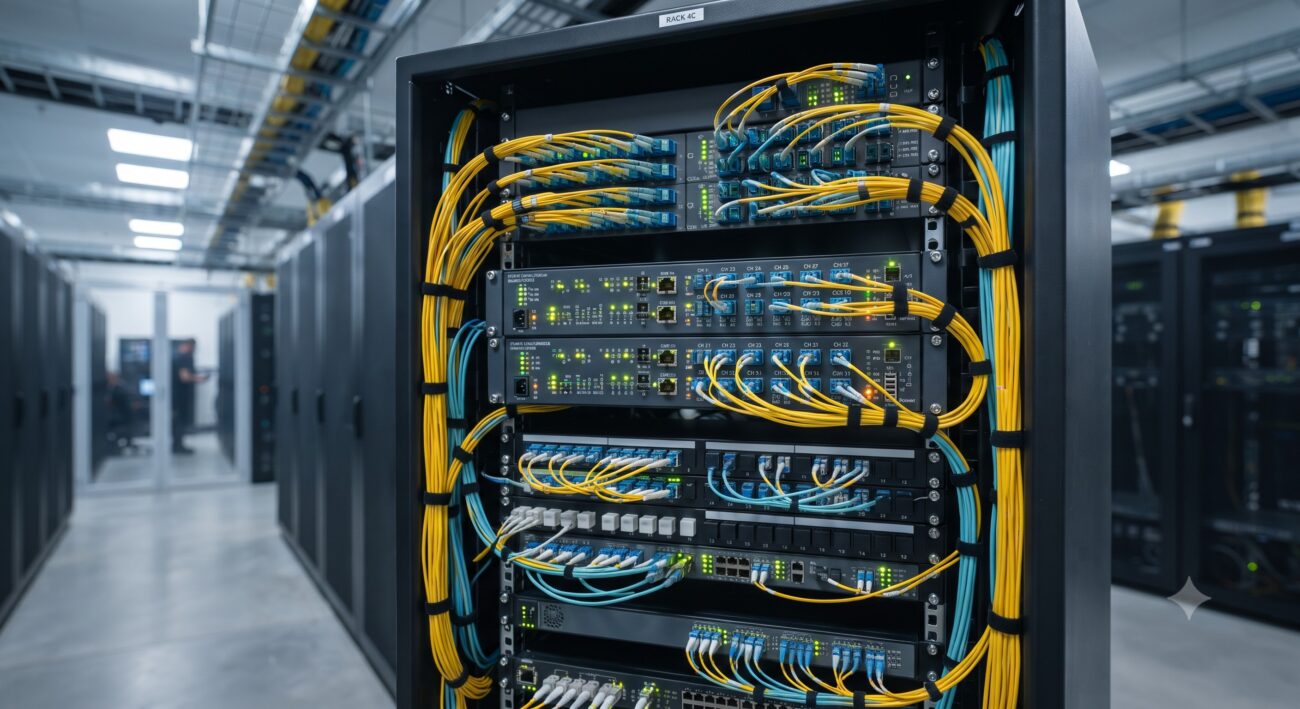
Overview & Thematic Scope
Dense Wavelength Division Multiplexing (DWDM) MUX/DEMUX units are passive optical components that maximize the capacity of existing fiber infrastructure by combining and separating multiple data channels at different wavelengths. This FAQ provides definitive technical answers for network engineers and procurement specialists, covering the maximum channel capacity, ITU grid specifications, compatibility, deployment, and troubleshooting. A standard DWDM MUX/DEMUX system can support up to 80 channels on a single fiber pair, with advanced systems reaching 96 channels, enabling total capacities of up to 19.2 Tbps per fiber pair .
Frequently Asked Questions
- Q1: What is the absolute maximum channel capacity of a DWDM MUX/DEMUX?
- The maximum channel capacity for a standard DWDM MUX/DEMUX is 80 channels, with some advanced configurations supporting up to 96 channels on a single fiber pair . This limit is determined by the ITU-T G.694.1 grid standard, which defines channel spacing. The C-band (1530nm-1565nm) is most commonly used. With 100GHz spacing, 80 channels are available; with 50GHz spacing, the channel count can double to 96 or more. At 100Gbps per channel, this translates to a massive aggregate capacity of 19.2 Tbps per fiber pair .
- Q2: What are the standard ITU channel spacings and how do they affect capacity?
- The ITU-T G.694.1 standard defines 100GHz (0.8nm) and 50GHz (0.4nm) as the primary grid spacings for DWDM . Choosing 50GHz spacing doubles the number of available channels within the same optical bandwidth compared to 100GHz spacing, significantly increasing the fiber’s total capacity. However, 50GHz systems typically require more precise wavelength control and may have higher insertion loss, impacting the overall link budget and requiring higher-quality transceivers .
- Q3: Can a DWDM MUX/DEMUX support both 10G and 100G services simultaneously?
- Yes, DWDM MUX/DEMUX units are protocol and data-rate transparent, allowing them to multiplex a mix of services (e.g., 1G, 10G, 25G, 40G, 100G) on different channels simultaneously . For instance, a 40-channel MUX can carry forty 10G signals (400G total), or a mix of ten 10G signals and three 100G signals, as long as each uses a unique, grid-aligned wavelength. A common strategy to add high-speed services is using a dedicated 1310nm port for 40G/100G LR4/ER4 transceivers alongside traditional DWDM channels .
- Q4: What are the practical implications of insertion loss when scaling to maximum channels?
- Insertion loss is the signal power lost as light passes through the MUX/DEMUX, and it increases with the number of channels. A typical 4-channel unit has an insertion loss of ≤1.8dB, an 8-channel unit ≤3.2dB, a 16-channel unit ≤4.0dB, and a high-density 48-channel module can have an insertion loss of ≤5.5dB . Higher insertion loss directly reduces the Optical Signal-to-Noise Ratio (OSNR) and the maximum transmission distance. Therefore, engineers must budget for this loss when planning links, often requiring the use of Erbium-Doped Fiber Amplifiers (EDFAs) for long-haul, high-channel-count deployments .
- Q5: How can I expand my network capacity if my MUX/DEMUX has no free channels?
- If a DWDM MUX/DEMUX reaches its channel limit, capacity can be expanded without replacing the entire unit by leveraging built-in Expansion (EXP) or Upgrade (UPG) ports. An EXP port allows adding a secondary MUX/DEMUX in the field to support additional wavelengths outside the primary unit’s range . An UPG port can add more channels within the same wavelength band. Alternatively, implementing a 1310nm pass-through port enables the addition of a 40G/100G service without consuming a DWDM channel .
- Q6: What is the difference between Thin-Film Filter (TFF) and Arrayed Waveguide Grating (AAWG) technology for high channel counts?
- For maximum channel counts (e.g., 40-96 channels), AAWG (Arrayed Waveguide Grating) technology is the superior choice over TFF (Thin-Film Filter). TFF is cost-effective for modules with up to 16 channels but exhibits increasing insertion loss and physical size with higher channel counts. AAWG technology has a fixed, predictable insertion loss regardless of the channel count, making it ideal for high-density, high-channel-count applications. AAWG modules are available in 40, 48, and 80-channel configurations .
- Q7: What are common troubleshooting steps for signal loss in a high-channel-count DWDM system?
- Troubleshooting should begin by verifying the optical power budget, ensuring the received power is within the transceiver’s sensitivity range, accounting for the MUX/DEMUX’s insertion loss and fiber attenuation. Next, use a built-in Monitor (MON) port, if available, to non-intrusively check the composite signal power without taking the link down . Finally, confirm that transceivers are operating at the correct ITU wavelength and that connectors are clean. Inter-channel crosstalk can also be a factor, so ensure isolation specifications (>30dB adjacent) are being met .
- Q8: How does the MUX/DEMUX bandwidth affect upgrading a 10G system to 40G/100G?
- The passband bandwidth of a MUX/DEMUX is critical for upgrades. Research on hybrid 10G/40G systems indicates that a MUX/DEMUX bandwidth of 60GHz is optimal for supporting both data rates on a 100GHz ITU grid, balancing the need to contain the wider optical spectrum of higher-speed signals while preventing crosstalk . If a MUX/DEMUX’s filter bandwidth is too narrow, it will distort high-speed signals, increasing the Bit Error Rate (BER) and reducing the maximum transmission reach .

Leave a comment