
Introduction: The Storage Scaling Imperative in the AI Era
The modern data center is under siege. The proliferation of AI/ML workloads, analytics-heavy applications, and the relentless growth of unstructured data have pushed traditional storage architectures to their breaking point. Gartner projects data center spending to surpass $650 billion in 2026, a 31.7% year-over-year surge, yet budget allocation alone fails to address the fundamental bottleneck: a system can be large and still collapse under shifting demand . An aggressive backup window bleeding into business hours, an unplanned analytics job, or a sudden spike in random 4K writes can expose critical gaps in a storage design that appeared adequate just months prior .
At the heart of this challenge lies a simple truth: storage scalability is not merely about adding capacity; it’s about ensuring predictable performance, low latency, and operational resilience at exascale. This deep dive analyzes the core architectural parameters, ASIC-level packet forwarding, and I/O parallelism constraints that determine the success or failure of data center storage scaling initiatives. We will dissect the transition from legacy architectures to modern, disaggregated models, examining the critical role of hardware, protocols, and emerging technologies in enabling sustainable growth.
Core Architecture & Hardware Topology: The Foundation of Scalable Storage
Understanding the physical and logical topology is paramount before deploying any storage scaling strategy. The industry’s evolution has bifurcated into two primary expansion models, each with distinct technical and operational implications.
Scale-Up (Vertical) vs. Scale-Out (Horizontal) Architectures
Scale-Up (Vertical) involves expanding a single system by adding more resources—additional drives, memory, or faster controllers. While operationally simpler and offering predictable low-latency for single-namespace workloads like core OLTP databases, it is inherently limited by physical chassis and controller ceilings . Once these limits are reached, the only path forward is a costly and disruptive forklift upgrade, migrating data to a new, larger system. The high cost of top-tier components and the single point of failure risk further limit its viability for mission-critical petascale environments .
Scale-Out (Horizontal) offers a more flexible and theoretically infinite growth path by adding nodes to a distributed cluster. Each node contributes its own compute, storage, and network bandwidth, allowing capacity and performance to grow in concert . This model is ideal for unstructured data, large-scale object storage, and VM fleets . The HPE Alletra Storage MP X10000, for instance, exemplifies a scale-out, software-defined architecture, allowing independent scaling of capacity and performance from TB to EB . However, this approach introduces significant complexity: the network becomes the critical path, and internal cluster traffic can saturate switch fabric . Metadata hot spots are a known failure mode in distributed systems where high-traffic directories create bottlenecks . The operational overhead of managing dozens or hundreds of nodes, including firmware versions and rebalancing events, is substantial .
The Disaggregated Model: Decoupling Compute and Storage
The limitations of the traditional scale-up/scale-out binary have given rise to the disaggregated storage-compute model, a paradigm shift breaking the physical wall between processing power and storage . As a case study, an energy sector data center in a quarterly settlement experienced typical resource starvation, where storage node disk I/O saturated with historical data, causing query latency to spike from 2 to 45 seconds . By decoupling compute from storage, the model allows these resources to be scaled independently. Compute nodes become stateless, dynamically adjusting to workload demands, while storage nodes focus exclusively on high-throughput, durable data persistence.
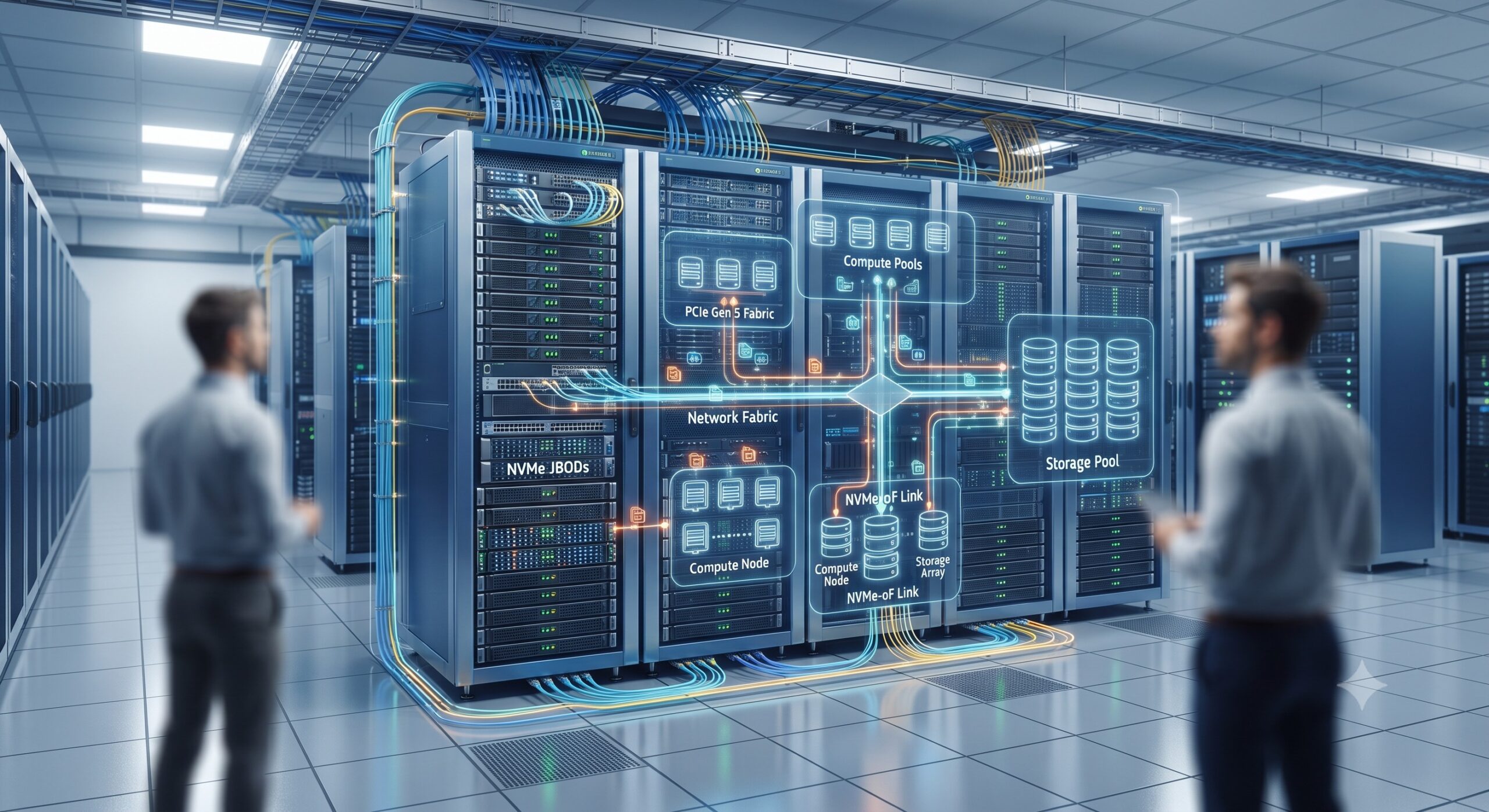
This architecture is heavily reliant on network performance. Moving data between layers requires significant bandwidth. The transition to NVMe-over-Fabrics (NVMe-oF), supporting both TCP and RoCEv2, is crucial for unleashing the potential of disaggregated storage. Nimbus Data’s FlashMax platform, for example, supports connectivity scaling up to 400GbE and includes protocol support for NVMe-oF, Fibre Channel, iSCSI, NFS, and S3 . This flexibility consolidates block, file, and object storage into a single namespace, reducing silos and simplifying capacity expansion .
| Key Parameter | Technical Specification |
|---|---|
| Switching Capacity (Forwarding Limit) | Up to 400 GbE per port, with support for 64G Fibre Channel |
| Latency (4K Random Write) | 80 µs (As low as) |
| IOPS (4 KiB) | 6.8M |
| Throughput (Sequential) | 100 GBps |
| Raw Capacity per System | Up to 21 PB (with expansion) |
| Network Protocols | NVMe-oF (TCP & RoCEv2), FC, iSCSI, NFS, SMB, S3 |
Logic Layer Deep Dive: The ASIC and Software-Defined Engine
The heart of a scalable storage system lies in its packet forwarding logic and data management layer. While legacy systems relied heavily on hardware RAID controllers, modern architectures leverage software-defined intelligence and custom ASICs to achieve line-rate performance.
Software-Defined Storage (SDS) and Performance
An empirical analysis of petascale all-flash systems has shown that software-defined storage (SDS) can dramatically outperform traditional hardware RAID. In a real system with 72 SSDs, the study found that SW-RAID could be up to 7 times faster than HW-RAID . However, this performance comes with caveats. As the number of SSDs increases, architectural bottlenecks such as limited I/O parallelism in SAS controllers and inter-enclosure handshaking can cause significant performance degradation . This underscores the need for intelligent software orchestration that understands and mitigates the physical limitations of scale-up hardware.
Dell’s PowerFlex platform exemplifies the new era of SDS, enabling independent scaling and seamless storage lifecycle management through a powerful software-defined engine . The platform’s ability to support high-performance workloads—including analytics, AI/ML, and containerized applications—demonstrates the value of decoupling intelligence from fixed-function hardware .
ASIC-Level Packet Processing and Forwarding Limits
Network latency and throughput are defined by the ASICs at the edge of the storage network. In a high-density data center, the cost and power of high-speed switches are significant. The latest generation of full-flash storage arrays leverage purpose-built processors to handle the immense I/O burden. For instance, the Supermicro Petascale line, leveraging the NVIDIA Grace CPU Superchip, is designed for AI workloads, offering 1 TB/s of memory bandwidth and deep integration with NVIDIA’s GDS and CUDA ecosystems . This hardware-level optimization is necessary to eliminate I/O bottlenecks and feed the ever-hungry GPUs.
Further pushing the boundaries of memory bandwidth and density, Compute Express Link (CXL) is emerging as a transformative technology. CXL enables memory pooling and expansion, allowing multiple processors to share a common memory pool . SK Hynix’s CMM-DDR5, for instance, has been shown to increase system bandwidth by 82% and capacity by 100% compared to DDR5-only systems, leading to a 31% improvement in AI token performance . This technology bypasses traditional memory expansion limits by disaggregating DRAM resources, dramatically lowering TCO and enabling support for massive datasets .
Tech Specs, Performance Metrics, and Industry Standards
To make informed architectural decisions, network architects rely on quantifiable benchmarks and rigorous industry standards. Below is a technical parameter matrix comparing leading platforms, illustrating the trade-offs between throughput, latency, and scalability.
Key Performance Metrics:
- Throughput: Measured in GBps or Gbps. Modern all-flash arrays target up to 100 GBps throughput .
- Latency: For the most demanding AI and financial workloads, latency as low as 80 µs is now achievable .
- IOPS: Random I/O performance. Top-tier systems can deliver up to 6.8 million IOPS for 4KiB blocks .
- Areal Density: For capacity scaling, Seagate’s Mozaic platform pushes areal density beyond 4 TB/disk, with second-gen HAMR drives qualified up to 44 TB . This translates to a 47% improvement in infrastructure efficiency per exabyte, reducing footprint and energy consumption .
Industry Standards & Compliance:
- IEEE & ITU-T: Adherence to IEEE 802.3 (Ethernet) and ITU-T G-series standards ensures interoperability in telecommunications environments.
- NVMe-oF: The protocol of choice for high-performance disaggregated storage, allowing data to travel between compute and storage nodes with low latency over TCP or RoCEv2.
- RoHS: Compliance with Restriction of Hazardous Substances is a basic requirement for enterprise hardware.
- CXL 2.0/3.0: Standards defining memory pooling and switching, vital for next-gen cache coherent fabrics .
Benchmark vs. Legacy: A Comparative Case Study
Evaluating the operational gains of modern architectures reveals the extent to which legacy systems are being outperformed. Consider the deployment of a scale-out distributed file system (PFS) for HPC and AI/ML workloads. The architectural problem often lies in the metadata node bottleneck. A classic scale-up approach could cap at about 5 GB/s throughput and struggle with latency .
In contrast, a disaggregated architecture like the one implemented by KingbaseES V9 has demonstrated a data throughput improvement from 5 GB/s to 45 GB/s for a 500 PB data lake . Complex analytical queries that took 30 minutes were completed in 45 seconds . This 9x performance gain stems from the ability to scale compute nodes independently without overwhelming the storage back-end, paired with compute down-push to reduce data movement .
Furthermore, studies on all-flash petascale systems warn that as SSD counts increase (e.g., a 144-SSD system), the raw IOPS can degrade due to backplane contention . This highlights why modern systems are moving to PCIe expansion shelves. Nimbus Data’s DirectLink PCIe expansion architecture, for instance, eschews traditional daisy-chained shelves to avoid oversubscription and stacking latency, directly attaching expansion capacity to the controllers via dedicated PCIe bandwidth .
Conclusion: The Future of Storage Scaling
The mandate for scalable storage in the data center is clear and unavoidable. The paradigm has shifted from simply stacking drives to designing intelligent, disaggregated, and software-defined architectures. As we look to the future, several key trends will dominate the storage landscape.
- AI as the Primary Driver: AI workloads require the extreme bandwidth and low latency that only modern architecture can provide. Technologies like CXL and PCIe 5.0 are no longer differentiators; they are baseline requirements for feeding the compute, as demonstrated by Supermicro’s Grace CPU integration .
- The Rise of QLC and High-Density HDDs: To manage TCO, tiered storage is essential. High-capacity HDDs (like Seagate’s 44 TB HAMR drives) remain the most cost-effective option for cold and warm data storage . Simultaneously, QLC flash, via partnerships like Pure Storage and SK Hynix, is emerging as a solution for high-density, active data tiers without sacrificing power efficiency .
- Operational Simplicity via Cloud-Style Management: The complexity of scale-out systems is being tamed by SaaS-based management platforms. HPE GreenLake, for instance, provides a consistent cloud experience for managing block, file, and object storage across heterogeneous environments, enabling data lifecycle policies and auto-tiering that reduce operational overhead .
- Mitigating the I/O Tax: Effective capacity planning must account for the real-world implications of rebalancing and rebuilds. Planning for a 70-75% utilization ceiling is crucial to maintain predictable performance .
In conclusion, the bottleneck is no longer the disk but the architecture. By embracing disaggregated models, optimizing the control plane, and leveraging high-speed interconnects, data centers can effectively scale to meet the demands of the next decade.

Leave a comment