

EXECUTIVE SUMMARY
Bidirectional (BIDI) optical transceiver technology represents a paradigm shift in fiber optic network infrastructure, enabling full-duplex communication over a single strand of standard single-mode fiber (SMF). By leveraging wavelength division multiplexing (WDM) techniques, BIDI transceivers effectively double the fiber utilization efficiency compared to traditional dual-fiber interfaces. This datasheet provides a comprehensive technical overview of our next-generation BIDI transceiver family, detailing the underlying WDM optical design, application-specific performance metrics, and integration best practices. Designed for carrier-grade and enterprise environments, these compact form-factor pluggable (SFP, SFP+, and QSFP) modules address the critical challenges of fiber exhaustion, spatial constraints, and operational expenditure (OPEX) in modern, high-density optical networks. This document serves as the definitive reference for network architects, procurement specialists, and systems engineers evaluating our BIDI solutions for passive optical networks (PON), 5G fronthaul/midhaul, and metro access aggregation.

ARCHITECTURE & CHASSIS DESIGN
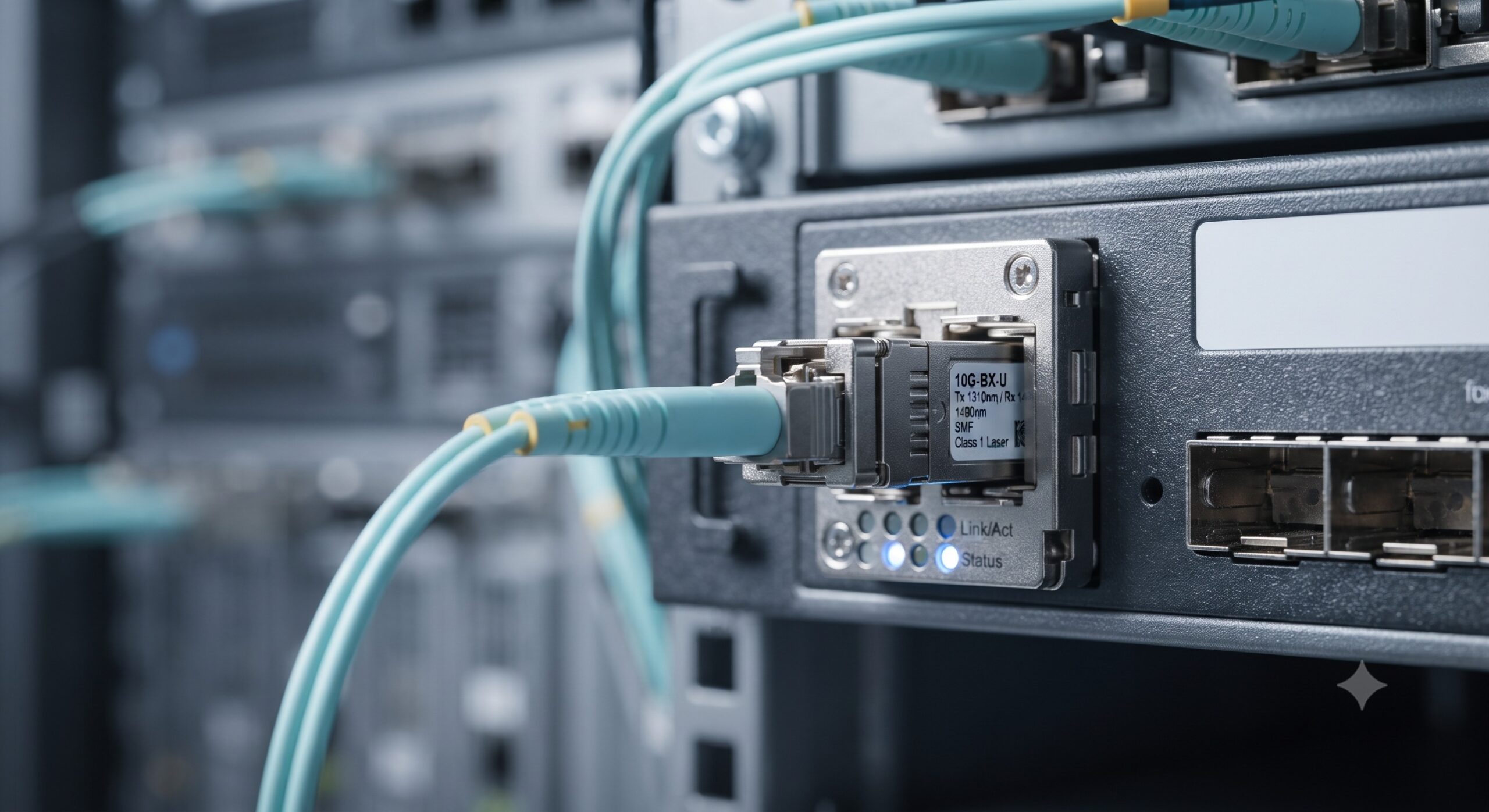
The foundational architecture of our BIDI transceiver is centered on an integrated optical sub-assembly (OSA) that combines a Fabry-Perot (FP) or Distributed Feedback (DFB) laser diode (LD), a photodetector (PD), and a wavelength-selective filter within a single, compact housing. The internal optical design utilizes a wavelength division multiplexing (WDM) coupler that isolates the transmit (Tx) and receive (Rx) paths. In practice, this allows a single fiber optic connector (LC simplex) to carry traffic in both directions. The product family is designed to accommodate a variety of standard form factors, including the ubiquitous Small Form-factor Pluggable (SFP) for 1G/2G/4G applications, SFP+ for 10G Ethernet and 8G Fibre Channel, and the higher-density Quad SFP (QSFP) for 40G and 100G parallel optics solutions. This flexible physical design ensures compatibility with a wide range of existing chassis, line cards, and fixed-configuration switches from leading hardware OEMs.
HARDWARE FEATURES
– WDM Optical Engine: The core of each device incorporates a precision WDM filter (typically 1310nm Tx / 1490nm Rx, or 1490nm Tx / 1550nm Rx, or 1310nm Tx / 1550nm Rx). This passive filter is the critical component that enables the simultaneous transmission and reception of optical signals on a single fiber. The performance of this filter is characterized by high isolation (typically >30dB) to prevent optical crosstalk and ensure data integrity. The laser source is a temperature-stabilized, high-power DFB laser designed to support extended reaches of up to 40km on 9/125 µm single-mode fiber. The receiver path consists of a high-sensitivity PIN photodiode or Avalanche Photodiode (APD) paired with a Transimpedance Amplifier (TIA) to convert photocurrent to a differential voltage for the CDR (Clock and Data Recovery) stage.
– Digital Diagnostic Monitoring (DDM): Full support for industry-standard DDM interfaces (I2C bus) is provided, allowing the host system to perform real-time monitoring of key parameters, such as temperature, supply voltage, laser bias current, transmitted optical power, and received optical power. This feature is critical for implementing proactive maintenance strategies, monitoring link budgets, and troubleshooting fiber plant degradation. The SFF-8472 and SFF-8636 MSA are fully supported to guarantee interoperability across vendor platforms.
– Hot-Pluggable Interface: All units are hot-pluggable, complying with the SFF MSA and allowing for field-replaceable upgrades, maintenance, and scaling without requiring a full system power-down, thereby maximizing network uptime.
COMPLIANCE & STANDARDS
Our BIDI transceivers are engineered for strict compliance with international standards to ensure seamless interoperability and reliability in diverse network environments. Key certifications and standards include:
– MSA Compliance: SFF-8472, SFF-8431, SFP+ MSA, QSFP MSA.
– IEEE 802.3: Compliance for 1000BASE-BX (1G) and 10GBASE-BX (10G) Ethernet standards.
– ITU-T G.652: Compliance with standard single-mode fiber specifications.
– RoHS (Restriction of Hazardous Substances): Fully compliant with RoHS 2.0 directives.
– FDA/CDRH Class 1 Laser Safety: Certified as a Class 1 laser product, indicating that the emitted optical radiation is safe under normal operation.
TECHNICAL SPECIFICATIONS
Operating Case Temperature: Standard (0°C to +70°C), Extended (-40°C to +85°C available for industrial-grade applications).
Data Rate Options: 125 Mbps to 10 Gbps per channel, with 40 Gbps and 100 Gbps solutions available in the QSFP form factor.
Tx Wavelength Options: 1310nm, 1490nm, 1550nm, 1270nm/1330nm for CWDM variants.
Link Budget: Up to 11dB for standard 10km reach, >20dB for 40km long-haul variants.
Power Dissipation: Typically
Parameter
Specification
ORDERING OPTIONS
Part Number | Data Rate | Tx/Rx Wavelength (nm) | Reach (km) | Operating Temp | Application
BIDI-SFP-1G-10 | 1.25 Gbps | 1310 / 1490 | 10 | 0°C to 70°C | 1000BASE-BX
BIDI-SFP-1G-40 | 1.25 Gbps | 1310 / 1550 | 40 | 0°C to 70°C | 1000BASE-BX
BIDI-SFP+-10G-20 | 10.31 Gbps | 1330 / 1270 | 20 | 0°C to 70°C | 10GBASE-BX
BIDI-SFP+-10G-40 | 10.31 Gbps | 1490 / 1550 | 40 | -40°C to +85°C | Carrier 5G Fronthaul
BIDI-QSFP-40G | 40 Gbps | 1310 / 1490 | 10 | 0°C to 70°C | 40GBASE-BX
📥 Download Technical Specification
Click the button below to view or download the full official PDF datasheet.

Leave a comment