
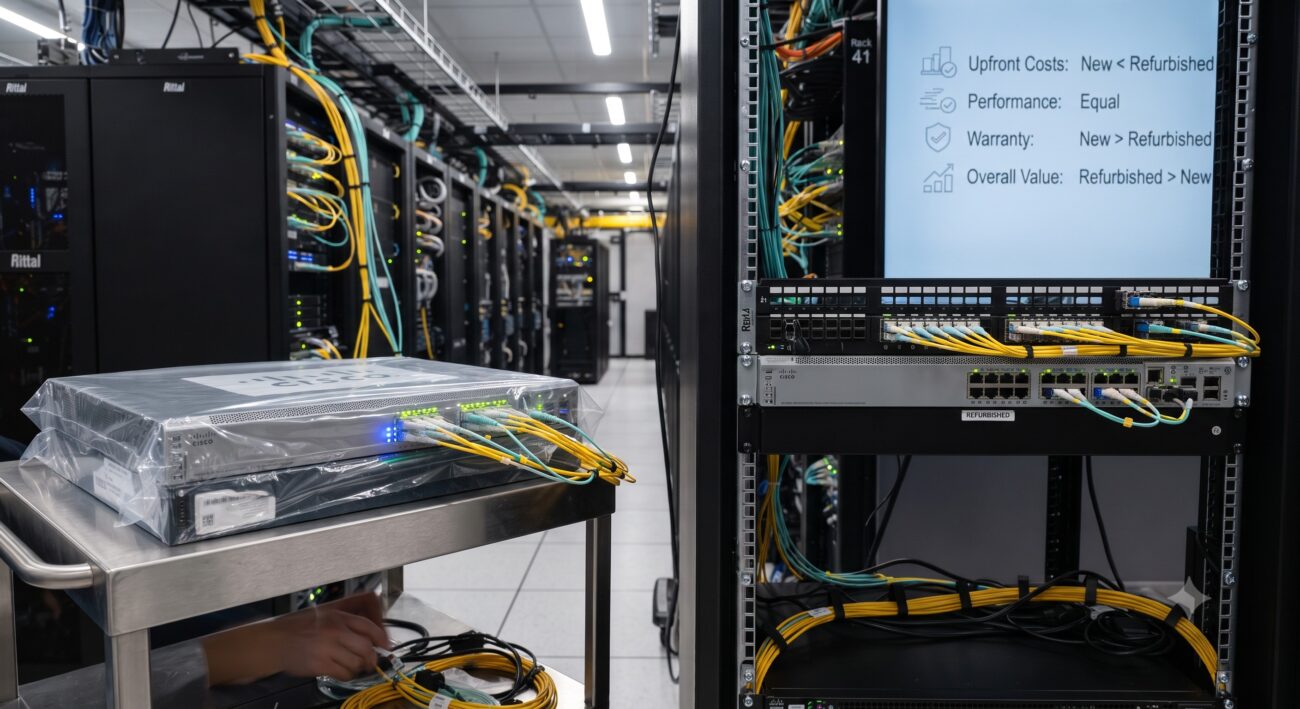
Executive Pain Points: The Telecom Hardware Investment Dilemma
As a senior network architect, I’ve witnessed firsthand the pressure on procurement and engineering teams to balance performance, reliability, and budget. The decision to buy new vs used telecom equipment is not a simple cost comparison; it’s a strategic choice that impacts your network’s TCO, operational agility, and risk profile. This guide provides a data-driven, executive-level analysis of the Total Cost of Ownership (TCO), weighing the CapEx savings of used equipment against the OpEx and long-term value of new, warranty-backed hardware. We will dissect the key factors, from MTBF and support contracts to compliance and lifecycle management, enabling you to make the most financially and technically sound decision for your infrastructure .
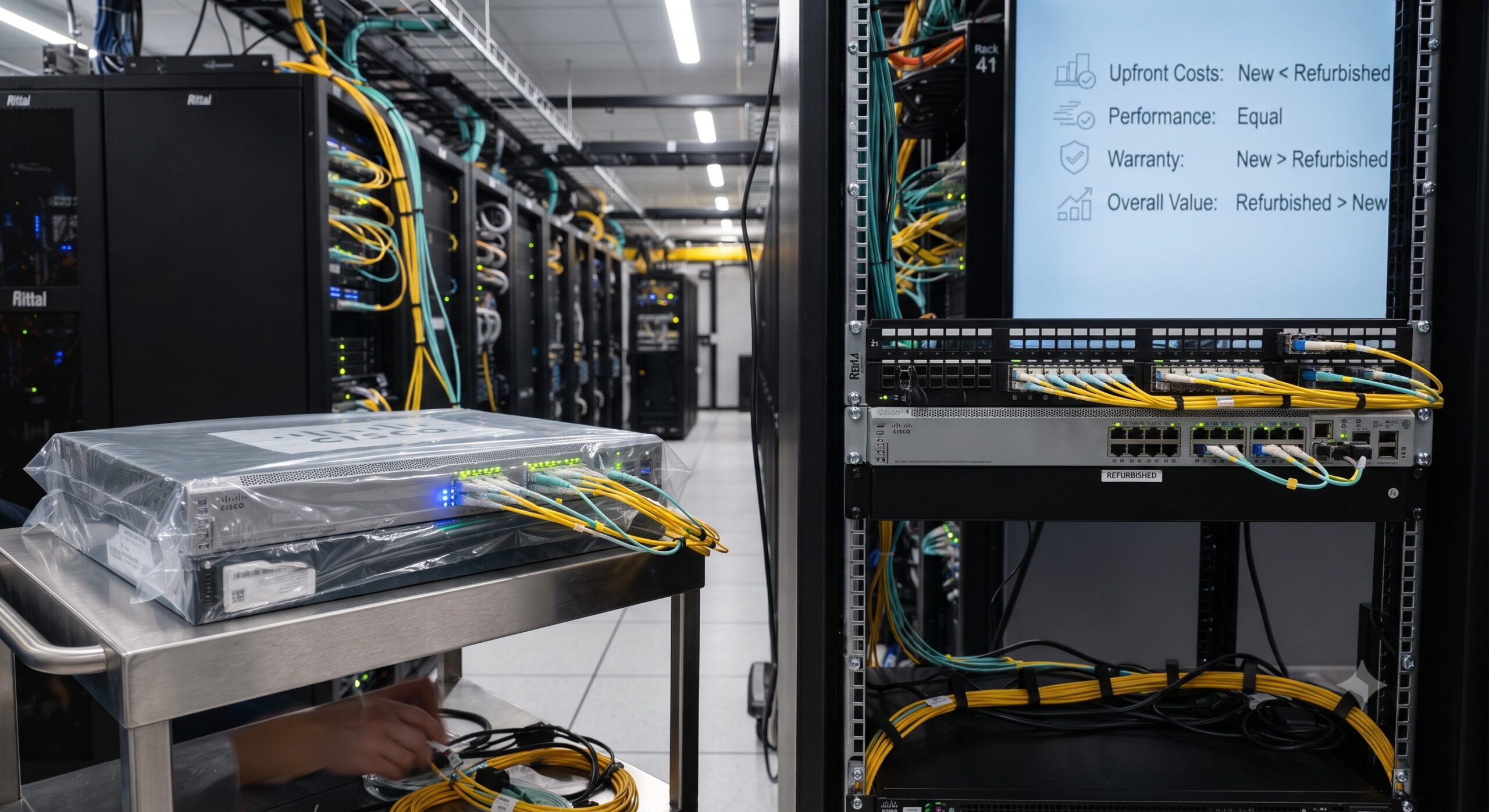
CapEx vs OpEx Analysis: The Financial Framework
The primary allure of the secondary market is the significant CapEx reduction. Customers typically save 50-95% compared to new OEM pricing, driven by rapid technology depreciation cycles, not a decline in functional quality . For instance, a new high-end core switch might cost $250,000, while a refurbished unit of the previous generation could be acquired for $25,000. For budget-constrained projects, greenfield deployments, or temporary network expansions, this upfront savings is transformative.
However, the OpEx picture is more nuanced. New equipment from Original Equipment Manufacturers (OEMs) usually includes a 1-3-year warranty and, critically, access to software, firmware updates, and support contracts. These are often essential for security patches, new features, and maintaining network stability. Without an active support contract, you are locked out of crucial updates, which can create security vulnerabilities and operational limitations . Used equipment’s warranty and support come from the third-party seller, not the OEM, and terms vary significantly. While third-party maintenance (TPM) can be cost-effective, it may not provide the same level of service or access to software entitlements as OEM support . The Total Cost of Ownership (TCO) model must therefore account for the cost of a support contract over the equipment’s useful life.
Lifecycle Cost Modeling
A comprehensive TCO analysis for critical infrastructure must factor in power consumption, maintenance costs, and the cost of downtime. A new, energy-efficient ASIC might save thousands in annual power costs over a 5-year lifespan, offsetting some of the initial CapEx. Conversely, a used unit that fails due to undocumented prior stress or an unknown fault could lead to costly downtime and emergency replacement. The Mean Time Between Failures (MTBF) is a critical metric . While the statistical MTBF might remain the same, a used unit’s risk profile is higher due to an unknown operational history. A rule of thumb is to calculate the Return on Investment (ROI) as the net savings (CapEx savings + OpEx savings) divided by the total investment, while also scoring risk factors such as the criticality of the device in your network topology.
Hardware Efficiency: ASIC, Architecture, and Performance
When evaluating new vs used, the underlying hardware architecture is paramount. New telecom equipment, especially in the core routing and switching space, features the latest generation of Application-Specific Integrated Circuits (ASICs). These custom chips are engineered for specific packet-forwarding tasks, delivering unparalleled performance in terms of Gbps throughput, ultra-low latency (measured in nanoseconds), and advanced features like in-band network telemetry (INT) or line-rate MACsec encryption .
Used equipment, often from the previous generation, might lack these advancements. Its ASIC might not support the same forwarding table sizes, Virtual Extensible LAN (VXLAN) tunnel termination count, or the latest high-density 400G/800G optics. This is a crucial consideration for high-density datacenter scaling . While a used chassis might be a perfect fit for a non-critical distribution layer or a lab environment, deploying it in a core routing role could create a bottleneck. For critical production networks, investing in new hardware ensures you have the headroom to support growing bandwidth demands and advanced protocols for the next 5-7 years. Always check the IEEE and ITU-T compliance matrix for the hardware version, as new equipment will support the latest standards, ensuring interoperability.
| Parameter | New Equipment | Used/Refurbished Equipment |
|---|---|---|
| Upfront CapEx | 100% OEM price | 50-95% Savings |
| Warranty | 1-3 year OEM warranty | Varies; often limited lifetime from third-party |
| Support & Licensing | Full OEM support, software updates, and entitlements | Third-party support, may lack OEM software entitlements |
| Performance (ASIC/Gbps) | Latest generation, highest throughput, lowest latency | Previous generation, lower throughput/table sizes |
| Risk Profile | Lowest (known history, factory-new) | Moderate-High (unknown history, provenance, counterfeit risk ) |
| Best Use Case | Core routing, mission-critical infrastructure, high-density datacenter | Lab/staging, DR, edge deployments, budget-conscious projects |
Performance Specs and Key Metrics
The following table summarizes the critical technical differentiators that drive the TCO decision.
| Parameter | New Equipment | Used/Refurbished Equipment |
|---|---|---|
| Upfront CapEx | 100% OEM price | 50-95% Savings |
| Warranty | 1-3 year OEM warranty | Varies; often limited lifetime from third-party |
| Support & Licensing | Full OEM support, software updates, and entitlements | Third-party support, may lack OEM software entitlements |
| Performance (ASIC/Gbps) | Latest generation, highest throughput, lowest latency | Previous generation, lower throughput/table sizes |
| Risk Profile | Lowest (known history, factory-new) | Moderate-High (unknown history, provenance, counterfeit risk ) |
| Best Use Case | Core routing, mission-critical infrastructure, high-density datacenter | Lab/staging, DR, edge deployments, budget-conscious projects |
Datacenter Integration and Deployment Scenarios
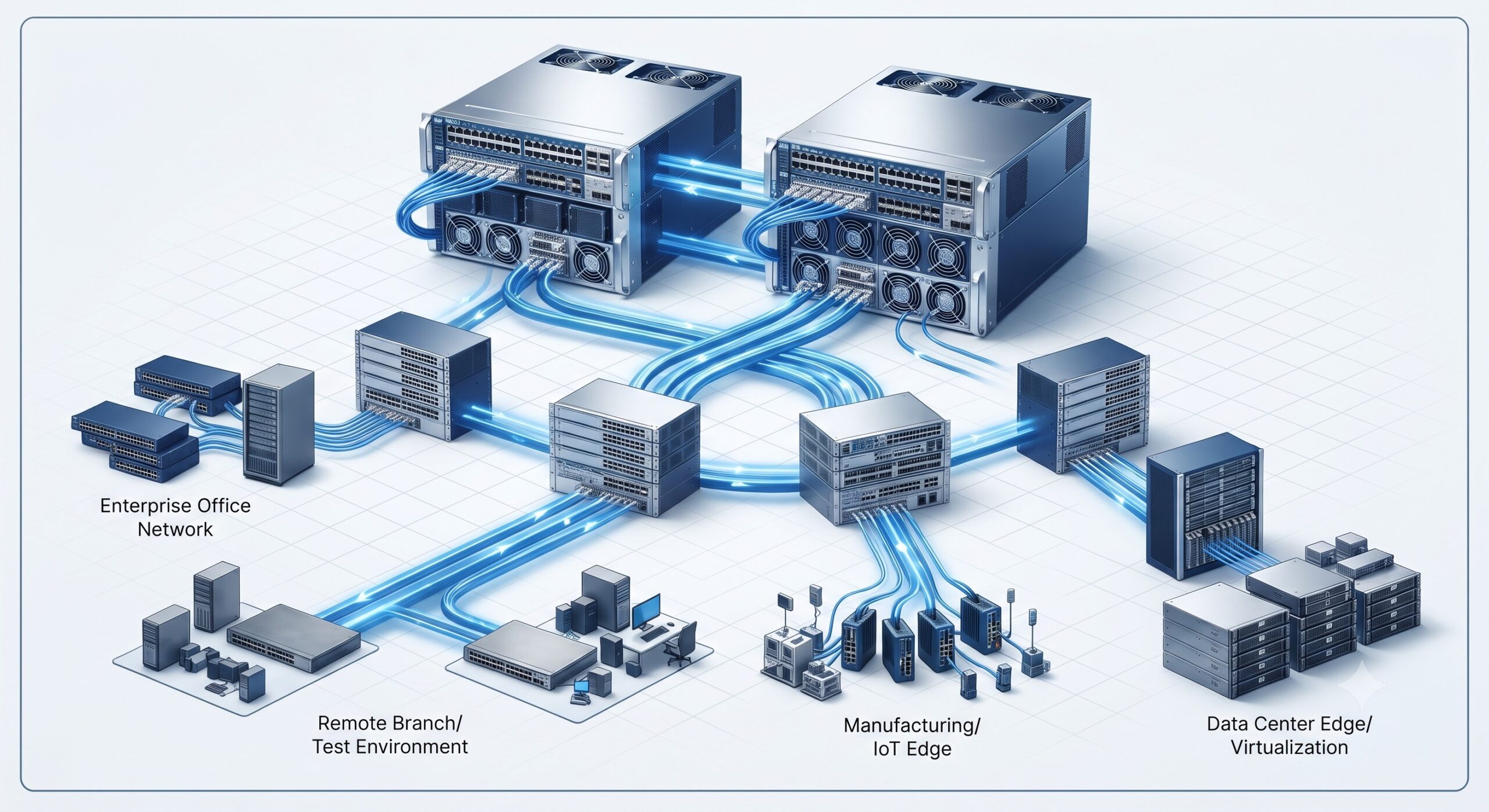
The most effective strategy often involves a hybrid procurement model, balancing the strengths of new and used equipment. For tier-1 applications—core routing, spine switches in a leaf-spine architecture, and high-performance storage networks—new equipment is the recommended investment. This ensures maximum performance, best-in-class latency, and full software entitlements for advanced features like segment routing or network slicing. Furthermore, a new purchase guarantees a known maintenance and support history, which is critical for mission-critical infrastructure.
Conversely, used equipment shines in scenarios where performance requirements are less stringent or where the cost of new hardware is prohibitive. This includes lab environments for pre-production testing, staging networks, or disaster recovery (DR) sites that are not active but must maintain readiness. Used hardware is also an excellent choice for edge deployments like Baseband Units (BBUs) in remote cell sites, where a shorter lifecycle is acceptable, and the CapEx savings are substantial . For network interface cards (NICs), used units can offer 40-70% savings, making them highly attractive for large-scale server refreshes or for supporting legacy server infrastructure with obsolete PCI and PCI-X slots .
For the secondary market, OEM-remanufactured equipment (e.g., Cisco Refresh) provides a middle ground. These devices are restored to original factory specifications and often remain eligible for OEM support and software updates, offering a level of assurance closer to new equipment than a third-party refurbishment .
Risk Mitigation and Vendor Due Diligence
The allure of deep discounts in the used market comes with inherent risks. The primary concern is the provenance of the hardware. Used or refurbished devices may be associated with a previous user’s network, making them difficult to provision . More concerning are the risks of receiving counterfeit hardware, units with missing or incorrect components (like power supplies), or devices that have not been rigorously tested.
To mitigate these risks, a strict vendor qualification process is essential. Reputable third-party suppliers offer a documented testing process and a warranty—often a limited lifetime warranty for hardware, with flexible, SLA-based support options from 8×5 NBD to 24x7x365 . Key due diligence steps include:
- Always request the serial number before purchase and verify it with the OEM. A refusal is a major red flag .
- Demand a documented testing protocol that details the burn-in process, not just a generic ‘fully tested’ claim .
- Ensure you have a clear, written warranty and Return Material Authorization (RMA) process in place.
- Verify the vendor’s trading history, physical address, and industry standing (e.g., UNEDA membership) .
- In a procurement process, request samples for functional benchmarking and inspection before committing to a large-volume order .
These steps protect your investment and ensure that the CapEx savings from used equipment do not translate into OpEx losses from unplanned downtime.
Lifecycle Verdict: A Hybrid Future
The ‘new vs used’ debate is not a binary choice but a strategic exercise in portfolio optimization. The data shows a clear path forward: deploy new, high-performance hardware with full OEM warranties and support in the critical core and for essential networking functions like routing, security, and high-density switching. This ensures peak performance, access to the latest features, and the lowest risk profile for your most critical assets.
Conversely, use the secondary market for non-critical roles—test and development, staging, disaster recovery, and edge deployments with shorter lifespans—to capture significant CapEx savings. By implementing a rigorous vendor qualification process, you can safely and effectively leverage the cost advantages of used equipment without compromising the integrity of your network. This hybrid model maximizes your network’s ROI, providing a balanced approach to capital allocation and operational efficiency.

Leave a comment