

EXECUTIVE SUMMARY
Bidirectional (BiDi) transceiver technology represents a paradigm shift in optical network infrastructure, enabling full-duplex data transmission over a single optical fiber strand. By leveraging Wavelength Division Multiplexing (WDM), BiDi modules effectively double the capacity of existing fiber plants while reducing capital and operational expenditures. This document provides a comprehensive technical overview of BiDi transceiver architecture, operational principles, performance specifications, and application scenarios for carrier-grade and enterprise network deployments. As bandwidth demands continue to accelerate, BiDi technology offers a strategic solution to fiber scarcity, infrastructure cost management, and network scalability challenges .

ARCHITECTURE & CHASSIS DESIGN
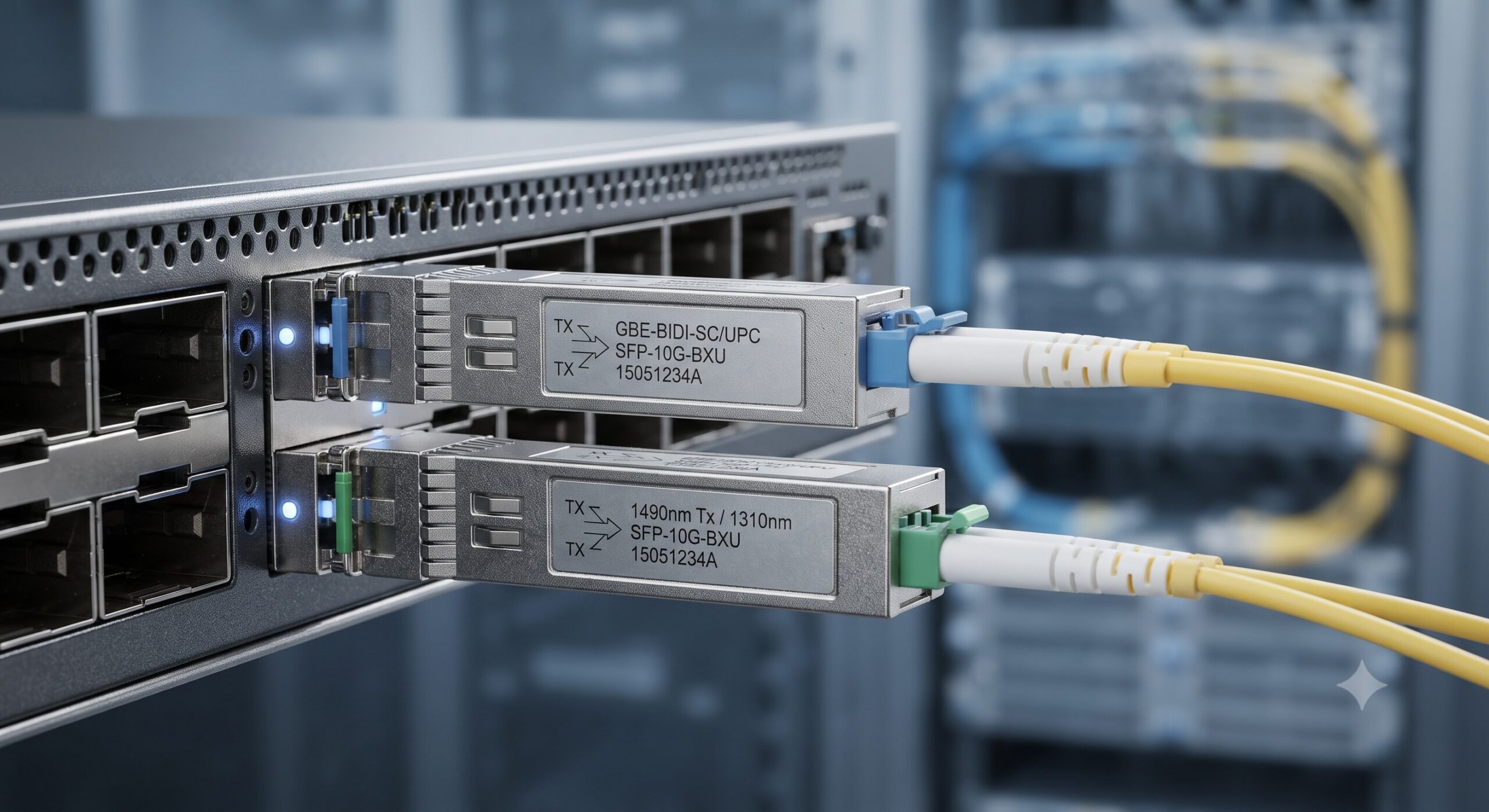
The fundamental architecture of a BiDi transceiver is distinguished by its Bidirectional Optical Sub-Assembly (BOSA), which integrates a laser transmitter, a photodiode receiver, and a WDM filter into a single optical subassembly . This integrated design allows the BiDi module to transmit and receive optical signals on different wavelengths through a single simplex LC or SC connector interface .
Wavelength Division Multiplexing (WDM) is the core enabling technology for BiDi modules. The WDM coupler, also known as a diplexer, separates and combines data transmitted over a single fiber based on wavelength . The internal WDM filter is typically implemented using thin-film coating technology, allowing the module to transmit on one wavelength while receiving on a different, spectrally separated wavelength to prevent signal interference .
Crucially, BiDi transceivers must be deployed in matched pairs with complementary wavelength configurations. For example, a module transmitting at 1310 nm and receiving at 1550 nm must be paired with a module transmitting at 1550 nm and receiving at 1310 nm at the opposite end of the link . This wavelength complementarity ensures proper bidirectional communication over the single fiber link .
HARDWARE FEATURES
BiDi transceiver modules are available in a comprehensive range of form factors and data rates to support diverse network requirements:
– Form Factor Support: SFP (1G), SFP+ (10G), SFP28 (25G), QSFP+ (40G), QSFP28 (100G), and emerging QSFP-DD/OSFP for 400G and 800G applications
– Data Rate Capabilities: From 155 Mbps to 800 Gbps, supporting Ethernet, Fibre Channel, and CPRI protocols
– Wavelength Combinations: Common pairs include 1310/1550 nm, 1310/1490 nm, 1270/1330 nm, and CWDM channel pairs for longer reach applications
– Transmission Distances: Ranging from 100 meters over multimode fiber to 80+ kilometers over single-mode fiber
– Connector Types: Simplex LC (most common), SC, or duplex LC for QSFP form factors
All modules incorporate digital diagnostic monitoring (DDM) features compliant with SFF-8472 standards, providing real-time visibility into parameters such as temperature, supply voltage, bias current, transmit power, and receive power .
COMPLIANCE & STANDARDS
BiDi transceiver modules conform to a comprehensive suite of industry standards:
– SFP/SFP+ MSA (Multi-Source Agreement) compliance ensures interoperability across a wide range of network equipment
– IEEE 802.3ah-2004 (1000BASE-BX) for Gigabit Ethernet single-fiber communications
– ITU-T G.959 and G.691 compliance for optical interface standards
– GR-253-CORE for SONET/SDH network equipment compliance
– Class 1 laser safety compliant with IEC 60825 international safety standards
– RoHS (Restriction of Hazardous Substances) compliant
– Hot-pluggable design allowing module insertion or removal without network interruption
TECHNICAL SPECIFICATIONS
| Parameter | Specification |
|---|---|
| Form Factor | SFP, SFP+, SFP28, QSFP+, QSFP28 |
| Data Rate Range | 155 Mbps to 800 Gbps |
| Wavelength Pairs | 1310/1550 nm, 1270/1330 nm, 1490/1550 nm, CWDM |
| Transmission Distance | Up to 80+ km (Single-Mode Fiber) |
| Connector Type | Simplex LC or SC |
| Operating Temperature | Commercial: 0°C to +70°C | Industrial: -40°C to +85°C |
| Power Supply | Single +3.3V DC |
| Laser Type | FP/DFB Laser Diode |
| Receiver Type | PIN or APD Photodiode |
| Digital Monitoring | SFF-8472 Compliant DDM |
| Safety Standard | Class 1 Laser, IEC 60825 Compliant |
| Environmental Compliance | RoHS Compliant |
ORDERING OPTIONS
BiDi transceivers are available in multiple operating temperature grades to accommodate various deployment environments:
– Commercial (C-TEMP): 0°C to +70°C for standard enterprise and data center environments
– Extended (E-TEMP): -20°C to +85°C for outdoor and uncontrolled environments
– Industrial (I-TEMP): -40°C to +85°C for extreme environments such as industrial and outdoor deployments
The modules support both single-mode fiber (SMF) for long-distance links and multimode fiber (MMF) for short-reach applications, with specific wavelength combinations optimized for each fiber type .
📥 Download Technical Specification
Click the button below to view or download the full official PDF datasheet.

Leave a comment