

EXECUTIVE SUMMARY
This document serves as the definitive technical reference for RAID (Redundant Array of Independent Disks) configuration and best practices within enterprise-class storage subsystems. As storage densities escalate and data throughput requirements intensify, the strategic deployment of RAID levels becomes paramount to achieving optimal balance between performance, data availability, and storage efficiency. This guide provides comprehensive hardware-level specifications, configuration methodologies, and operational best practices tailored for integration with next-generation server and storage platforms. Network engineers, systems architects, and storage administrators will find detailed parameterization of controller features, drive interface topologies, and fault-tolerance mechanisms essential for designing resilient, high-performance storage infrastructures.

ARCHITECTURE & CHASSIS DESIGN
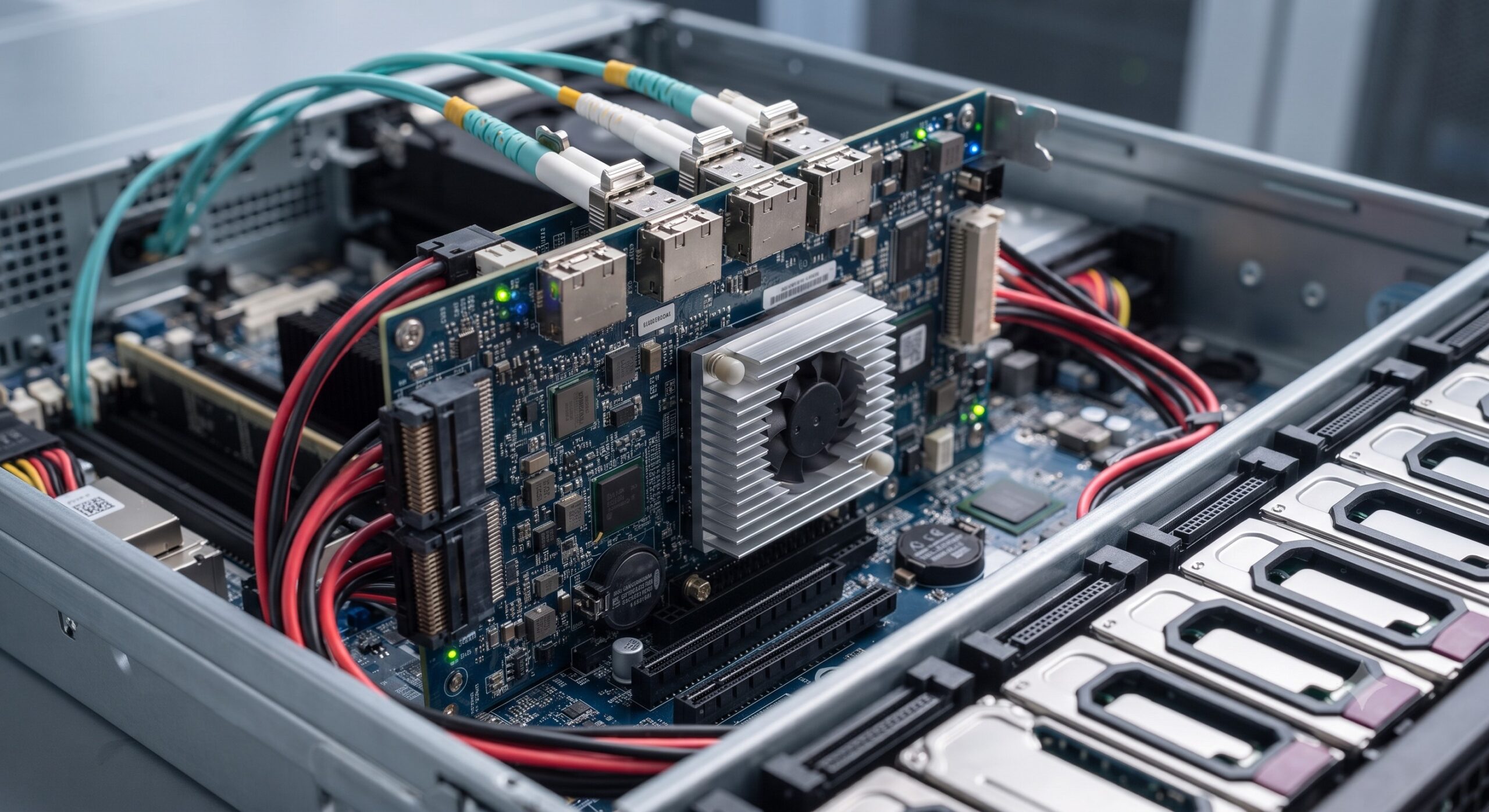
The foundational hardware architecture for RAID implementation centers upon a dedicated, high-performance RAID controller or integrated System-on-Chip (SoC) solution. The controller acts as an intelligent bridge between the host system’s I/O bus and the physical storage devices. Key architectural components include a high-speed PCIe host interface, a powerful multi-core processor for parity computation and XOR offload, and a robust memory subsystem dedicated to cache operations. Contemporary chassis designs accommodate a variety of form factors, ranging from compact 1RU enclosures with space-efficient internal disk bays to expansive 4RU and larger rack-mounted storage arrays supporting dense configurations of 3.5-inch and 2.5-inch drives. Backplane architecture is pivotal, incorporating high-speed SAS expanders or tri-mode (SAS/SATA/NVMe) bridges to facilitate connectivity to a diverse set of storage media. Redundant, hot-swappable power supply units and cooling fan modules are engineered to deliver carrier-grade reliability, ensuring continuous operation within stringent thermal and power envelopes.
HARDWARE FEATURES
RAID controllers are distinguished by a suite of advanced hardware features that underpin their operational capabilities. The cache memory, typically comprising DDR4 or DDR5 ECC-protected DRAM, is critical for write-back and read-ahead operations, significantly accelerating I/O performance. Advanced Battery Backup Units or Supercapacitor-based Flash Backup Modules are integrated to protect data in flight during unplanned power interruptions, enabling the secure flush of write-back cache to non-volatile storage. Hardware-assisted RAID engines offload parity generation for RAID 5, 6, and 50/60, liberating host CPU cycles for application processing. High-end controllers support PCIe 4.0 or 5.0 interfaces to maximize bandwidth to the host, while front-end drive interfaces often include support for SAS, SATA, and NVMe protocols, providing ultimate flexibility. Management interfaces, such as a dedicated out-of-band network port for remote administration, coupled with onboard diagnostics and LED status indicators, provide granular insight into controller health, drive status, and environmental parameters.
COMPLIANCE & STANDARDS
RAID controller hardware and its integration into storage systems adhere to a rigorous set of industry standards and compliance mandates. On a fundamental level, controllers are validated against the PCI-SIG specifications for host bus interoperability and the Serial Attached SCSI (SAS) and Serial ATA (SATA) standards for drive communication. For NVMe deployment, compliance with the NVM Express specifications is mandatory. From a regulatory standpoint, products are certified to meet electromagnetic interference standards, including FCC Part 15 Subpart B (Class A) and CE marking (EN 55032/EN 55035). Safety certifications, such as UL/cUL (UL 60950-1/UL 62368-1) and CB Scheme (IEC 60950-1/62368-1), ensure the equipment’s electrical safety. For environmental compliance, the design adheres to RoHS (Restriction of Hazardous Substances) and WEEE (Waste Electrical and Electronic Equipment) directives. Key industry interoperability certifications, such as VMware vSAN ReadyNode, Microsoft Windows Server Hardware Compatibility, and Red Hat Enterprise Linux certification, ensure seamless integration into diverse enterprise ecosystems.
TECHNICAL SPECIFICATIONS
The following table details the core technical parameters and specifications applicable to a reference enterprise-class RAID controller. Values serve as representative performance baselines and capabilities that can be validated in actual hardware deployments.
| Parameter | Specification |
|---|---|
| Form Factor | Half-Height, Half-Length (HHHL) and Full-Height, Half-Length (FHHL) |
| Host Interface | PCIe 4.0 / 5.0 x8, (up to 16 GT/s) compliant |
| Drive Interface | Tri-Mode: SAS-3 (12 Gbps), SATA-3 (6 Gbps), NVMe (PCIe 3.0/4.0) |
| Cache Memory | 4GB / 8GB DDR4-3200 ECC, upgradable |
| Cache Protection | Supercapacitor + Flash Backup Module (optional) |
| Onboard RAID Engine | Hardware XOR Parity Offload and Data Integrity Check |
| Max Drives Supported | Up to 240 via SAS Expander / 8 Direct-attach NVMe |
| RAID Levels Supported | 0, 1, 5, 6, 10, 50, 60 |
| Advanced Features | Online Capacity Expansion, Global/ Dedicated Hot Spares, SSD Guard |
| Operating Temperature | 0°C to 55°C (32°F to 131°F) |
| Power Consumption | Typical: 25W, Maximum: 35W |
ORDERING OPTIONS
The naming convention for RAID controller product families is constructed to convey salient features and intended deployment scenarios. Base SKUs typically include the controller card itself, with standard-height and low-profile bracket options to accommodate different chassis types. Advanced models may include onboard supercapacitor modules for cache protection, with the cache size being a key differentiation point (e.g., 2GB, 4GB, or 8GB). Software licensing tiers are critical and often unlock advanced features: Standard licenses include core RAID levels 0, 1, 10, 5, and 50. Advanced licenses (SKU suffix -ADV) add RAID 6 and 60. Premium licenses (SKU suffix -PRE) include RAID 6, 60, SSD Guard, and online capacity expansion. Cache protection options are offered as separate accessory bundles (SKU suffix -BP) to facilitate custom configurations. Field-upgradeable options for cache memory, battery backup units, and transceivers are available to adapt hardware to evolving workload requirements, providing flexibility for long-term infrastructure investment protection.
📥 Download Technical Specification
Click the button below to view or download the full official PDF datasheet.

Leave a comment