
Overview & Thematic Scope
Choosing between UPC (Ultra Physical Contact) and APC (Angled Physical Contact) fiber connectors is a critical decision that impacts the performance, reliability, and cost of your optical network. This technical FAQ addresses the key differences, from physical end-face geometry and return loss specifications to compatibility rules and application-specific deployment guidelines. Whether you are designing a high-density data center, a passive optical network (PON), or a long-haul link, understanding these distinctions is essential for preventing signal degradation and equipment damage .
Frequently Asked Questions
- Q1: What is the fundamental physical difference between UPC and APC fiber connectors?
- The fundamental difference is the end-face geometry. A UPC connector features a slightly rounded, dome-shaped end face polished at a 0-degree angle . In contrast, an APC connector has an end face polished at an industry-standard 8-degree angle . This physical distinction is designed to address how light is reflected at the connection point.
- Q2: Why is return loss (ORL) significantly better on APC connectors compared to UPC connectors?
- APC connectors achieve superior return loss performance because their 8-degree angle directs reflected light into the fiber cladding, rather than back towards the light source . The industry standard for UPC return loss is -50 dB or greater, while APC connectors are rated at -60 dB or greater . In field applications, APC mated pairs can often achieve -65 dB or better, compared to approximately -55 dB for UPC connections . This makes APC the preferred choice for analog video, high-wavelength RF signals, and systems with high-power lasers that are sensitive to back reflections .
- Q3: Can I connect an APC connector directly to a UPC connector?
- Absolutely not. UPC and APC connectors are physically incompatible and should never be mated . Attempting to connect them will not only cause extremely high insertion loss and signal failure due to core misalignment, but it can also cause permanent physical damage to the delicate fiber end faces . You must always connect UPC to UPC and APC to APC.
- Q4: How do I visually identify the difference between a UPC and an APC connector?
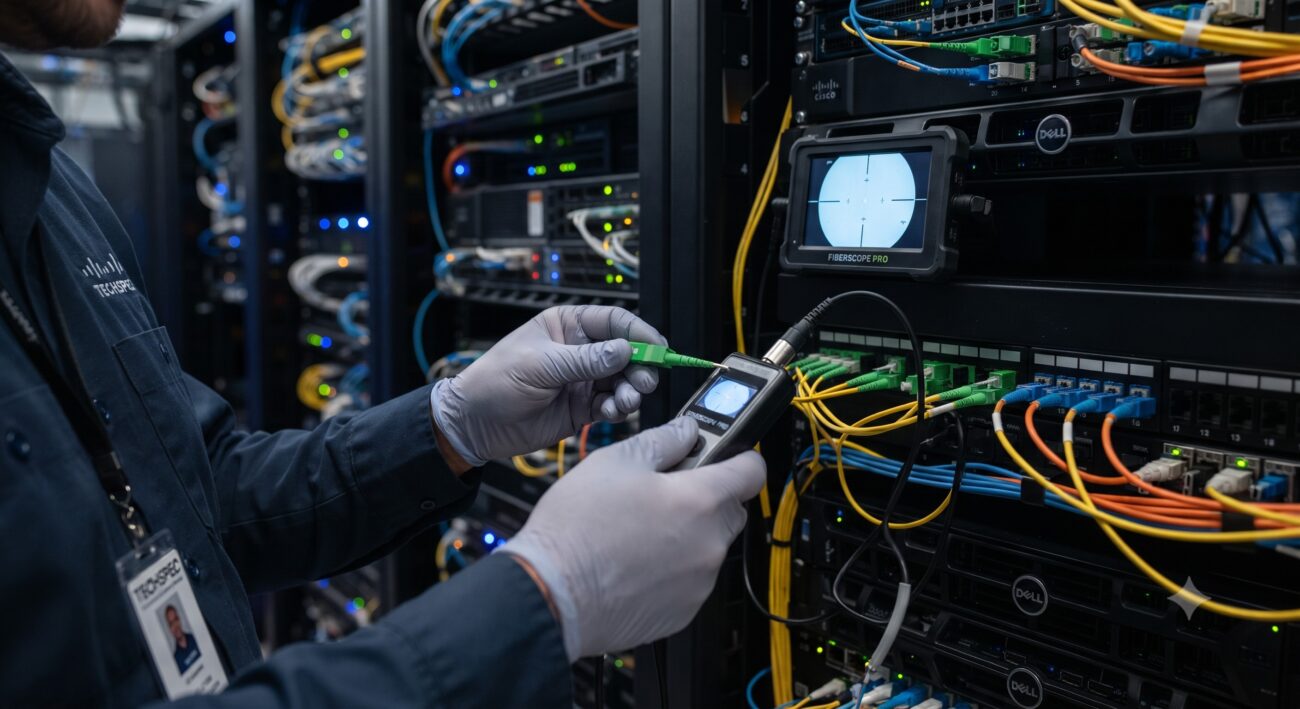
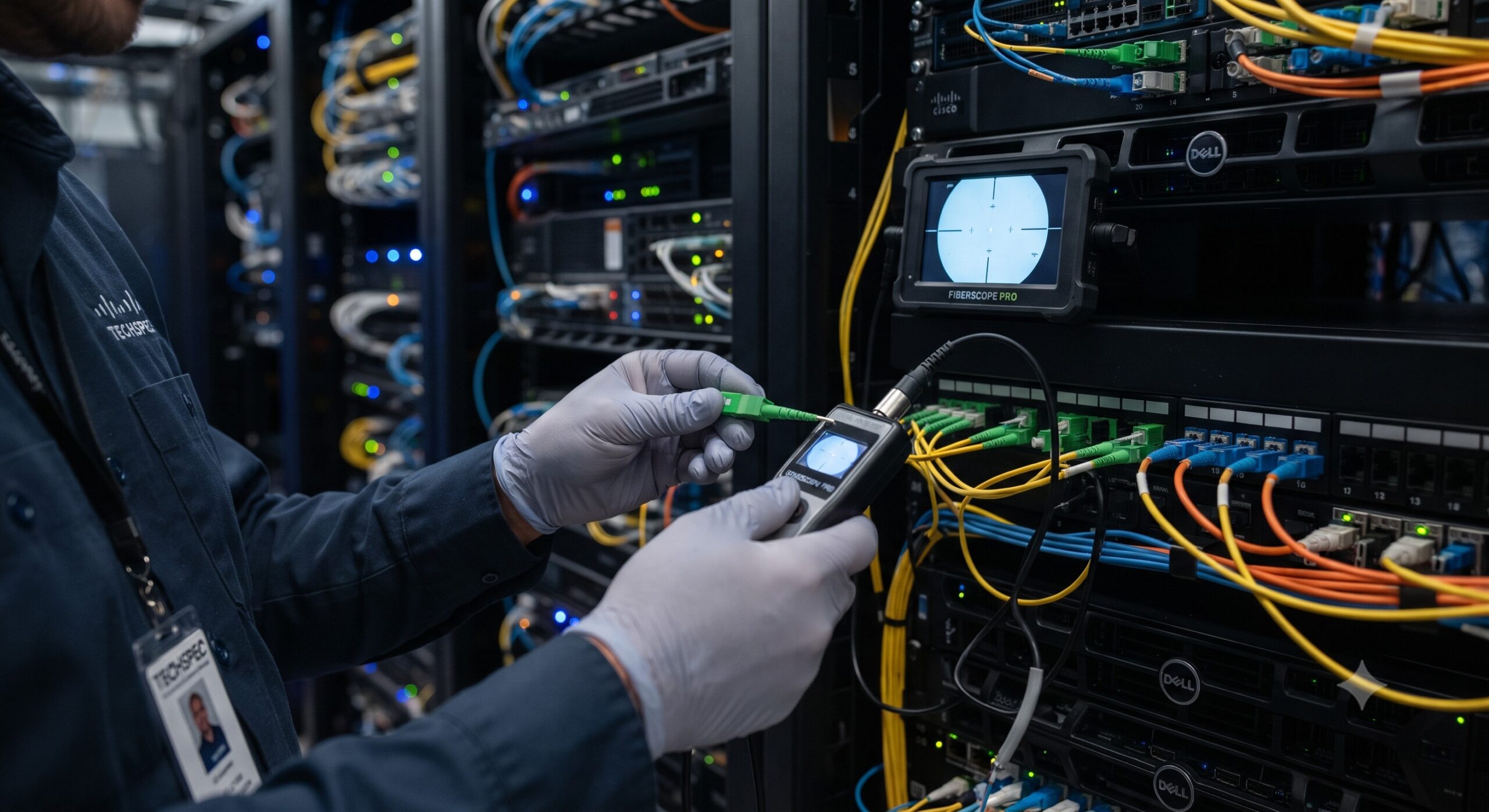
- The most reliable visual identifier is the color of the connector body or boot. In standard industry practice, UPC connectors are typically blue, while APC connectors are green . This color-coding was adopted to prevent accidental mismating . It is also common to see the label “/APC” or “/UPC” printed on the connector boot or cable jacket.
- Q5: Which applications typically require APC connectors, and where are UPC connectors preferred?
- APC connectors are essential for applications highly sensitive to return loss. These include Passive Optical Networks (PON/GPON), FTTx deployments, RF video (CATV) transmission, and WDM systems operating at higher wavelengths (above 1500 nm) . Conversely, UPC connectors remain the standard for most enterprise LANs, data center interconnects (using single-mode fiber), and digital telephony systems where return loss requirements are less stringent .
- Q6: Is insertion loss different between UPC and APC connectors?
- Historically, APC connectors were more difficult to manufacture, sometimes resulting in higher insertion loss. However, modern manufacturing improvements have largely eliminated this difference . Currently, both connector types typically achieve an insertion loss of 0.3 dB or less, making it a non-critical differentiating factor in most procurement decisions .
- Q7: Are APC connectors ever used directly with standard optical transceivers (SFP/SFP+)?
- Using an APC connector directly on a standard single-mode transceiver is generally not recommended. Most standard SFP/SFP+ transceivers are designed with a UPC interface . Mating an APC connector to a transceiver’s UPC port risks damaging the internal transmitter (TOSA) and receiver (ROSA) components . If you need to interface equipment with a UPC port to an APC field, always use a hybrid patch cable (UPC to APC) .
- Q8: Does the performance of APC connectors degrade with repeated matings?
- No. One of the advantages of APC connectors is their durability in high-mating environments. While the return loss of PC and UPC connectors can degrade by 4 to 6 dB every 100 matings, the return loss of APC connectors does not degrade with repeated matings, ensuring long-term network stability .

Leave a comment