

PRODUCT IDENTIFICATION
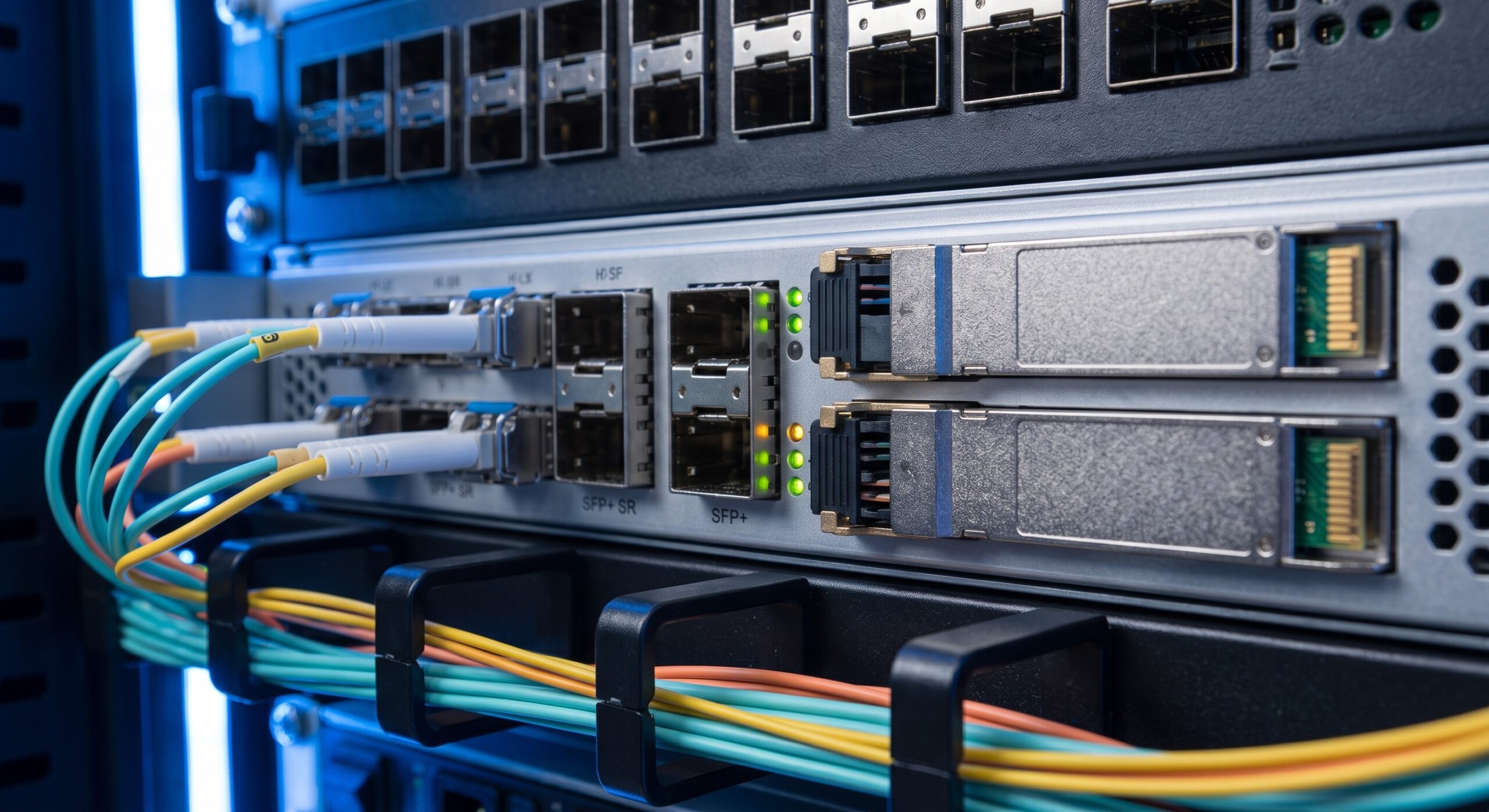
The H3C Supported Transceiver Matrix is a comprehensive portfolio of optical and electrical transceiver modules engineered for seamless interoperability across the entire H3C switching, routing, and data center infrastructure ecosystem. This document serves as the definitive technical reference for network architects, procurement specialists, and field deployment engineers seeking validated, performance-optimized physical layer connectivity solutions. Each transceiver listed within this matrix has undergone rigorous H3C certification testing to guarantee signal integrity, thermal compliance, and protocol adherence across all supported host platforms.

SYSTEM HARDWARE TOPOLOGY
The transceiver matrix architecture is structured around a hierarchical compatibility framework that maps directly to H3C’s switching and routing families. Physical layer connectivity is delineated into five primary form factor categories: SFP, SFP+, SFP28, QSFP+, and QSFP28, each supporting distinct data rates from 100 Mbps to 100 Gbps. The matrix topology is further subdivided by reach categories—SR (Short Range), LR (Long Range), ER (Extended Range), and ZR (Ultra-Long Range)—ensuring that network designers can select optimal optics for data center interconnect, metro aggregation, and campus core deployments. All transceivers are hot-swappable and equipped with Digital Diagnostic Monitoring (DDM) interfaces to provide real-time optical power, temperature, and bias current telemetry, enabling proactive network maintenance and fault isolation.
DATA & CONTROL PLANE CAPABILITIES
Every certified transceiver in the H3C matrix supports industry-standard management interfaces, including I2C-based register access per SFF-8472 (for SFP types) and SFF-8636 (for QSFP types). The control plane integrates seamlessly with H3C Comware V7 and V9 operating systems, enabling functions such as transceiver type validation, vendor locking, and real-time performance threshold alarming. Advanced capabilities include support for digital signal processing (DSP) across coherent optics (CFP2-DCO, QSFP-DD) for 400G DWDM deployments, leveraging forward error correction (FEC) algorithms compliant with IEEE 802.3 Clause 91/119. The matrix also encapsulates media access control (MAC) for direct attach copper (DAC) and active optical cables (AOC), providing low-latency interconnection solutions for top-of-rack and spine-leaf architectures.
COMPONENT BREAKDOWN
The H3C transceiver matrix is organized into a modular component structure comprised of the following distinct families:
1. 10G SFP+ SR/LR/ER: Deployed for 1U access and distribution switches, providing uplink capacity with LC duplex interfaces.
2. 25G SFP28 SR/LR: Optimized for next-generation compute nodes, supporting 25G Ethernet link aggregation (LAG) and RoCEv2 traffic.
3. 40G QSFP+ SR4/LR4: Utilized for stacking and 40GE core uplinks, featuring MPO/MTP ribbon fiber connectivity.
4. 100G QSFP28 SR4/CWDM4/LR4: Flagship optics for high-density core switching, leveraging PAM4 modulation across IEEE 802.3bm standards.
5. 400G QSFP-DD SR8/DR4/FR4: High-capacity modules for next-generation hyperscale data centers.
6. DWDM Transceivers: Fixed-wavelength and tunable XFP/CFP units for metro and long-haul dense wavelength division multiplexing.
Each component label includes a unique H3C reference code (e.g., QSFP-100G-SR4-2026) ensuring precise identification in procurement workflows.
OPERATIONAL SPECS MATRIX
All operational parameters are derived from Telcordia GR-468-CORE reliability standards. The matrix specifies absolute maximum power dissipation ratings, with QSFP-DD modules capped at 12W, QSFP28 at 3.5W, and SFP28 at 1.5W. Operating temperature range is validated across 0°C to 70°C for commercial grade and -40°C to +85°C for industrial extended variants. The optical output power, receiver sensitivity, and extinction ratio are meticulously characterized per IEEE 802.3ae, 802.3bm, and 802.3bs specifications to ensure minimal bit error rate (BER) ≤ 1e-15 under typical conditions. All modules feature EMI shielding compliant with FCC Part 15 Class A and CISPR 22 standards.
| Parameter | Specification |
|---|---|
| Form Factor | SFP, SFP+, SFP28, QSFP+, QSFP28, QSFP-DD (1×4, 1×8, 2×4 configurations) |
| Data Rate Range | 100 Mbps up to 400 Gbps per port |
| Switching Capacity | Up to 51.2 Tbps aggregate per host line card (dependent on host platform) |
| Power Supply | Hot-swappable, 3.3V primary supply with DDM telemetry |
| Operating Temperature | Commercial: 0°C to 70°C / Industrial: -40°C to +85°C |
| Fiber Interface | Duplex LC, MPO-12, MPO-24, or CS connector depending on form factor |
| Wavelength | 850 nm (SR), 1310 nm (LR), 1550 nm (ER/ZR), DWDM C-band tuning |
| Diagnostic Monitoring | Real-time temperature, voltage, bias current, TX power, RX power per SFF-8472/8636 |
REGULATORY COMPLIANCE
The entire transceiver matrix holds certifications for safety (UL/CSA 60950-1, IEC 60825-1 Class 1 Laser Eye Safety), environmental (RoHS 2.0, REACH, WEEE), and electromagnetic compatibility (CE marking, FCC, VCCI). Additionally, the matrix complies with the Network Equipment Building Standards (NEBS) GR-63-CORE and GR-1089-CORE for carrier-grade deployment in central offices. Fiber optic interfaces are compliant with ITU-T G.652 and G.657 bend-insensitive fiber recommendations.
📥 Download Technical Specification
Click the button below to view or download the full official PDF datasheet.

Leave a comment