
Introduction: The Capacity Imperative and the Tunable Solution
Network architects and systems integrators face a relentless bandwidth surge driven by 5G infrastructure expansion, AI model training, and high-density data center interconnects (DCI) . Dense Wavelength Division Multiplexing (DWDM) remains the bedrock technology for scaling fiber capacity without laying new cable. However, the operational complexity and inventory overhead of fixed-wavelength optics have historically hindered agility. This blog provides a data-driven evaluation of Tunable DWDM Transceivers, moving beyond simple unit-cost comparisons to quantify the Total Cost of Ownership (TCO), operational gains, and technical performance metrics that define next-generation network deployment.
Technical Architecture and Core Specifications
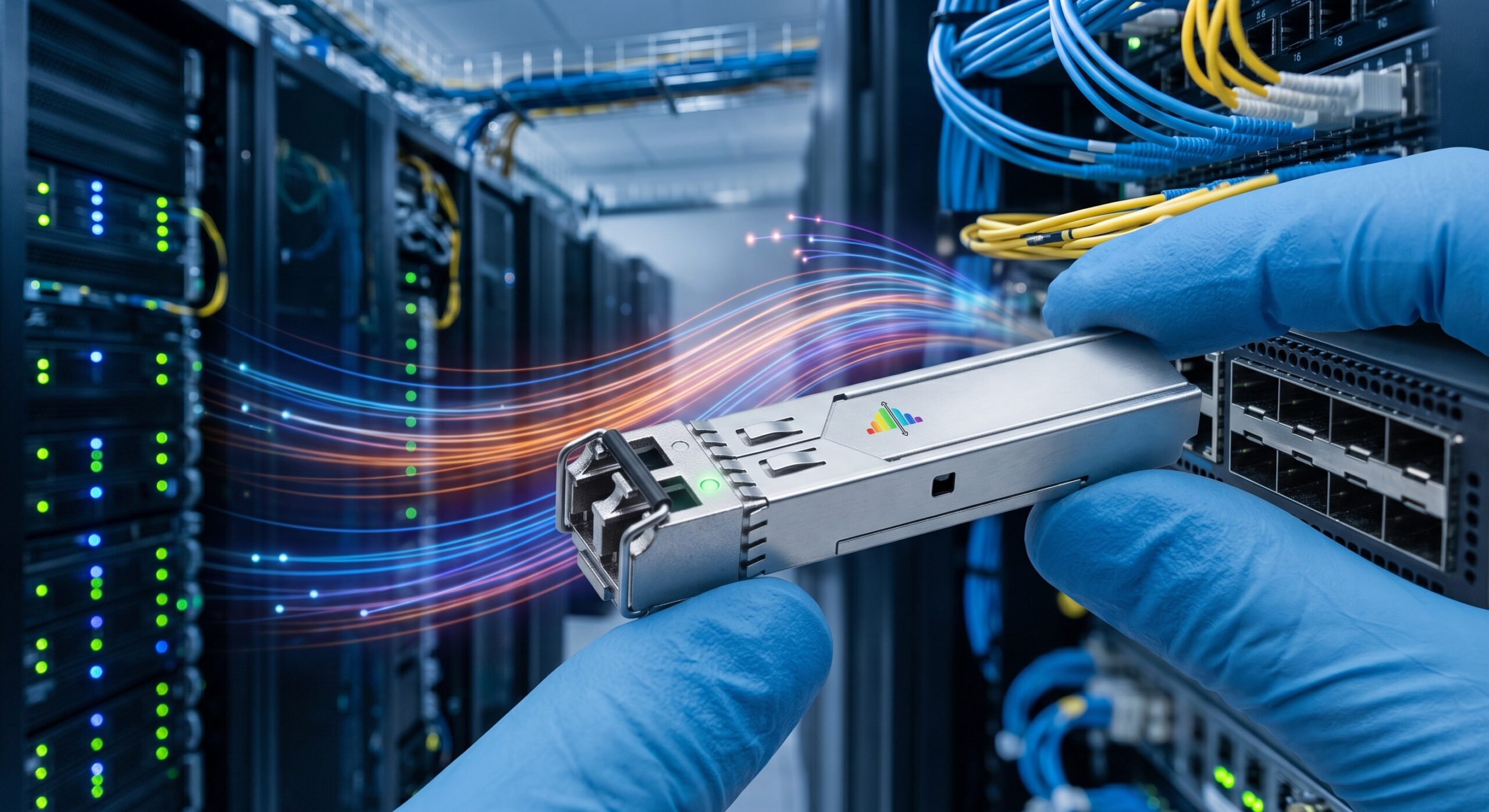
Modern tunable DWDM transceivers integrate sophisticated digital signal processing (DSP) and optical components into compact form factors. The core of these modules is a tunable laser, typically a Monolithically Integrated Mach-Zehnder Modulator (MZM) or a tunable InP MZM . This allows the transmitter to be software-actuated to any channel on the ITU-T C-band grid. The operational gains are heavily dependent on key performance metrics as defined by industry standards (IEEE, ITU-T, SFF).
| Key Parameter | Technical Specification (Example: Coherent 25G SFP28 / 100G CFP2-DCO) |
|---|---|
| ITU-T Grid Compliance | C-band DWDM, 50GHz or 100GHz channel spacing (96 Channels for 50GHz) |
| Form Factors | SFP+ / SFP28 (10G/25G), CFP2-DCO (100G/200G) |
| Data Rate | 10G, 25G, 100G, 200G (soft-selectable QPSK, 8-QAM, 16-QAM) |
| Maximum Reach | 80 km (SMF) for 10G/200G; up to 15 km (SMF) for 25G |
| Key Standards & Compliance | SFF-8431/8432, SFF-8690, G.698.1, SFF-8472 (DOM), G.709 FEC, RoHS |
| Optical Components | Tunable + InP MZM (Transmitter), APD (Receiver for 25G) |
ITU-T Grid and Channel Density
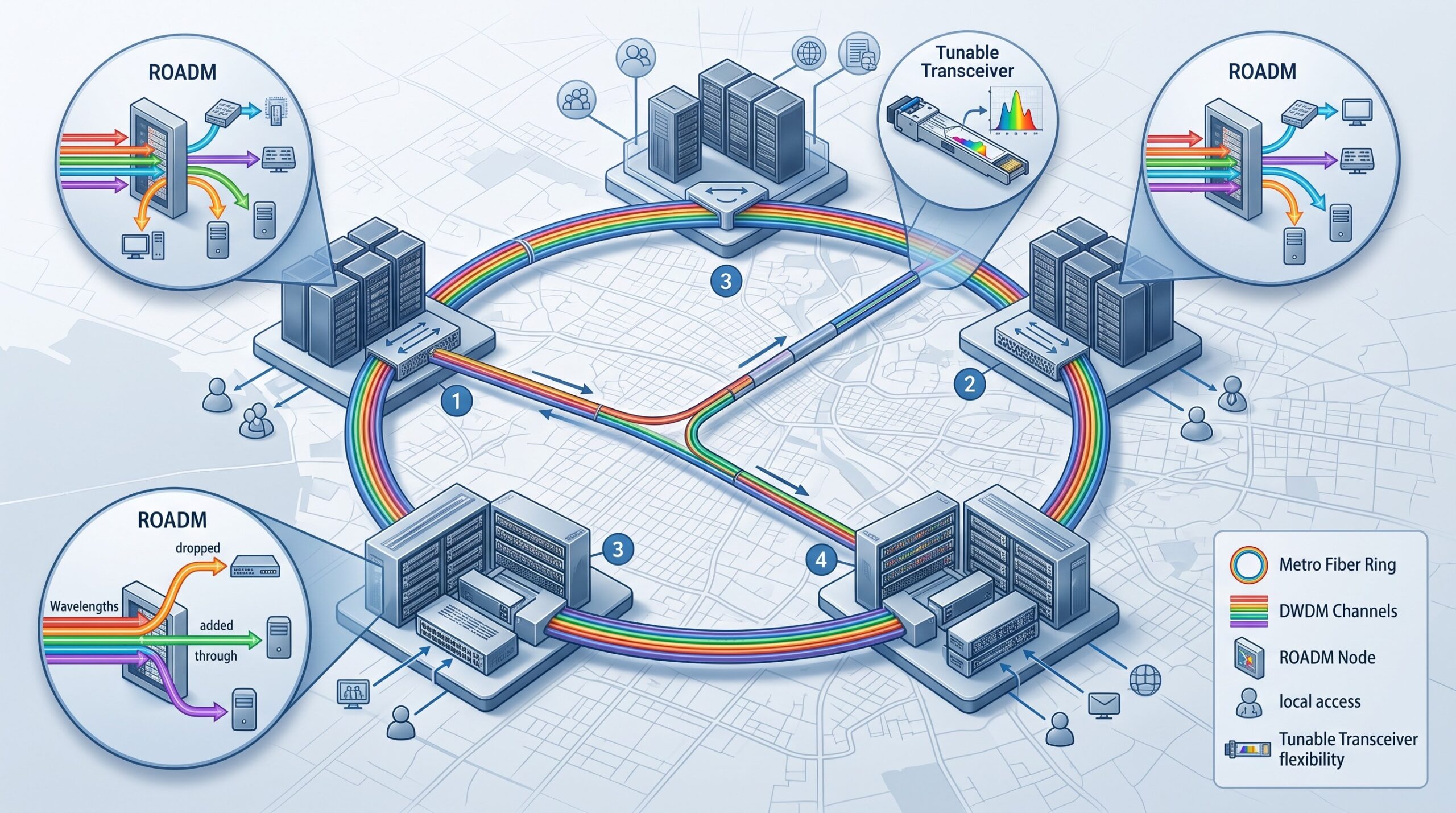
These transceivers operate on the ITU-T G.694.1 grid. A key specification is the channel spacing. A module with 100GHz spacing can be tuned to 40 channels, while a 50GHz grid spacing opens access to 96 channels across the C-band . This granularity is crucial for colorless, directionless, and contentionless (CDC) ROADM architectures, enabling dynamic wavelength assignment without hardware changes. Coherent CFP2-DCO modules have further extended this by demonstrating wide-bandwidth tuning across the C6T+L6T bands, covering a spectrum of 12.3 THz, to support future C+L-band transmission systems .
Quantifying Operational Gains: Fixed vs. Tunable
A data-driven evaluation requires dissecting the TCO, which involves CapEx (unit cost) and OpEx (sparing, provisioning, power, and maintenance).
CapEx and Unit Cost
Fixed-wavelength transceivers generally cost 3 to 5 times less per unit than their tunable counterparts . This upfront premium is the primary argument for fixed-wavelength optics in small, stable deployments. However, this narrow view fails to account for the broader operational lifecycle.
Sparing Inventory and OpEx
A single tunable transceiver in a spares drawer can replace up to 80 different fixed-wavelength SKUs . For a network operating 20 or more active DWDM channels, the reduced sparing inventory of tunable optics typically produces a lower TCO over a 3 to 5-year horizon . A practical rule: if your channel plan is stable, fixed optics keep things simple. However, for dense metro rings, rapid restoration, and evolving channel plans, the tunable spare strategy is operationally superior .
Deployment and Provisioning Efficiency
Provisioning a tunable module traditionally required a field technician to tune each transceiver via a tuning box or NOC coordination, a time-consuming process . This is where significant operational gains are realized with innovations like Flextune (Self-Tuning Optics). These transceivers automatically scan and find the correct optical path, tuning themselves to the proper wavelengths in a plug-and-play fashion, reducing provisioning time from hours to minutes and minimizing human error .
Real-World Deployment Scenarios
Data Center Interconnects (DCI) and Metro Networks
For DCI and metro carrier applications, the CFP2-DCO (Digital Coherent Optics) form factor is becoming dominant. These modules provide 100G/200G throughput and support flexible modulation schemes (100G QPSK, 200G 8-QAM, 200G 16-QAM) via software actuation . They support up to 80km over SMF, making them ideal for line-side trunk DWDM .
Enterprise and Edge Networks
At the enterprise access layer, SFP28 form factor tunable modules enable a cost-effective upgrade path from 10G to 25G Ethernet . These modules overcome challenges of native device compatibility, offering consistent wavelength visibility (DOM) and stability across device reboots in multi-vendor environments .
Conclusion
A data-driven evaluation of Tunable DWDM Transceivers reveals that while the CapEx is higher, the quantifiable operational gains in sparing efficiency, provisioning speed, and network agility often outweigh the initial investment in medium-to-large scale deployments. The choice between fixed and tunable should not be binary but strategic. For stable, low-channel-count links, fixed-wavelength optics are cost-effective. For dense metro, DCI, and future-proofed networks where rapid restoration and software-defined flexibility are paramount, tunable DWDM transceivers, bolstered by innovations like Flextune, represent a clear competitive advantage, delivering a demonstrable ROI through reduced OpEx and enhanced network availability.

Leave a comment