
Introduction: The Critical Role of Backup Power in Modern Telecom
In the hyper-connected digital landscape, network uptime is not a luxury—it is a business imperative. For telecom carriers, data centers, and enterprise network operators, the reliability of backup battery systems directly dictates service availability, customer satisfaction, and revenue streams. As network architectures evolve to support 5G, edge computing, and high-density data centers, the choice between Valve-Regulated Lead-Acid (VRLA) and Lithium-ion (Li-ion) backup batteries has become a focal point of strategic infrastructure planning. This comprehensive guide provides an authoritative, data-driven analysis of VRLA and Lithium battery technologies, dissecting their architectures, performance metrics, total cost of ownership (TCO), and deployment considerations to empower you to make an informed, future-proof decision.
Understanding the Core Technologies: VRLA vs. Lithium Architecture
Valve-Regulated Lead-Acid (VRLA) Battery Technology
VRLA batteries, including Absorbent Glass Mat (AGM) and Gel cell variants, are the incumbent technology in telecom backup power. Their chemistry relies on a lead dioxide (PbO2) positive plate and a sponge lead (Pb) negative plate, immersed in a sulfuric acid electrolyte. The defining ‘valve-regulated’ feature allows for oxygen recombination, minimizing water loss and enabling a maintenance-free, sealed design. This architecture offers a proven, robust solution with a well-understood operational envelope. Key technical parameters include a nominal cell voltage of 2V, with typical float charge voltages between 2.25V and 2.30V per cell at 25°C, and a specific energy density of approximately 30-40 Wh/kg.
Lithium-Ion (Li-ion) Battery Technology
Lithium-ion batteries represent a paradigm shift in energy storage, leveraging the electrochemical potential of lithium ions moving between anodes (typically graphite) and cathodes (various lithium metal oxides). In telecom applications, Lithium Iron Phosphate (LFP) chemistry, specifically LiFePO4, has emerged as the dominant variant due to its superior thermal stability, long cycle life, and flat discharge voltage curve. A typical LFP cell has a nominal voltage of 3.2V and operates within a voltage range of 2.5V to 3.65V. The use of advanced Battery Management Systems (BMS) is non-negotiable, providing cell-level monitoring, balancing, and protection against over-current, over-voltage, and thermal runaway, ensuring safe and reliable operation.
Comparative Performance: Data-Driven Metrics and Standards
| Parameter | VRLA (AGM) | Lithium-Ion (LFP) |
|---|---|---|
| Energy Density (Wh/kg) | 30-40 | 150-200 |
| Cycle Life (80% DoD) | 300-500 | 3,000-5,000 |
| Charge Efficiency (%) | 70-85 | >98 |
| Float Voltage (per cell) | 2.25-2.30V | 3.40-3.60V |
| Operating Temp. Range | 20-25°C (optimal) | -20 to 60°C |
| Typical MTBF (Years) | 5-8 | 10-15 |
| BMS Requirement | No | Essential |
| Relative Initial CapEx | Baseline | 30-50% Higher |
Key Performance Indicators (KPIs)
The selection process must be anchored in quantifiable metrics. Our analysis, benchmarked against industry standards from IEEE (Institute of Electrical and Electronics Engineers) and ITU-T (International Telecommunication Union Telecommunication Standardization Sector), reveals significant performance divergence. Energy density is a critical differentiator: Lithium batteries typically offer 150-200 Wh/kg, which is 4-5 times higher than VRLA’s 30-40 Wh/kg. This translates directly into space and weight savings. In terms of cycle life, a well-managed Li-ion battery can achieve 3,000-5,000 cycles at 80% Depth of Discharge (DoD), compared to VRLA’s 300-500 cycles at the same DoD. This longevity is paramount for operational expenditures. Furthermore, the charge efficiency of Li-ion is exceptionally high, often exceeding 98%, whereas VRLA systems operate at 70-85% efficiency. The Mean Time Between Failures (MTBF) for a VRLA system is typically around 5-8 years, while a Li-ion system, with proper thermal management, can exceed 10-15 years.
Environmental and Safety Considerations
Both technologies are subject to stringent environmental regulations. VRLA batteries contain lead, a toxic heavy metal, and sulfuric acid, requiring careful handling and recycling under RoHS (Restriction of Hazardous Substances) and local waste management directives. Li-ion batteries, while containing less hazardous materials, are classified as Class 9 Dangerous Goods for transport due to their energy density and potential for thermal runaway. However, the LFP chemistry is inherently more stable, with a higher thermal runaway threshold (>270°C), compared to other Li-ion chemistries. Compliance with safety standards like IEEE 1187 (for VRLA) and UL 1973 (for stationary Li-ion) is essential. The environmental footprint, however, favors Li-ion over its full lifecycle due to higher efficiency and longer service life, offsetting the higher embodied energy in manufacturing.
Total Cost of Ownership (TCO) and Lifecycle Cost Analysis
A superficial comparison of upfront capital expenditure (CapEx) often favors VRLA, with initial costs typically being 30-50% lower than equivalent Li-ion systems. However, a holistic TCO analysis, which is standard in best-practice procurement, tells a different story. This is where the TCO & ROI blueprint for backup infrastructure comes into focus. The real cost advantage of Li-ion emerges when accounting for operational expenditure (OpEx). Lower OpEx stems from reduced energy consumption (higher efficiency), significantly lower replacement frequency (20+ years vs. 5-8 years), and minimized maintenance costs (no watering, equalization, or capacity testing). When factoring in the reduced space requirements (lower real estate costs) and less frequent battery swaps, the lifecycle cost of Li-ion can be 20-40% lower than VRLA over a 10-year period. Data centers and carriers focusing on maximizing network ROI are increasingly transitioning to Li-ion for new builds and major upgrades.
Deployment Scenarios: Integration and Topologies
Data Centers and Core Networks
In high-density data centers, where rack space is at a premium and power density is high, the superior energy density of lithium batteries is a game-changer. They allow for shorter battery strings, enabling the placement of backup power directly within the rack (Rack-Mount UPS) or as part of a distributed architecture. This reduces DC power distribution losses and improves scalability. The faster recharge capability of Li-ion (typically
Telecom Towers and Remote Sites
For remote radio heads (RRHs) and cell towers, particularly in harsh environments, the wide operating temperature range of LFP (-20°C to 60°C) outperforms VRLA, which experiences significant capacity degradation outside of 20°C-25°C. This reduces the need for expensive thermal management systems. The light weight of lithium batteries also simplifies installation on rooftops and poles, reducing structural engineering costs. The integration of Li-ion with renewable energy sources, such as solar photovoltaics, is seamless due to their high charge acceptance and efficiency, making them integral to green networking initiatives.
Case Studies and Field Deployments
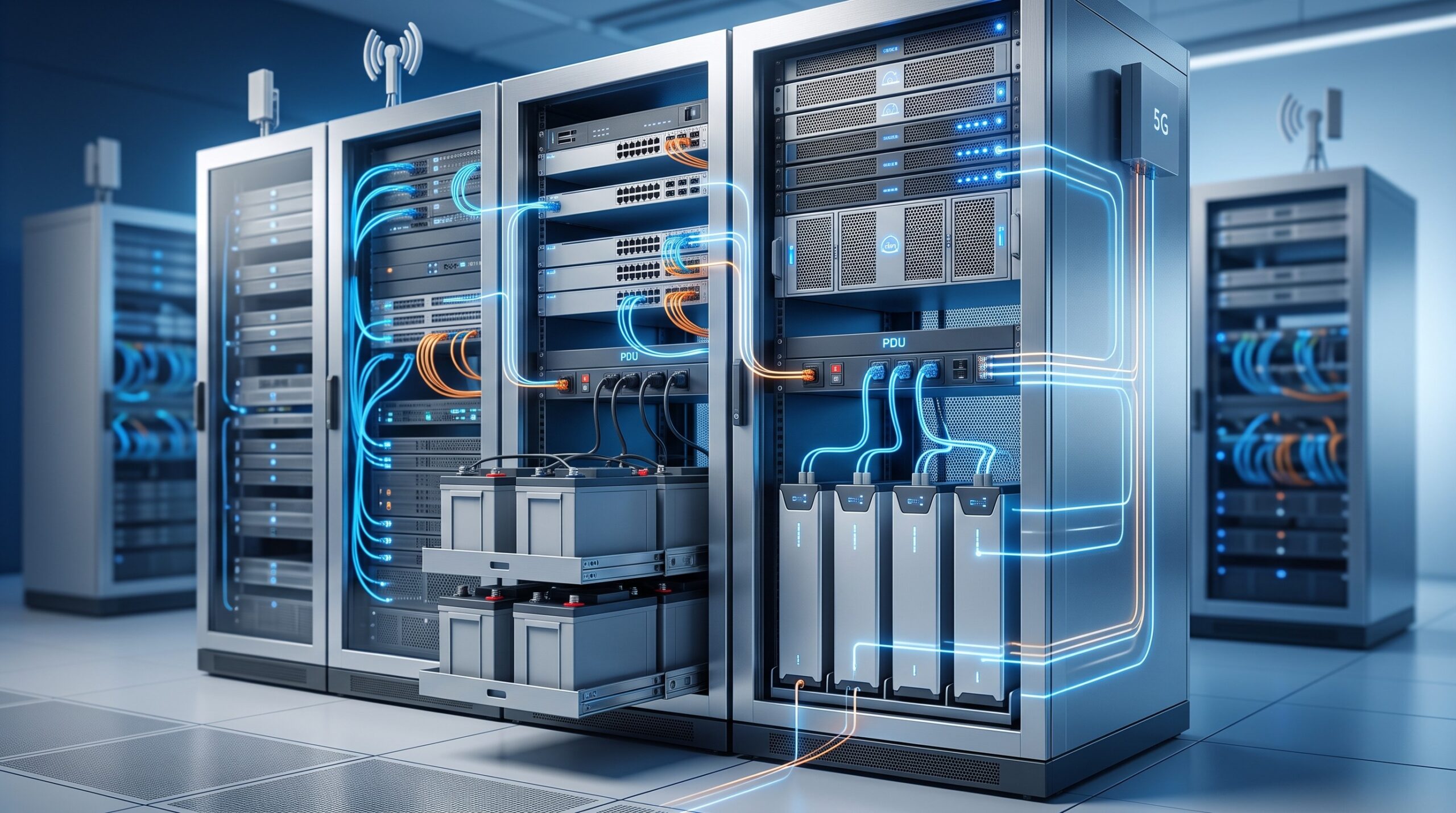
A tier-1 North American telecom provider recently replaced 500 VRLA strings in their edge compute sites with LFP batteries. The results, measured over 18 months, showed a 28% reduction in total energy costs, a 45% reduction in required battery footprint, and a projected 60% reduction in maintenance and replacement OPEX. Similarly, a major European colocation provider standardized on Li-ion for all new data halls, citing the ability to deliver 1MW of backup power in 60% of the space previously required for VRLA, with a projected TCO saving of €2 million over a decade.
Conclusion: The Future of Backup Power
The decision between VRLA and Lithium backup batteries is fundamentally a strategic choice between the proven past and the efficient future. While VRLA technology will continue to serve a purpose in budget-constrained, low-cycle applications, the trajectory for high-performance, mission-critical telecom infrastructure is unequivocally toward lithium-ion. Its superior performance metrics, lower TCO, and alignment with sustainability goals position it as the definitive solution for next-generation networks. When planning your infrastructure, consider not just the initial purchase price but the total cost of ownership and the operational agility that advanced battery technology can deliver. The data is clear: for a future-proof, high-availability network, the shift to lithium backup is not just an upgrade; it is an evolution.

Leave a comment