
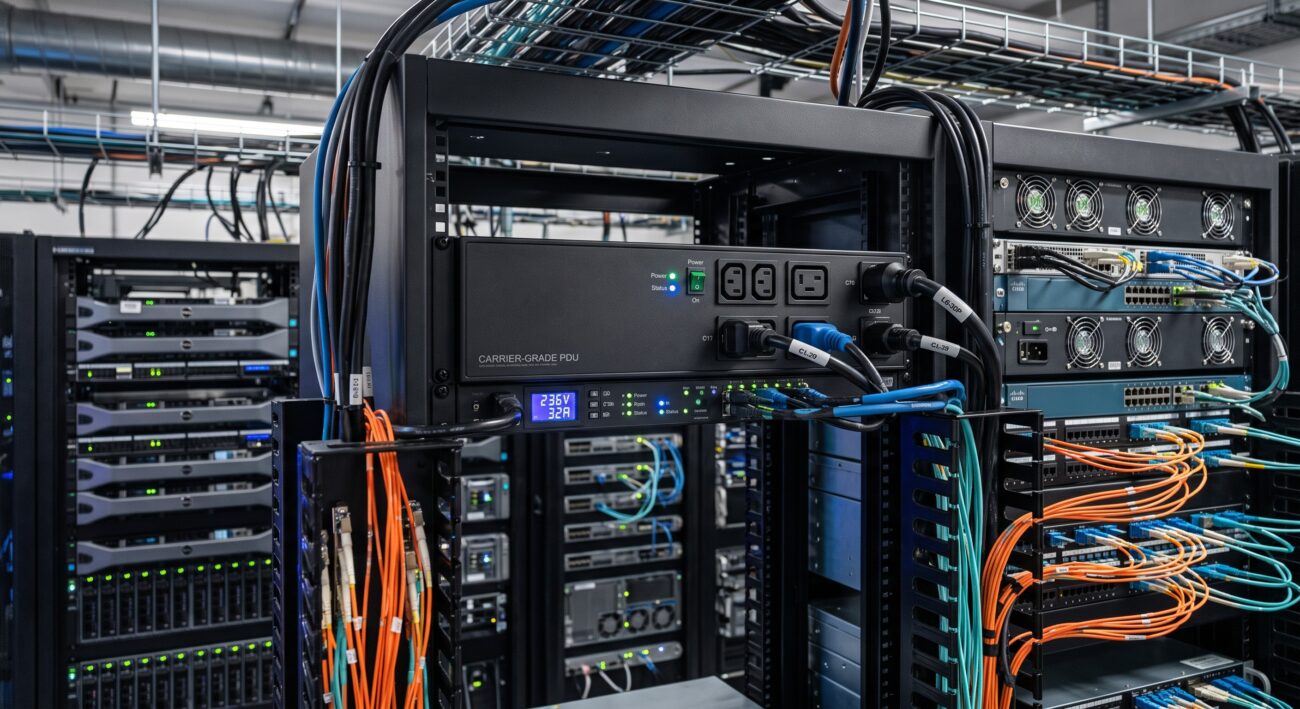
Introduction: The Unseen Pillar of Carrier-Grade Infrastructure
In the hyper-connected landscape of modern telecommunications, the conversation often orbits around core routers, optical transport, and switching capacity measured in Terabits per second. However, the foundation upon which this entire digital ecosystem rests is one of the most overlooked yet critical components: the Power Distribution Unit (PDU). For network architects and data center engineers tasked with maintaining five-nines (99.999%) availability, the selection of a PDU transcends simple power delivery. It is a strategic decision that impacts uptime, operational efficiency, and total cost of ownership (TCO). This comprehensive guide delves deep into the engineering specifications, redundancy architectures, and reliability metrics essential for selecting a carrier-grade PDU.
As we push towards 800G and 1.6T networking, the power densities per rack are escalating, creating thermal and electrical challenges that demand intelligent power distribution. A single point of failure in the power chain can cascade into a network-wide outage, undermining even the most robust network topology. This article provides a data-driven evaluation, focusing on Mean Time Between Failures (MTBF), redundancy topologies, and compliance with industry standards like RoHS and IEC, ensuring your infrastructure remains resilient.
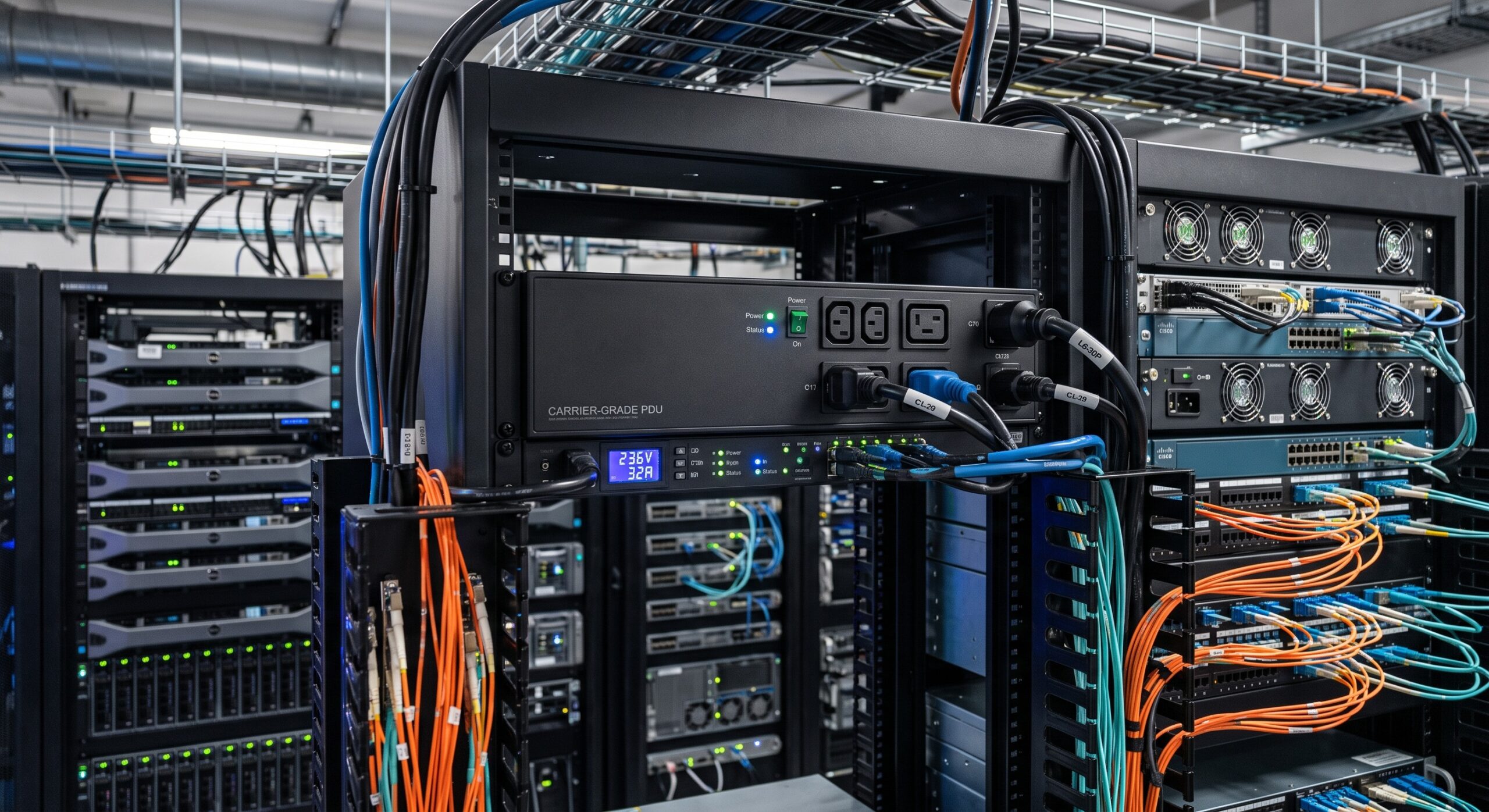
Understanding Modern Power Distribution Units
A Power Distribution Unit is far more than a power strip. It is a sophisticated electrical distribution device designed to distribute AC or DC power to networking equipment within a rack or cabinet. In enterprise and carrier environments, PDUs are categorized into two primary types: Basic PDUs and Intelligent PDUs.
Basic vs. Intelligent PDUs
Basic PDUs provide reliable power distribution without monitoring capabilities. They are cost-effective but lack the visibility and control required for modern data centers. Conversely, Intelligent PDUs incorporate network connectivity, allowing administrators to monitor power consumption in real-time (in Watts), remotely control outlets (on/off/reboot), and track environmental metrics like temperature and humidity. This intelligence is critical for capacity planning and dynamic load balancing, ensuring that no circuit breaker is tripped unexpectedly due to overcapacity.
Standards and Compliance
Compliance with international safety and environmental standards is non-negotiable. High-quality PDUs adhere to IEC 62368-1 for audio/video, information, and communication technology equipment safety. Additionally, they comply with the Restriction of Hazardous Substances (RoHS) directive, ensuring environmentally responsible manufacturing. For carriers, adherence to NEBS (Network Equipment-Building System) standards is often mandatory to ensure survivability under extreme environmental conditions, including temperature fluctuations, humidity, and seismic activity.
Redundancy Architecture: The Dual Power Feeds
The golden rule of carrier-grade infrastructure is redundancy. The Dual-engine failover architecture is a standard design pattern in telecom hardware, and it applies equally to power distribution. The primary implementation involves deploying two independent PDUs (A/B feeds) within a single rack. Each PDU is connected to a separate power source, usually backed by distinct UPS systems and generators.
Redundant Topologies
- N+N Redundancy: This is the most common topology for mission-critical systems. The rack is equipped with two fully rated PDUs. Equipment with dual power supplies connects one supply to PDU A and the other to PDU B. If PDU A fails or requires maintenance, PDU B carries the full load seamlessly. This ensures zero downtime during component failures or scheduled upgrades.
- 2N Redundancy: Often confused with N+N, 2N involves two separate, independent power distribution chains from the utility feed all the way to the rack. This is significantly more expensive but guarantees that an entire distribution path can fail without affecting operations.
- Per-Outlet Switching: Modern Intelligent PDUs offer per-outlet switching. This granular control allows administrators to remotely power-cycle individual servers or network devices without affecting neighboring equipment. This capability is invaluable for troubleshooting and reducing Mean Time To Repair (MTTR).
Evaluating MTBF and Reliability Metrics
For any carrier-grade hardware, the MTBF is a crucial indicator of expected lifespan and reliability. MTBF is typically calculated based on component stress analysis using standards like Telcordia SR-332.
| Key Parameter | Technical Specification | Carrier-Grade Requirement |
|---|---|---|
| Mean Time Between Failures (MTBF) | ≥ 1,500,000 hours (Based on Telcordia SR-332) | Essential for 5-nines availability |
| Redundancy Architecture | N+N (A/B Independent Feeds) | Mandatory for carrier-grade uptime |
| Operating Temperature | 0°C to 55°C (NEBS Level 3) | Critical for edge and central office deployments |
| Monitoring & Protocols | Real-time kW, kWh, V, A; SNMP v3 | Required for DCIM integration and remote management |
| Compliance | IEC 62368-1, RoHS, UL 1449 | Non-negotiable for safety and environmental standards |
Interpreting MTBF figures requires caution. While a high MTBF is desirable, it is a statistical prediction, not a guarantee. Network architects should pair MTBF analysis with the calculation of Annualized Failure Rate (AFR) to estimate yearly failure probabilities. For example, a PDU with an MTBF of 2,000,000 hours (approximately 228 years) would have an AFR of 0.44%. This means that statistically, out of 1,000 units, approximately 4.4 units might fail in the first year of operation. This is why redundancy architecture is not optional but mandatory.
Deep Dive: Internal Architecture and Component Quality
The reliability of a PDU is determined by the quality of its internal components. A breakdown of the critical components reveals why cost differentiation exists in the market.
Circuit Breakers
Hydraulic-magnetic circuit breakers are preferred over thermal breakers in high-reliability environments. Hydraulic-magnetic breakers provide more consistent trip characteristics across a wide temperature range and offer faster response times to short circuits.
Surge Protection
Carrier-grade PDUs often incorporate advanced surge suppression modules that meet UL 1449 standards. These protect sensitive networking ASICs and optical transceivers from voltage spikes and transients originating from the grid.
Connector Durability
The connectors (C13, C19, or IEC 60309) must have a high insertion cycle rating. In dynamic data centers where equipment is constantly being moved, a robust connector with gold-plated contacts minimizes resistance and heat build-up.
Performance and Environmental Specifications
When selecting a PDU, you must review the detailed technical specifications to match your specific environmental and load requirements.
Operating Temperature and Humidity
Most PDUs are rated for an operating temperature range of 0°C to 45°C (32°F to 113°F). However, for NEBS Level 3 compliance, the equipment must operate reliably at temperatures as high as 55°C (131°F). If your data center utilizes hot-aisle containment or has high-density GPU clusters, ensuring your PDU can operate efficiently at the upper end of this spectrum is essential. High operating temperatures can derate the current-carrying capacity of conductors, potentially leading to overheating.
Power Metrics and Monitoring
Intelligent PDUs provide real-time visibility into power consumption at the rack level (kW/kWh), voltage (V), current (A), and power factor (PF). This data is accessible via SNMP, Modbus, or RESTful APIs, integrating seamlessly into the Data Center Infrastructure Management (DCIM) software. Accurate power monitoring helps optimize energy usage, identify underutilized capacity, and manage carbon footprint.
Deployment Scenarios: Mission-Critical Environments
The practical application of PDU selection varies significantly depending on the use case.
Hyperscale Data Centers
In hyperscale environments, efficiency is paramount. Here, the focus is on high-voltage (e.g., 480V) PDUs with busway distribution to reduce transmission losses. They often feature high-density outlets (up to 54 outlets in a 42U form factor) to support thousands of servers.
5G Edge Nodes
Edge deployments are often space-constrained and located in non-traditional environments (e.g., street cabinets). PDUs in these scenarios must support DC power (-48V) and be compact. Additionally, they must have a wider operating temperature range to survive outdoor conditions without dedicated cooling.
Telecom Central Offices
Central offices require absolute reliability. PDUs here often provide NEBS Level 3 certification, robust alarm inputs/outputs, and support for legacy equipment requiring both AC and DC power distribution.
Total Cost of Ownership (TCO) Analysis
While the initial capital expenditure (CapEx) for Intelligent PDUs is higher than Basic units, the operational expenditure (OpEx) savings often justify the investment.
- Energy Savings: Built-in metering allows administrators to identify zombie servers (powered-on but not in use) and shut them down remotely, reducing energy consumption by up to 10-15%.
- Reduced Downtime: Remote reboot capabilities eliminate the need for truck rolls or physical dispatches to power cycle equipment, significantly reducing MTTR.
- Capacity Planning: Data-driven decisions on rack provisioning prevent the need for costly mid-cycle power upgrades by optimizing utilization across existing racks.

Conclusion: The Strategic Infrastructure Decision
Selecting the right Power Distribution Unit is a strategic decision that directly influences the reliability and operational efficiency of your network. It is not a commodity purchase but an investment in infrastructure resilience. By prioritizing features such as high MTBF, robust redundancy architectures (N+N), intelligent monitoring capabilities, and rigorous compliance with NEBS and RoHS standards, network architects can future-proof their facilities against the growing power demands of next-generation telecom hardware.
Remember, the best router with a perfect ASIC is rendered useless if it lacks power. Do not overlook the PDU; it is the silent guardian of your carrier-grade network.
As you embark on your next data center build or expansion, evaluate the total cost of ownership, demand transparency on component quality, and always design for redundancy. In a world where downtime costs can exceed $300,000 per hour, the role of a reliable PDU cannot be overstated. For systems integrators and engineers, mastering the art of PDU selection is a fundamental step towards achieving unmatched network uptime and operational excellence.

Leave a comment