
Executive Summary: Maintaining Carrier-Grade Uptime in Power Infrastructure
In carrier-grade telecommunications and datacenter environments, the DC power system is the literal lifeline of network operations. A rectifier module failure, such as that of a Huawei R4850G series unit, can cascade into service outages, impacting customer SLAs and generating significant operational expenditure. The R4850G series—encompassing models like the R4850G2, R4850G5, and R4850G6—is a high-efficiency, 48V/50A (up to 3000W) rectifier widely deployed in systems like the Huawei ETP48200 . This technical brief provides a data-driven framework for evaluating, troubleshooting, and safely replacing these critical power modules. We will analyze the architecture, MTBF metrics, and deployment best practices, ensuring your infrastructure maintains the highest standards of reliability and performance.
R4850G Series Architecture and Hardware Specifications
The Huawei R4850G series is designed for high-density power conversion with a standard 1U form factor (40.8mm x 105mm x 281mm for the R4850G2) . The key to its carrier-grade status lies in its robust technical specifications, which are critical for any replacement strategy.
Model Variants and Cross-Compatibility
Understanding the nuances between models is paramount. While the R4850G2, R4850G5, and R4850N6 share a common physical interface and pinout, there are operational differences that must be verified prior to replacement .
| Parameter | R4850G2 | R4850G5/G6 | R4875G1 |
|---|---|---|---|
| Form Factor | 40.8 x 105 x 281 mm (1U) | 40.8 x 105 x 281 mm (1U) | 90 x 250 x 390 mm |
| Max Output Power | 3000W | 3000W | 3600W |
| Nominal Output | 53.5V / 50A | 53.5V / 50A | 48V / 75A |
| Efficiency | >96% | >96% | Up to 97% |
| Input Voltage | 176-300V AC | 100-240V AC | 85-300V AC |
| MTBF | >500,000 hours | >500,000 hours | 500,000 hours |
| Communication | CAN Bus | CAN Bus | CAN Bus |
| Hot-Swap Support | Yes | Yes | Yes |
Compatibility and Integration Logic
When planning a replacement, cross-compatibility among the R4850G series modules is generally high due to the matching form factor and edge connector layout . However, a detailed review of your system’s specific voltage requirements is non-negotiable. For instance, while the R4850G2 can support a wide AC input (176-300VAC for full output), other variants may have optimized parameters for specific voltage environments . The use of third-party connectors, such as the Jonhon DP4SC0504-001 or PHZ-F020304-BW00x, is feasible provided they meet the same physical and electrical specifications .
Diagnosing Hardware Faults: LED Status Matrix
A solid understanding of the diagnostic LED indicators on the R4850G module is essential for efficient troubleshooting and reducing Mean Time To Repair (MTTR). The following table aligns with standard Huawei LED definitions .
- Solid Red (Fault) LED: Typically indicates an unrecoverable internal fault or output overvoltage lockout. The immediate action is to reseat the module; if the condition persists, the module must be replaced .
- Solid Green (Power) LED: This indicates the module is operating normally with AC input and stable DC output .
- Solid Yellow/Amber (Warning) LED: A protection alarm often triggered by overtemperature (ambient >75°C) or ventilation blockage. Check airflow and environmental conditions . A blinking yellow LED (0.5Hz) signals a communication interruption with the external monitoring system .
- LED Off (No Power): Confirms a complete loss of AC input or an internal catastrophic failure of the module itself .
Replacement Procedure and Safety Protocols
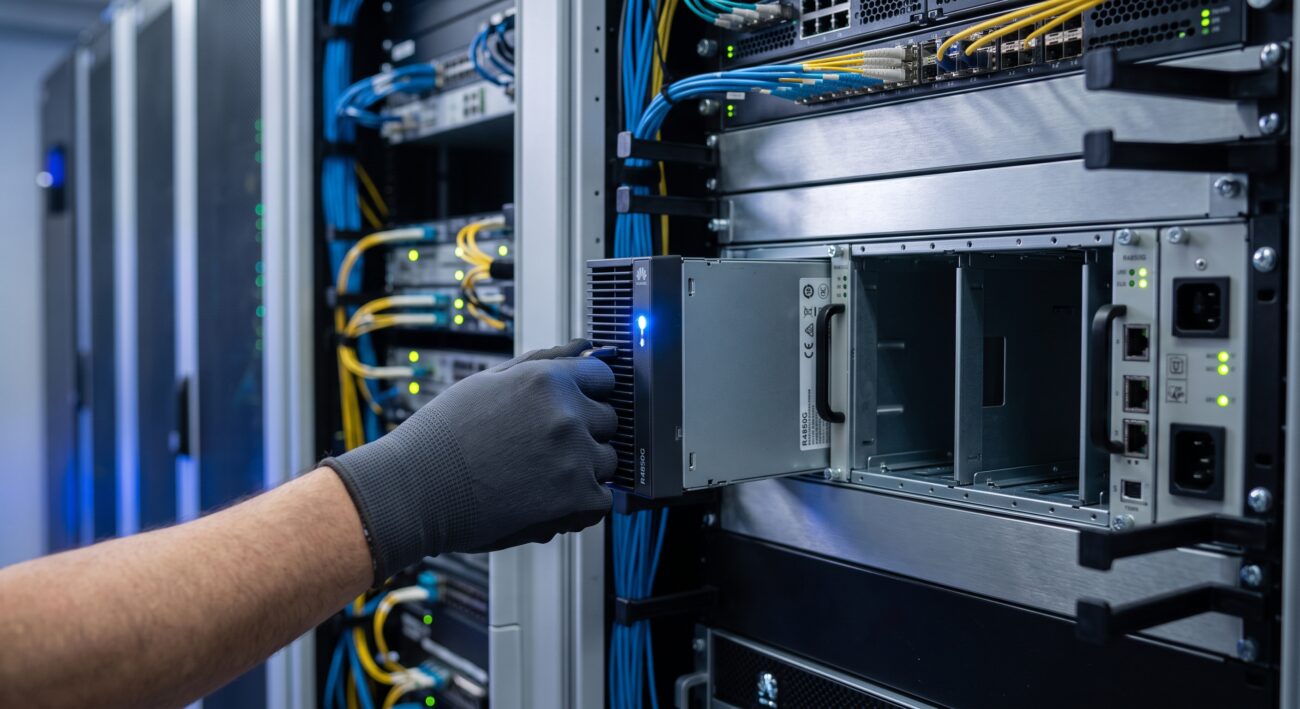
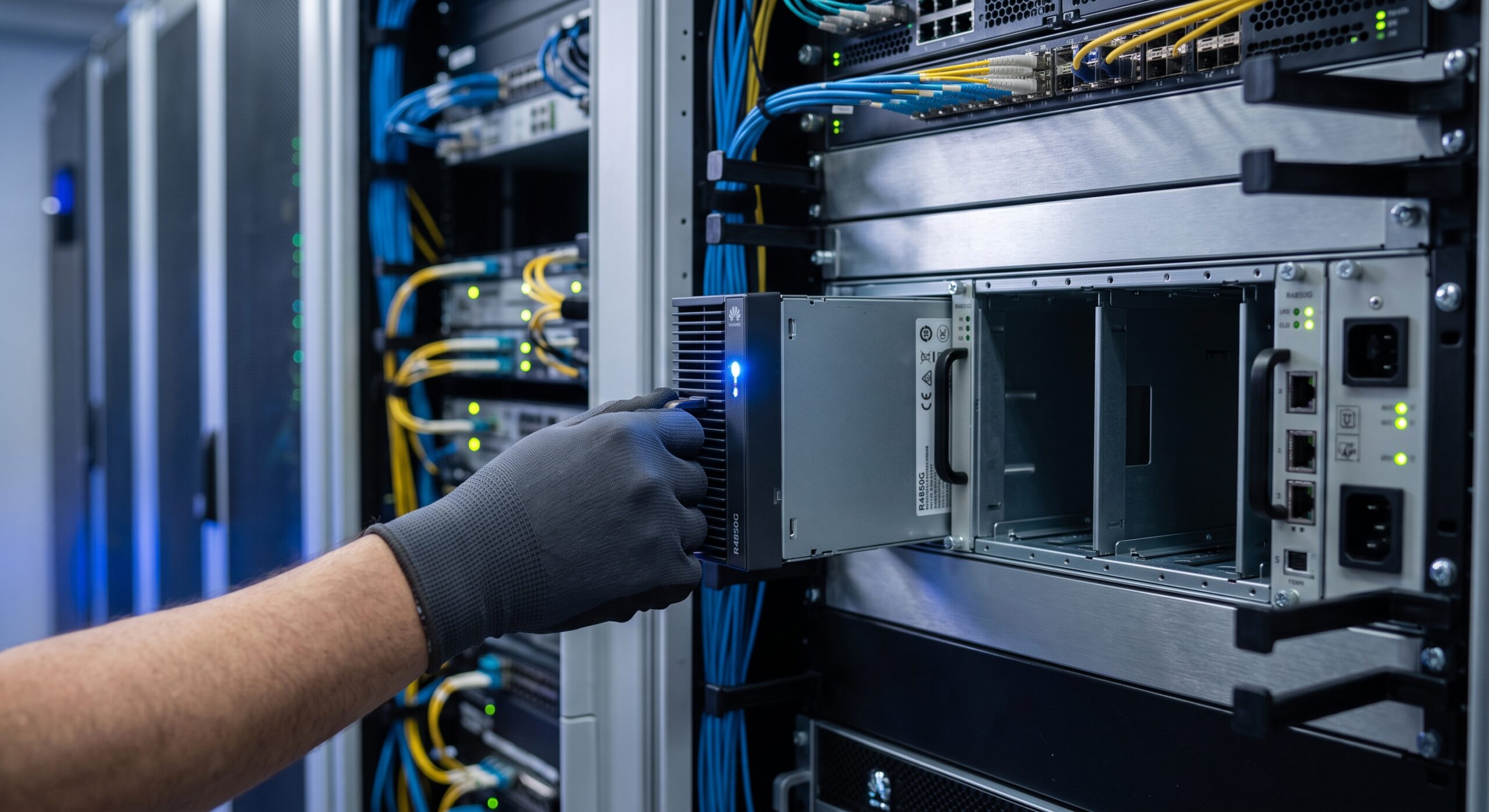
The Huawei R4850G series is designed with full hot-swap support, a feature critical for maintaining high availability in live environments. This allows for the replacement of a faulty module without powering down the entire subrack, provided the system has the necessary redundancy .
Step-by-Step Hot-Swap Replacement
- Preparation: Don protective gloves. The unit may be hot. Unlock the cabinet door .
- Removal: Push the locking latch on the right side of the panel leftward. Gently draw the handle outward and slide the rectifier from the subrack .
- Installation: Align the new rectifier and push it firmly into the subrack until it is securely seated, ensuring a distinct ‘click’ .
- Verification: Lock the module in place and observe the power LED. It should transition to a solid green .
Due to the large internal capacitors, connecting an unpowered R4850G module to a live battery bus can cause significant sparks. It is strongly recommended to hot-swap into a system where the subrack is already powered, or to utilize the internal pre-charge circuit (DC Pre-charge pin) to mitigate this .

Carrier-Grade Reliability: MTBF and Redundancy Analysis
The core of a carrier-grade evaluation is the Mean Time Between Failures (MTBF). For the R4875G1 (a high-output relative in the same family), the MTBF is rated at an impressive 500,000 hours . While direct figures for the R4850G are within a similar high range, the design’s parallel redundancy is what truly defines its reliability. By deploying N+1 modules, network operators can sustain a failure event without impacting the load, ensuring zero downtime during the replacement window .
Energy Efficiency and Cost of Ownership (TCO)
From an operational expenditure perspective, the R4850G series boasts impressive energy efficiency, with modules like the R4875G1 achieving up to 97% efficiency . This translates directly into lower cooling requirements and reduced electricity costs over the lifecycle of the equipment. When evaluating replacement options, prioritizing a unit with >96% efficiency ensures you are maximizing the return on your power infrastructure investment .
Compliance and Standards Adherence
All replacement modules for critical infrastructure must meet rigorous industry standards. Ensure that the procured unit adheres to critical regulations such as UL, CE, and RoHS . Compliance with ITU-T recommendations for telecom equipment is also a baseline requirement for carrier-grade deployments. Units are typically designed to operate reliably across a broad temperature range of -40°C to +75°C .
Conclusion
Replacing a Huawei R4850G rectifier is a routine but mission-critical maintenance task. By adhering to a structured diagnostic process, confirming model-specific compatibility, and leveraging the hot-swap capabilities, engineers can maintain the resilience of their power systems. The combination of high MTBF, N+1 redundancy, and ultra-high efficiency makes the R4850G series a robust choice for telecom and datacenter environments. A data-driven approach to replacement—rooted in understanding the technical specifications and environmental constraints—ensures sustained operational excellence and minimized downtime for your network infrastructure.

Leave a comment