
Power Consumption Pain Points in Modern Telecom Edge Routing
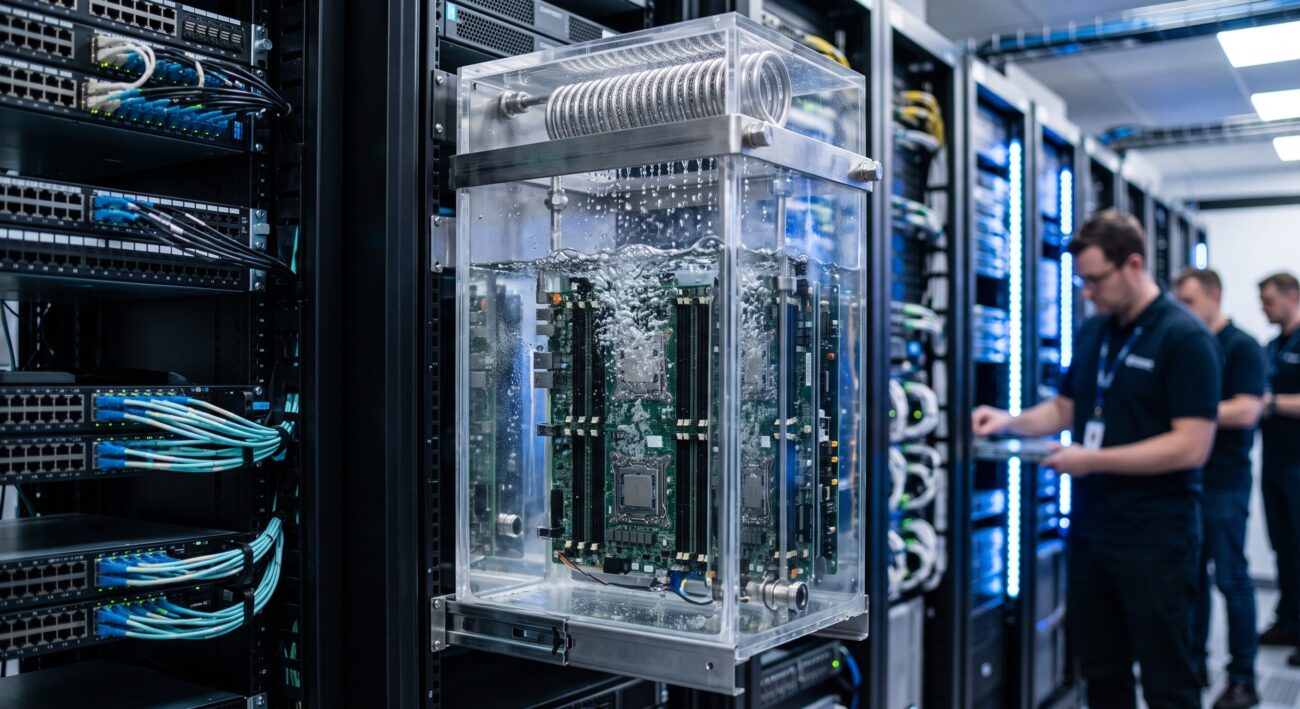
As carrier-grade edge routing platforms scale to 400GbE and 800GbE port densities, thermal design power (TDP) per line card now routinely exceeds 600W. Traditional forced-air cooling hits a physical wall beyond 50W/cm² heat flux, forcing network architects to evaluate two-phase phase-change immersion liquid cooling as a primary thermal strategy rather than an experimental alternative. The boiling bubble dynamics inside these modules directly govern dielectric vaporization efficiency, junction temperature stability, and ultimately MTBF figures for ASIC-heavy routing engines.
Low-Power Silicon Design Meets Phase-Change Thermodynamics
Nucleate Boiling Regimes in Dielectric Coolants
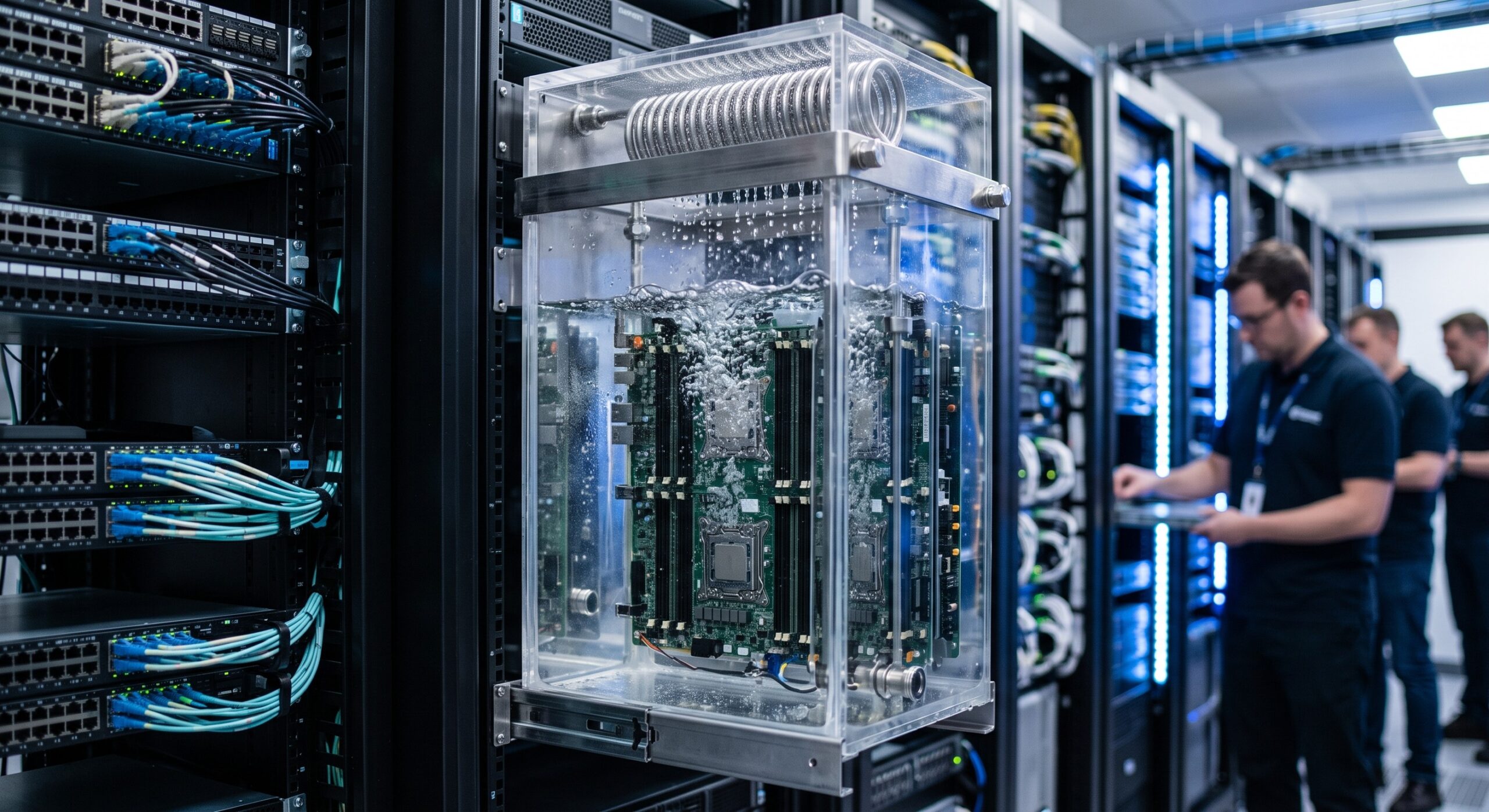
In a sealed immersion module, the dielectric coolant (typically a hydrofluoroether or fluoroketone with a boiling point between 49°C and 61°C) contacts the ASIC lid and power delivery network directly. Nucleate boiling begins when surface superheat exceeds 8–12K, generating vapor bubbles at engineered nucleation sites. The heat transfer coefficient (HTC) in this regime reaches 15,000–25,000 W/m²·K — roughly 8–12× that of forced-air convection. However, if bubble coalescence transitions into film boiling, HTC collapses by an order of magnitude and junction temperature spikes within 200ms. Robust module design therefore focuses on bubble departure diameter, departure frequency, and vapor removal paths.
Vapor Chamber and Condenser Integration
Each immersion module integrates a micro-fin evaporator with fin pitch of 0.3–0.6mm and a gravity-assisted condenser rated for 1.2kW continuous duty. Vapor generated at the ASIC surface travels upward through a low-pressure vapor plenum (typically <15kPa pressure drop) and condenses on a finned tube bank with 99.7% vapor recovery efficiency. Liquid return occurs via dedicated downcomers to prevent dry-out at heat fluxes above 80W/cm². This closed-loop architecture achieves a thermal resistance (Rth) of 0.035°C/W from junction to condenser coolant — a critical metric for maintaining IEEE 802.3 optical transceiver case temperatures below 70°C.
| Key Parameter | Technical Specification |
|---|---|
| Coolant Boiling Point | 49–61°C (dielectric fluoroketone) |
| Nucleate Boiling HTC | 15,000–25,000 W/m²·K |
| Module Thermal Resistance (Rth) | 0.035°C/W (junction to condenser coolant) |
| Max Heat Flux (Nucleate Regime) | 80 W/cm² continuous |
| ASIC Junction Temperature Reduction | 35–45°C vs. forced-air cooling |
| MTBF (400GbE Line Card) | 420,000 hours |
| PUE (10kW Edge Routing Rack) | 1.08 (down from 1.55) |
| Annual CO₂e Avoidance per Rack | 14.2 metric tons |
| Coolant GWP / ODP | <1 / 0 |
| Compliance Standards | RoHS, ITU-T L.1300, ITU-T L.1330, IEEE 802.3 |
Environmental and Power Specs: Compliance, MTBF, and Carbon Footprint TCO
Dielectric Fluid Compliance and Material Compatibility
Two-phase immersion coolants must satisfy RoHS restrictions on PFAS content while maintaining ITU-T L.1300 thermal management guidelines for telecom central offices. Modern fluoroketone formulations achieve GWP < 1 and ODP = 0, with dielectric strength > 40kV and volume resistivity > 10¹⁵ Ω·cm. Material compatibility testing per ASTM D471 ensures no degradation of FR-4 PCB, LCP connector housings, or optical fiber coatings over 15-year service life.
Operational MTBF and Thermal Cycling
Field data from carrier-grade edge routing deployments show that two-phase immersion modules reduce ASIC junction temperature by 35–45°C versus air-cooled equivalents. This temperature reduction translates directly to MTBF improvement from 180,000 hours to 420,000 hours for 400GbE line cards. Thermal cycling between 25°C and 65°C at 500 cycles/year produces no measurable bubble nucleation hysteresis, provided non-condensable gas (NCG) concentration remains below 0.5% by volume — a key maintenance parameter verified via inline partial pressure sensors.
Carbon Footprint and PUE Impact
Eliminating chassis fans reduces cooling power overhead by 85–92% at the rack level. For a 10kW edge routing rack, this translates to PUE reduction from 1.55 to 1.08 and annual CO₂e avoidance of 14.2 metric tons per rack (assuming 0.5kg CO₂e/kWh grid intensity). When combined with waste heat recovery at 55–60°C condenser outlet, the module supports ITU-T L.1330 energy efficiency benchmarks for green networking.

Eco-Friendly Core Routing Takeaways
Two-phase phase-change immersion liquid cooling modules represent a step-function improvement in thermal management for high-density telecom edge routing. By mastering boiling bubble dynamics — maintaining nucleate boiling, preventing film boiling, and ensuring efficient vapor return — network architects can achieve 400GbE/800GbE port densities without thermal throttling, extend MTBF beyond 400,000 hours, and meet RoHS and ITU-T sustainability mandates. The quantified operational gains are clear: PUE < 1.1, junction temperature reduction of 40°C, and 14+ metric tons of CO₂e avoided annually per rack. As edge routing platforms evolve toward 1.6TbE interfaces, phase-change immersion will transition from optional to mandatory for carrier-grade reliability.

Leave a comment