

EXECUTIVE SUMMARY
As telecom infrastructure evolves toward higher density and increased thermal loads, traditional air-cooling architectures are reaching their physical limits. The Hybrid Heat Pipe and Liquid Cooling Module represents a paradigm shift in thermal management, integrating phase-change heat pipes with liquid cooling loops to manage extreme heat budgets in high-performance network equipment. This module is engineered to sustain optimal junction temperatures for next-generation ASICs and optical transceivers, enabling continuous operation in high-density environments such as 5G massive MIMO base stations, edge data centers, and high-capacity core routers. By leveraging phase-change heat transfer mechanisms, this hybrid solution offers a superior heat budget envelope, ensuring reliability and performance longevity.

ARCHITECTURE & CHASSIS DESIGN
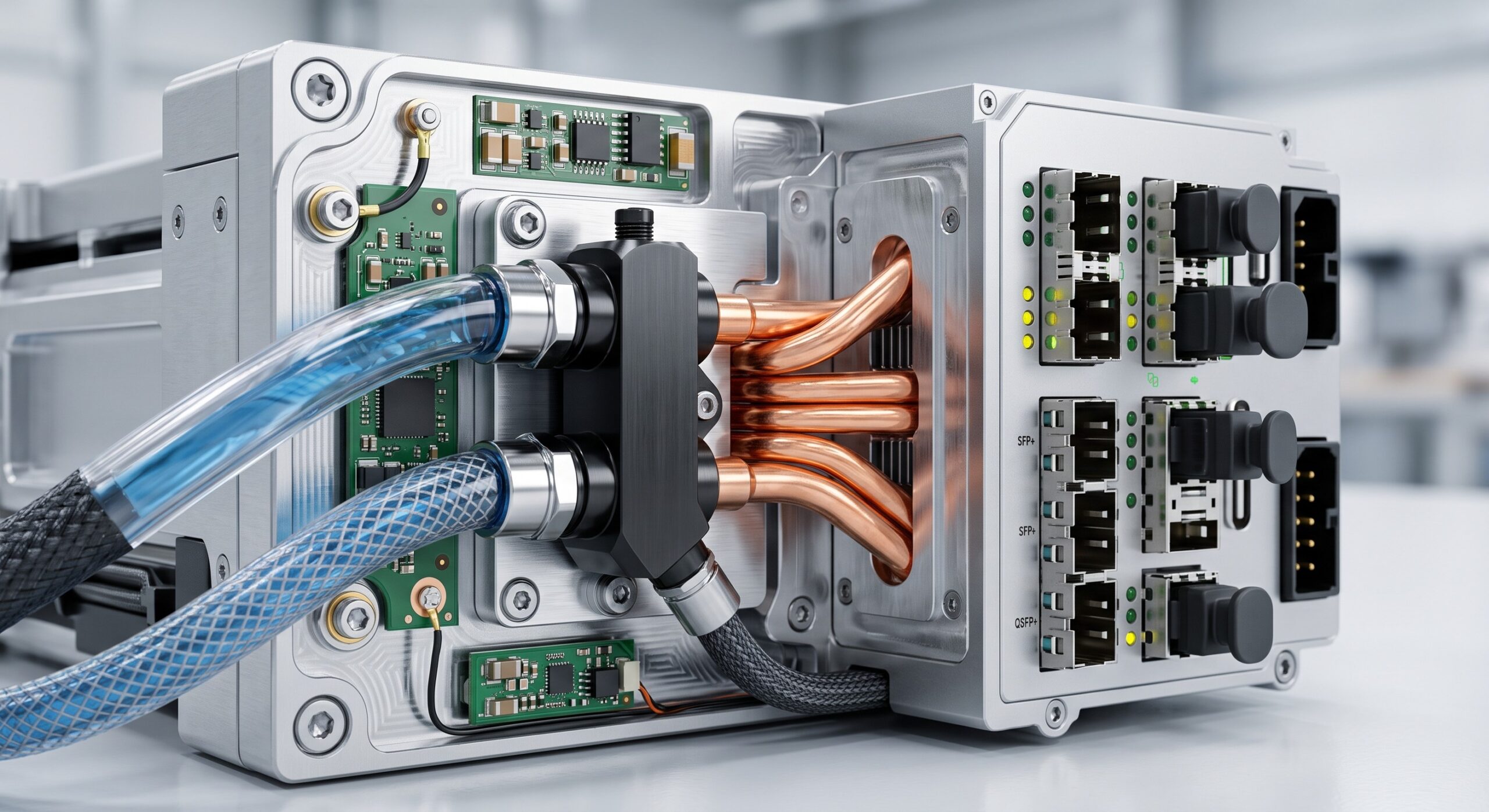
The hybrid module is designed as a compact, integrated assembly compatible with standard telecom rack units (1RU/2RU) and line card form factors. The architecture consists of a copper-based heat pipe array embedded in a cold plate, which interfaces directly with high-heat-flux components. The heat pipes utilize phase change (evaporation and condensation) to transport heat to a liquid-cooled manifold. The liquid loop is a closed, pressurized system with quick-disconnect couplings for easy maintenance. The chassis design incorporates airflow channels for supplementary convective cooling, ensuring redundancy. The module’s mechanical structure is optimized for shock and vibration resistance, adhering to NEBS Level 3 and ETSI standards.
HARDWARE FEATURES
– Hybrid Cooling: Combines heat pipe phase-change with liquid cooling for maximum heat dissipation up to 1,500W per module.
– Adaptive Thermal Control: Integrated sensors and microcontrollers dynamically adjust liquid flow and fan speed to maintain optimal temperatures.
– Leak-Proof Design: Industrial-grade seals and leak detection sensors prevent coolant ingress into electronic components.
– Hot-Swappable: Supports hot-swap of cooling modules without system downtime.
– Scalable: Modular design allows stacking for higher heat loads.
– Compatibility: Interfaces with standard 19-inch racks and OCP ORV3 liquid cooling manifolds.
COMPLIANCE & STANDARDS
– NEBS: GR-63-CORE, GR-1089-CORE
– ETSI: EN 300 019, EN 300 132-2
– Safety: UL 60950-1, IEC 62368-1
– Environmental: RoHS, REACH
– Liquid Cooling: OCP Liquid Cooling Standard, ASHRAE Class W4
TECHNICAL SPECIFICATIONS
The following table outlines the key operational parameters of the Hybrid Heat Pipe and Liquid Cooling Module.
| Parameter | Specification |
|---|---|
| Form Factor | 1RU / 2RU Chassis |
| Heat Dissipation Capacity | Up to 1500W (1RU) / 2000W (2RU) |
| Cooling Mechanism | Hybrid Heat Pipe + Liquid Cooling |
| Liquid Coolant | Propylene Glycol (PG25) or Deionized Water |
| Operating Temperature | -5°C to 55°C (ambient) |
| Liquid Flow Rate | 1.5 L/min (nominal) |
| Pressure Drop | |
| Power Supply | 1+1 Redundant AC/DC |
| Monitoring | SNMP, Redfish, I2C |
| MTBF | > 500,000 hours |
ORDERING OPTIONS
– Part Number: HHP-LC-1500 (1RU Module, 1500W)
– Part Number: HHP-LC-2000 (2RU Module, 2000W)
– Accessories: Liquid manifold, quick disconnects, monitoring software
– Warranty: 5-year standard, extendable to 10 years
📥 Download Technical Specification
Click the button below to view or download the full official PDF datasheet.

Leave a comment