

MARKET POSITIONING
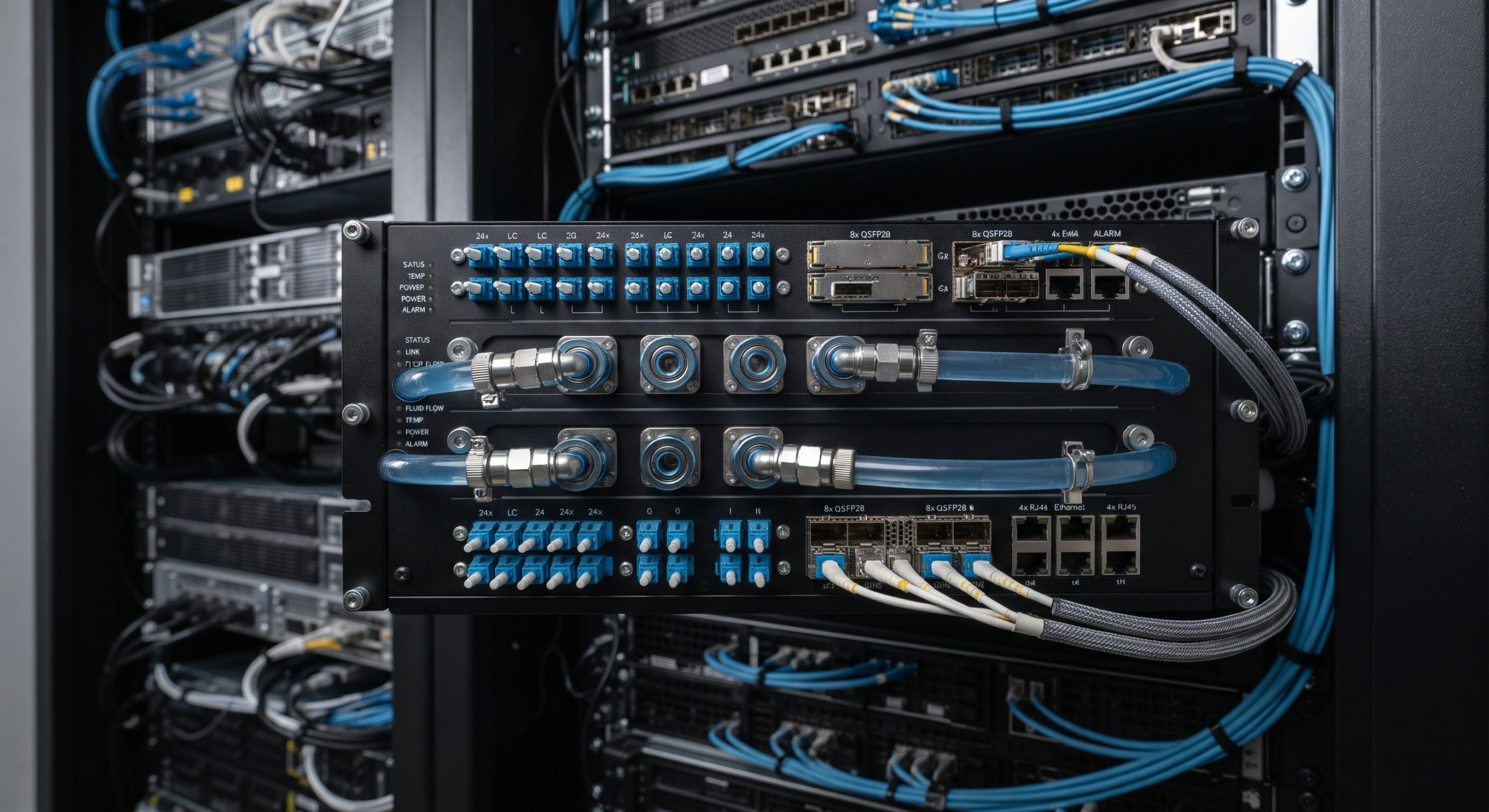
The Secondary Fluid Network Module (SFNM) represents a critical advancement in carrier-grade thermal management and fluid distribution for next-generation telecom infrastructure. Designed for deployment in high-density central offices, edge data centers, and ruggedized outdoor enclosures, the SFNM addresses the stringent requirements of secondary fluid loops used in liquid-cooled radio units, optical transport shelves, and high-power compute nodes. This solution brief outlines the material selection methodology and pressure rating framework that ensure long-term reliability, leak-free operation, and compatibility with dielectric and non-dielectric coolants. The SFNM is engineered to meet Telcordia GR-63-CORE and GR-487-CORE standards while delivering a 20-year service life in uncontrolled environmental conditions.

HIGH-AVAILABILITY REDUNDANCY
The SFNM incorporates a dual-barrier seal architecture with redundant O-ring faces and a secondary containment shell that captures any primary seal seepage. Material selection prioritizes 316L stainless steel for wetted metallic components, EPDM and FKM elastomers for coolant compatibility across temperature extremes (-40°C to +85°C), and PPSU thermoplastic for manifold bodies requiring high dimensional stability under pressure cycling. Pressure ratings are validated per ASME B31.3 and ISO 4413, with a design burst pressure of 4x maximum operating pressure. The module supports hot-swap serviceability without isolating the primary loop, ensuring five-nines availability for mission-critical cooling circuits.
PROTOCOL INTEROPERABILITY
SFNM interfaces are standardized to SAE J1926 and ISO 6149 port configurations, enabling drop-in replacement across multi-vendor fluid networks. Quick-disconnect couplings meet IEC 62368-1 and are compatible with propylene glycol, ethylene glycol, and fluorinated dielectric fluids. Integrated pressure and temperature sensors provide Modbus RTU and SNMP v3 telemetry, allowing seamless integration into DCIM and EMS platforms. The module’s flow path is optimized for low pressure drop (ΔP
Parameter
Specification
LIFECYCLE ASSURANCE (MTBF)
SFNM reliability is demonstrated through accelerated life testing per Telcordia SR-332, yielding an MTBF of 1,200,000 hours at 40°C ambient. The material selection process includes 5,000-hour immersion testing in both inhibited glycol and dielectric fluids, with no significant degradation in tensile strength, elongation, or seal compression set. Pressure cycling to 1.5x rated pressure for 100,000 cycles shows zero leakage or fatigue failure. The module carries a 10-year warranty with optional 20-year extended service coverage.
TARGET NETWORK TOPOLOGIES
The SFNM is optimized for centralized liquid-cooling distribution units (CDUs) serving remote radio heads, baseband units, and edge compute racks. It supports star and ring fluid topologies with up to 48 branch circuits per module. Typical deployments include 5G mmWave sites, hyperscale edge nodes, and hybrid cooled central offices where secondary fluid loops bridge facility water and IT equipment.
📥 Download Technical Specification
Click the button below to view or download the full official PDF datasheet.

Leave a comment