
VXLAN on Switches: Key Applications in Data Center and Campus Networks
1. What Is VXLAN?
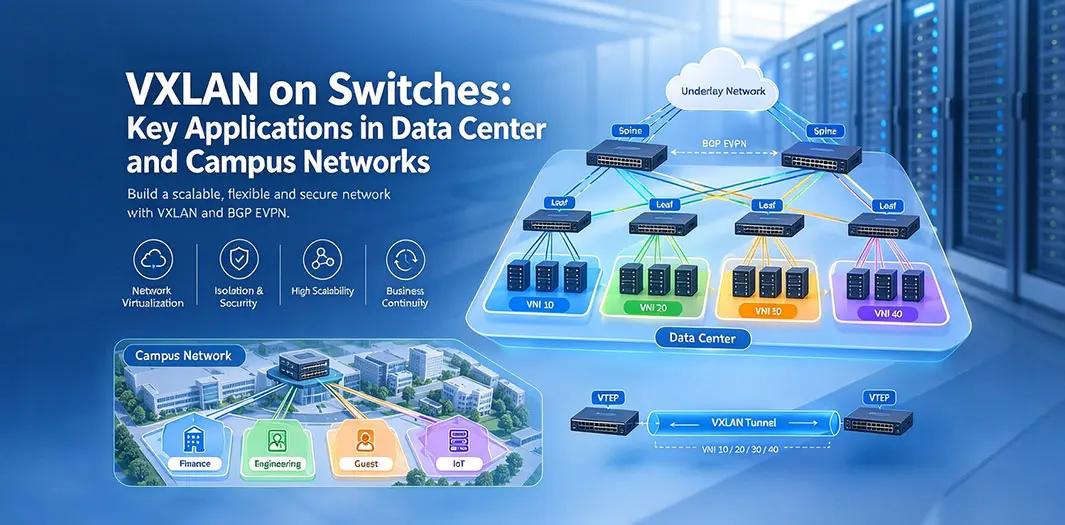
VXLAN (Virtual Extensible LAN) is a network virtualization technology that creates Layer 2 overlay networks over an existing Layer 3 IP network. It allows devices and workloads located on different physical networks to communicate as if they were connected to the same logical network.
On VXLAN-capable switches, VXLAN encapsulates original Ethernet frames into UDP packets, enabling traffic to travel across an IP-based underlay network. Each VXLAN segment is identified by a 24-bit VXLAN Network Identifier (VNI), supporting up to approximately 16 million logical network segments.
When combined with BGP EVPN (Ethernet VPN), VXLAN can provide scalable network segmentation, dynamic MAC/IP address learning, and efficient traffic forwarding across distributed switching infrastructure.
2. Key Applications of VXLAN on Switches
2.1 Data Center Network Virtualization
In modern data centers, VXLAN is widely used to build scalable overlay networks across spine-leaf switching architectures.
Servers and virtual machines connected to different leaf switches can communicate within the same logical network, even when they are located on different physical subnets or racks.
Key benefits:
- Extend Layer 2 connectivity across a Layer 3 infrastructure.
- Support multi-tenant network isolation using different VNIs.
- Improve scalability without relying on large numbers of VLANs.
- Enable flexible workload placement across physical servers.
2.2 Communication Between VXLAN and Traditional VLAN Networks
Many enterprise networks operate with both traditional VLAN-based infrastructure and newer VXLAN overlay networks. VXLAN-capable switches can provide gateway functions to connect these environments.
For example, a server in a VXLAN segment may need to communicate with a legacy application connected to a traditional VLAN. A switch configured as a gateway can route traffic between the corresponding networks according to the configured policies.
Key benefits:
- Support gradual network migration.
- Maintain connectivity with legacy systems.
- Reduce disruption when introducing network virtualization.
- Enable integration between traditional and virtualized environments.
2.3 Virtual Machine Migration and Workload Mobility
VXLAN can help maintain network connectivity when virtual machines move between physical servers connected to different switches.
When the destination environment supports the same logical network and the required routing and policy configuration, a virtual machine can retain its IP address and continue communicating with other workloads after migration.
This is particularly useful in virtualized data centers, where workloads may need to move for maintenance, resource balancing, or disaster recovery.
Key benefits:
- Simplify workload migration.
- Reduce the need for IP address reconfiguration.
- Support flexible resource allocation.
- Help maintain application connectivity during planned infrastructure changes.
2.4 Data Center Interconnection (DCI)
VXLAN can also be used as part of a data center interconnection solution to connect network segments across separate data center sites.
Depending on the design, VXLAN tunnels can extend selected Layer 2 segments between sites or support Layer 3 connectivity between data center networks.
This can help organizations build active-active or disaster recovery architectures while maintaining the required network segmentation.
Key benefits:
- Connect distributed data center environments.
- Support workload mobility where the architecture permits.
- Maintain logical network separation across sites.
- Enable flexible disaster recovery and business continuity designs.
- DCI deployments require careful planning of WAN connectivity, MTU, routing, failure handling, and Layer 2 loop prevention. Extending Layer 2 across sites should be limited to cases where it is genuinely required.
2.5 Spine-Leaf Architecture and Distributed Gateways
In a typical data center spine-leaf architecture, VXLAN is commonly deployed with BGP EVPN to provide scalable forwarding and distributed gateway services.
Leaf switches connect directly to servers and may function as VXLAN Tunnel Endpoints (VTEPs). Spine switches provide high-speed IP connectivity between leaf switches and may also serve as BGP EVPN route reflectors.
With distributed gateways, inter-subnet routing can take place close to the source server at the leaf layer, reducing unnecessary traffic forwarding through a centralized gateway.
Key benefits:
- Improve east-west traffic forwarding efficiency.
- Reduce dependence on centralized gateways.
- Support scalable Layer 2 and Layer 3 segmentation.
- Simplify network expansion in large data centers.
3. VXLAN Applications in Campus Networks
3.1 Network Segmentation for Different Departments
In large enterprise campuses, VXLAN can create separate logical networks for departments, business systems, guests, and other user groups over a shared physical switching infrastructure.
For example, finance, engineering, and guest users can be assigned to separate virtual networks with independent routing and security policies.
This approach improves network isolation while allowing the organization to share the same physical access and aggregation infrastructure.
3.2 User Access Authentication and Policy Mobility
VXLAN can work alongside access control technologies such as IEEE 802.1X and centralized network management systems.
After successful authentication, a user or endpoint can be assigned to a designated network segment according to its identity, role, or authorization policy. Depending on the platform and deployment design, the assignment may map to a VLAN or a VXLAN-based segment.
When users connect at different locations across the campus, consistent network access and security policies can follow their assigned identity or role.
3.3 Connectivity for Virtualized Campus Services
Where campus infrastructure hosts virtualized applications or services, VXLAN can provide logical connectivity between workloads attached to different switches.
When the relevant network segments and policies are consistently configured, services can be relocated between supported hosts without requiring the physical network topology to match the logical network layout.
4. How VXLAN Works on a Switch
A typical VXLAN deployment includes the following components:
- Underlay network: The physical IP network that provides reachability between VTEPs.
- Overlay network: The logical network created using VXLAN tunnels.
- VTEP: The VXLAN Tunnel Endpoint responsible for encapsulating and decapsulating traffic.
- VNI: The identifier used to distinguish VXLAN segments.
- BGP EVPN: A control-plane mechanism that distributes MAC/IP reachability information and supports scalable VXLAN deployments.
When a server sends traffic to a destination in another VXLAN segment endpoint, the ingress VTEP encapsulates the original Ethernet frame into a VXLAN packet. The underlay network forwards the packet to the destination VTEP, which decapsulates it and forwards the original frame to the destination network.
5. Key Considerations When Deploying VXLAN
Before implementing VXLAN on switches, network engineers should evaluate the following factors:
- Hardware and software support: Verify that the switch model and software version support the required VXLAN, VTEP, and BGP EVPN features.
- Underlay connectivity: Ensure reliable IP reachability between VTEPs.
- MTU configuration: Account for VXLAN encapsulation overhead to avoid packet fragmentation or drops.
- Gateway design: Determine whether centralized or distributed gateways best fit the network architecture.
- Routing and redundancy: Plan BGP EVPN, route reflectors, gateway redundancy, and failure recovery where applicable.
- Security and segmentation: Define VNI assignments, routing boundaries, access policies, and isolation requirements.
- Interoperability: Confirm compatibility across the selected switch models, software releases, and network management systems.
6. Conclusion
VXLAN extends the capabilities of traditional switching by enabling logical networks to operate across a scalable IP infrastructure. It is particularly valuable in data centers that require multi-tenant isolation, efficient east-west traffic forwarding, workload mobility, and flexible network expansion.
In campus networks, VXLAN can help implement role-based segmentation, consistent access policies, and connectivity for distributed services.
For successful deployment, VXLAN should be designed together with the underlay network, gateway architecture, routing control plane, and security policies. The appropriate configuration depends on the switch platform and the specific network requirements.
Leave a comment