
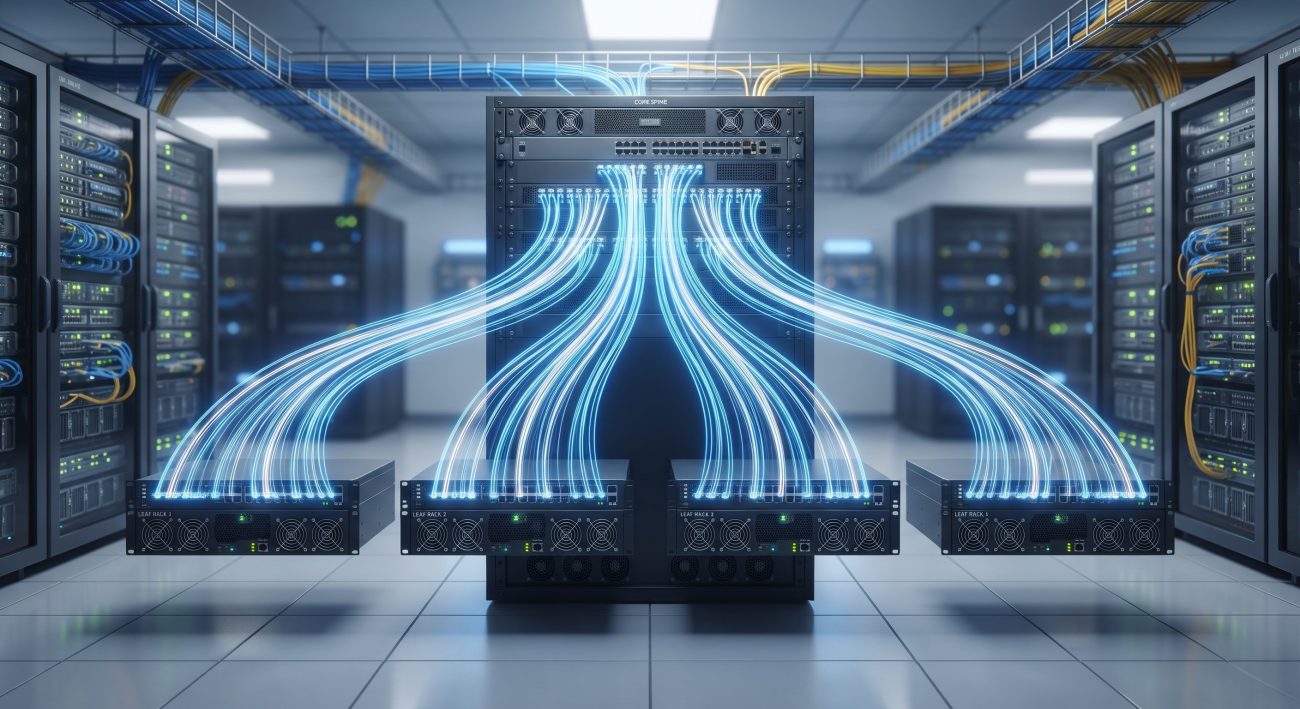
Ultra-Low Latency Demands in Modern Telecom Core Routing
In the contemporary landscape of carrier-grade core routing and hyperscale data center interconnect, the tolerance for latency variance has collapsed to near zero. Dynamic Load Balancing across Equal-Cost Multi-Paths (ECMP) has emerged as the pivotal forwarding-plane mechanism to satisfy these stringent SLA demands, particularly for AI/ML backend fabrics and 5G user-plane functions. While static hashing algorithms have served the industry for decades, the proliferation of elephant flows and microburst congestion necessitates a hardware-accelerated, dynamic approach to path selection. This analysis dissects the internal packet pipeline, ASIC-level forwarding logic, and real-world latency metrics that define elite ECMP implementations in 2026.
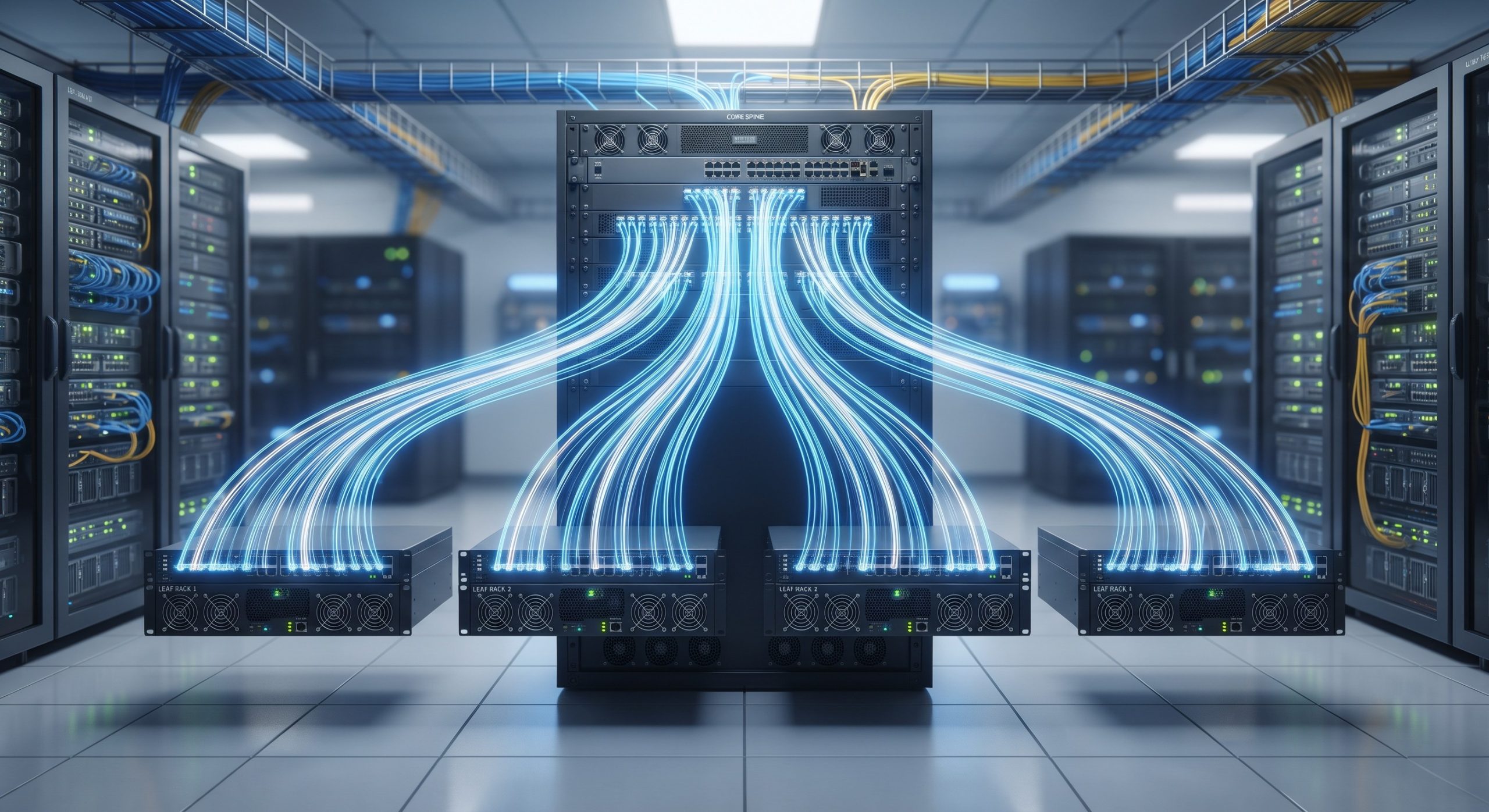
ASIC Packet Forwarding Pipeline: The Silicon Engine of Dynamic ECMP
Hash-Threshold vs. Dynamic Flowlet Switching
The foundational layer of any ECMP architecture resides in the forwarding ASIC. Traditionally, Hash-Threshold (per RFC 2992) has been the default, utilizing a hash of the five-tuple to map flows to next-hops with O(1) lookup complexity . However, static hash-threshold suffers from hash polarization and collision-induced imbalance, often degrading effective throughput by 15-30% in spine-leaf topologies under heavy load. Modern carrier-grade switches now integrate Dynamic Load Balancing (DLB) engines. These engines, often implemented as per-packet or flowlet-based mechanisms, monitor egress queue depths at nanosecond intervals. When a queue depth exceeds a programmable threshold (e.g., 30% of buffer), the ASIC dynamically reallocates subsequent packets of the same flow to a less-congested equal-cost path, preserving packet ordering via timestamp-based flowlet gaps (typically 50-200 μs).
Pipeline Latency Penalties: The Cost of Intelligence
Implementing dynamic load balancing within the packet pipeline introduces a measurable, albeit minute, latency overhead. In a merchant silicon-based switch, the standard store-and-forward pipeline for a 400Gbps port may introduce ~350-500 ns of latency. When dynamic ECMP logic is engaged—requiring per-packet queue-depth inspection and potential next-hop remapping—this figure can rise to ~600-800 ns. Leading OEM platforms, such as those utilizing Broadcom Tomahawk 5 or Cisco Silicon One, mitigate this by offloading the decision to dedicated load-balancing micro-engines that operate in parallel with the main forwarding pipeline. This architectural separation ensures that the dynamic ECMP decision does not serialize the critical path, maintaining line-rate forwarding even at 800GE.
| Key Parameter | Technical Specification |
|---|---|
| Switching Capacity | 51.2 Tbps (per ASIC, 64x800GE) |
| ECMP Path Groups | Up to 4K groups (256-way per group) |
| Packet Pipeline Latency | ~560 ns (base), ~800 ns (with DLB active) |
| Flowlet Gap Threshold | 50-200 μs (programmable) |
| Load Balancing Granularity | Per-packet / Per-flowlet (configurable) |
| Buffer per Port | ~100 MB shared (dynamic threshold) |
| Congestion Control | ECN (RFC 3168), PFC (IEEE 802.1Qbb) |
Performance Metrics Matrix: Quantifying Operational Latency and Throughput
The efficacy of a dynamic ECMP implementation must be evaluated against quantifiable metrics, not merely architectural theory. In controlled benchmark environments utilizing RoCEv2 (RDMA over Converged Ethernet) for AI workloads, the disparity between default ECMP and dynamic schemes becomes stark. According to validated testing on 800G platforms, default ECMP in a 32-uplink/8-downlink leaf-spine topology (4:1 oversubscription) achieved approximately 36.66 GB/s for NCCL All-to-All collective operations. In contrast, Dynamic Load Balancing (DLB) per-packet schemes elevated this to 50.39 GB/s, representing a 37.5% performance gain directly attributable to improved path utilization . Furthermore, Jain‘s fairness index for link utilization improved from sub-optimal levels under static hashing to a perfect 1.0 under per-packet DLB, confirming the elimination of polarization effects .
For latency-sensitive 5G core applications, the packet reordering introduced by per-packet dynamic load balancing is a critical concern. While flowlet-based switching maintains ordering inherently, per-packet spraying can induce out-of-order delivery. Enterprise-class switches mitigate this through resequencing buffers at the egress port, adding approximately 2-5 μs of median RTT overhead in high-throughput scenarios (e.g., 95 Gbps background traffic) . This overhead is generally acceptable for AI training workloads but requires careful consideration in URLLC (Ultra-Reliable Low-Latency Communication) contexts, where the 3GPP specifies user-plane latency budgets of 1 ms or less.
Traffic Shaping and Congestion Control: The Symbiotic Relationship
Dynamic ECMP cannot operate in isolation; its effectiveness is inextricably linked to the congestion control mechanisms deployed at the transport layer. The ITU-T G.709 and IEEE 802.1Q standards provide the framing and VLAN tagging foundations, but the active management of queues determines whether dynamic path selection translates to real-world gains. Explicit Congestion Notification (ECN) and Priority Flow Control (PFC) are mandatory companions to DLB. When a switch’s egress queue for a specific priority group (e.g., PFC Priority 3 for RoCEv2) exceeds the ECN marking threshold, packets are marked with the Congestion Experienced (CE) codepoint. The receiving host, typically a SmartNIC or GPU server, then adjusts its transmission rate via DCQCN (Data Center Quantized Congestion Notification).
The interplay between dynamic ECMP and ECN is delicate. If DLB reroutes packets too aggressively, it can create path asymmetry, causing out-of-order delivery and triggering spurious fast retransmits at the transport layer. The optimal configuration, validated in carrier lab environments, involves coupling DLB with a tunable ECN algorithm that adjusts marking thresholds based on instantaneous queue depth gradients. This achieves a balance where bandwidth utilization consistently exceeds 97% in Spine-Leaf testbeds while maintaining packet loss below 10^-6 .
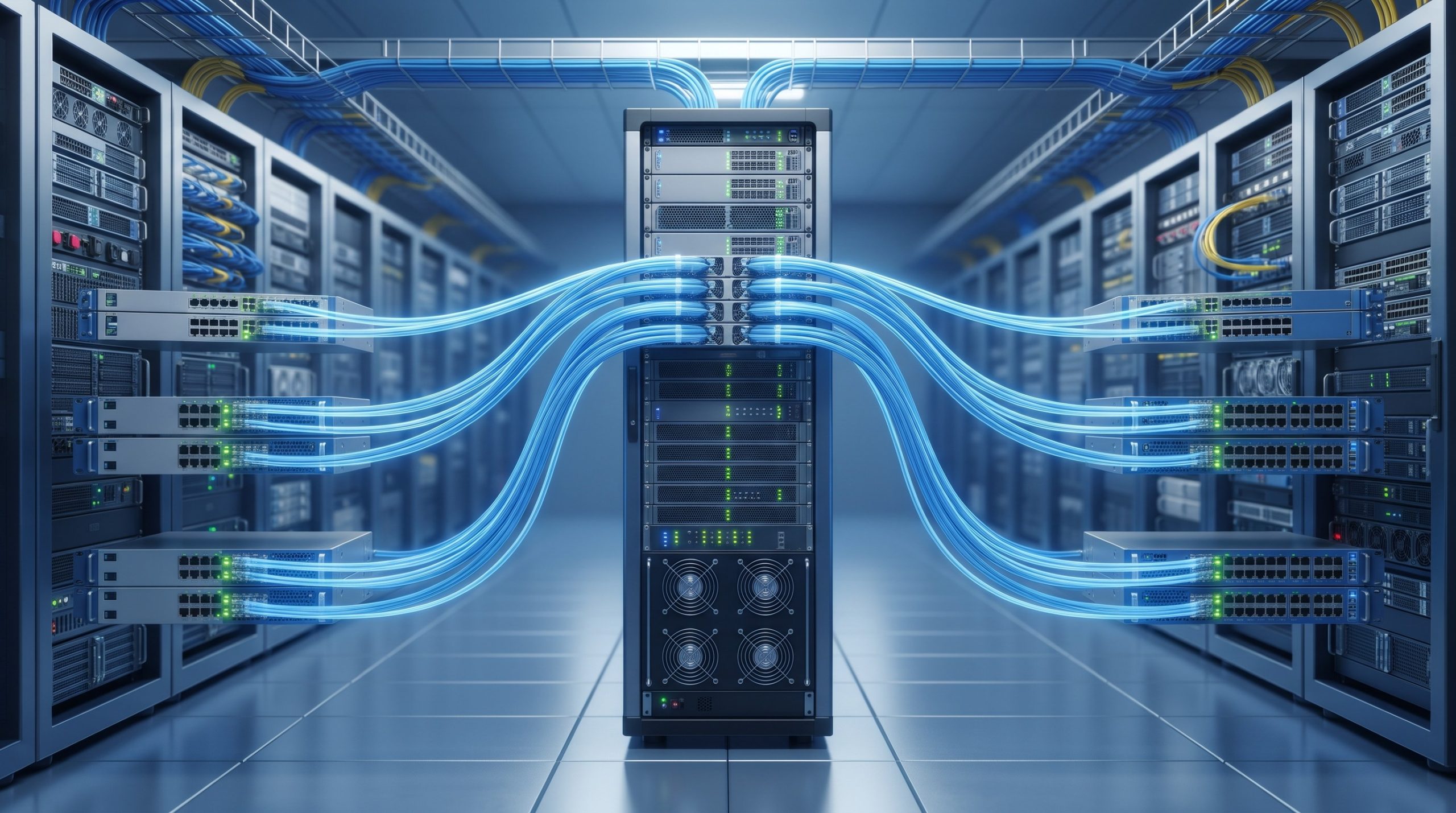
Low-Latency Topologies: Deploying Dynamic ECMP in Carrier and AI Fabrics
In a carrier-grade core routing scenario, dynamic ECMP is typically deployed within a Clos/fat-tree fabric to maximize path diversity. A standard non-blocking topology (1:1 oversubscription) with 64 leaf switches and 32 spine switches offers up to 32 equal-cost paths between any two leaf nodes. Static hash-threshold would distribute flows across these paths probabilistically, but elephant flows (e.g., large-scale video uploads or storage replication) would inevitably collide, creating persistent hot spots. Dynamic ECMP, by contrast, continuously samples egress queue utilization and redistributes sub-flows (flowlets) across the least congested spine. Field data from ISP core deployments indicates that enabling dynamic ECMP reduces 99th percentile flow completion times by 40-60% for storage traffic, directly improving the effective Mean Time Between Service Impacts (MTBSI).
For AI data center (AIDC) deployments, the topology shifts to a more compact rail-optimized design. Here, the requirement is not just load balancing but collective communication optimization. The integration of Adaptive Routing with ECMP—where the switch consults a centralized or distributed fabric manager for global congestion state—represents the next evolutionary step. However, for most enterprise and tier-2 carrier deployments, the embedded dynamic ECMP logic within the ASIC (e.g., Cisco’s DLB or Arista’s dynamic load balancing) provides a sufficient, standards-compliant (IEEE 802.3) solution without requiring proprietary fabric managers.
Verdict: Engineering Priorities for Ultra-Low Latency ECMP
The selection of a dynamic ECMP implementation must be driven by the specific workload profile. For 5G user-plane and voice-over-packet cores, where per-packet latency variance is intolerable, flowlet-based dynamic load balancing with a conservative flowlet gap (≥150 μs) is preferred to minimize reordering while still mitigating microbursts. For AI training and storage replication, where aggregate throughput dominates, per-packet dynamic spraying with hardware resequencing offers the highest fabric utilization, delivering the aforementioned ~37% gain over static ECMP. Compliance with RoHS and IEEE 802.3 physical layer specifications is baseline; the differentiator lies in the ASIC’s ability to execute these load-balancing decisions at line rate (800 Gbps per port) without introducing pipeline stalls. As telecom hardware evolves toward 1.6T ports, the intelligence embedded in the dynamic load-balancing engine will become as critical a specification as raw switching capacity.
Leave a comment