

CORE INFRASTRUCTURE OBJECTIVES
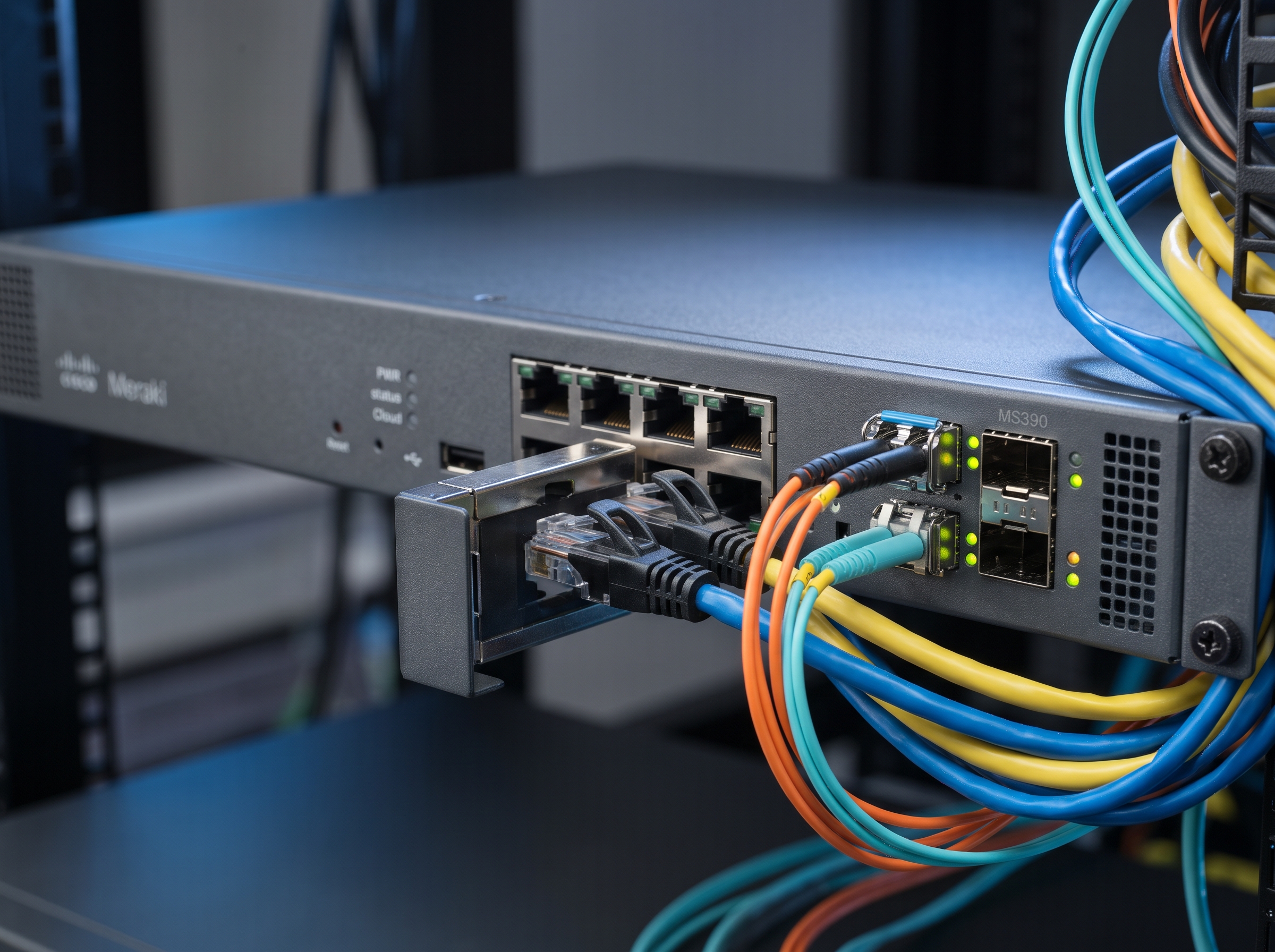
The Cisco Meraki MS390 Series represents a paradigm shift in cloud-managed access switching, purpose-built to address the most demanding enterprise and campus network requirements. As organizations transition toward high-density Wi-Fi 6 (802.11ax) deployments and bandwidth-intensive applications, the need for a robust Layer 3 routing foundation at the network edge becomes paramount. The MS390 integrates powerful Cisco Catalyst-class ASIC hardware with the intuitive simplicity of the Meraki dashboard, delivering wire-speed routing, advanced security segmentation, and hardware-level redundancy. This reference design guide establishes the architectural framework for deploying the MS390 as a strategic Layer 3 routing node, detailing its forwarding pipeline, protocol interoperability, and physical resilience mechanisms essential for modern enterprise edge topologies.

MULTI-GIGABIT THROUGHPUT ARCHITECTURE
The MS390 is engineered around a high-capacity, non-blocking switching fabric designed to eliminate bottlenecks between the access layer and the core. Unlike traditional fixed-configuration switches, the MS390 series offers a modular uplink architecture, supporting optional 10GbE or 40GbE modules to scale backbone connectivity in line with evolving traffic patterns. The platform delivers switching capacities ranging from 208 Gbps on the 24-port Gigabit models to 640 Gbps on the multi-gigabit models, ensuring ample headroom for aggregated access traffic and inter-VLAN routing workloads. Central to its routing capability is the dedicated hardware stacking architecture, which provides 480 Gbps of stacking bandwidth via dual dedicated ports. This physical stacking, combined with sub-second convergence, allows network architects to build resilient Layer 3 distribution blocks where routing adjacencies and forwarding tables remain synchronized across the stack, minimizing disruption during link or unit failures.
REDUNDANCY FEATURES
High availability at the routing edge is non-negotiable. The MS390 introduces StackPower, a Cisco innovation making its Meraki debut, which aggregates power supplies across up to four switches in a stack into a single shared pool. This architecture eliminates the need for per-switch redundant power supplies, dynamically reallocating power budgets to accommodate PoE+ or UPoE demands on any member switch without manual intervention. For routing resiliency, the platform supports First Hop Redundancy Protocols (FHRP) including VRRP, enabling seamless gateway failover for hosts utilizing the MS390 as their default gateway. Furthermore, the MS390 supports OSPF (Open Shortest Path First) for dynamic route advertisement, allowing the switch to participate in larger routed domains and converge around topology changes without static route reconfiguration. The Enterprise license tier supports up to 1,000 OSPF routes, while the Advanced license tier removes this limitation for larger-scale deployments.
COMPREHENSIVE SPECS
The Layer 3 routing feature set on the MS390 is comprehensive and designed for operational simplicity. Inter-VLAN routing is configured via Switch Virtual Interfaces (SVIs) or routed ports, with support for both IPv4 and IPv6 addressing. DHCP services can be hosted locally on the switch or relayed to external servers, and OSPFv2/v3 can be enabled per interface to advertise connected subnets. Access Control Lists (ACLs) can be applied to routed interfaces to enforce security policies between VLANs, reducing the load on upstream firewalls. For multicast traffic, IGMP snooping is supported to constrain flooding, though administrators should note that without IGMP snooping enabled, the MS390 will flood multicast traffic to all ports in the VLAN. Quality of Service (QoS) is managed centrally through the Meraki dashboard, with support for DSCP marking and honoring, ensuring that latency-sensitive voice and video traffic is prioritized across the routed path.
TECHNICAL SPECIFICATIONS
| Parameter | Specification |
|---|---|
| Form Factor | 1RU Rack Mount Chassis |
| Switching Capacity | 208 Gbps to 640 Gbps (model dependent) |
| Stacking Bandwidth | 480 Gbps (Dedicated Hardware Stack Ports) |
| Forwarding Rate | 154.76 Mpps to 476.19 Mpps (model dependent) |
| Layer 3 Routing Protocols | Static Routing, OSPFv2/v3, VRRP |
| Uplink Options | Modular 10GbE (SFP+) or 40GbE (QSFP+) |
| Downlink Ports | 24 or 48 ports; 1GbE, 2.5GbE, 5GbE, or 10GbE mGig options |
| PoE Capabilities | PoE+ (802.3at) and UPoE/802.3bt (up to 90W per port) |
| Power Redundancy | 1+1 Hot-swap PSU; StackPower shared pool (up to 4 switches) |
| Operating Temperature | -5°C to 45°C |
| Management | Cisco Meraki Cloud Dashboard (Zero-touch provisioning) |
The table below outlines the core hardware and performance parameters for the MS390 series, reflecting the platform’s capability to serve as a high-performance Layer 3 routing node in enterprise environments.
REGULATORY DIRECTIVES
The MS390 is designed to meet stringent international standards for safety, electromagnetic compatibility, and environmental resilience. The platform operates reliably across a temperature range of -5°C to 45°C and humidity levels of 5% to 90%, making it suitable for deployment in diverse wiring closet environments. Hot-swappable fan trays and power supplies ensure serviceability without disrupting network operations, while the fanless option on select non-PoE models (where applicable) or variable-speed fan logic contributes to acoustic comfort in open-office deployments. Compliance with IEEE 802.1Q (VLAN tagging), 802.1p (QoS), 802.3ad (LACP), and 802.1x (authentication) ensures seamless integration into existing enterprise network policy frameworks.
ENTERPRISE TOPOLOGY
In a typical enterprise edge routing topology, the MS390 stack serves as the Layer 3 boundary between access VLANs and the core network. Uplinks from the MS390 (via optional 10/40GbE modules) connect to the campus core or distribution layer, where OSPF adjacencies are formed to exchange routing information. Access ports are configured as trunk or access ports, with SVIs acting as default gateways for endpoint devices. Adaptive Policy, available with the Advanced license, enables micro-segmentation based on security group tags rather than IP addresses, simplifying policy management in dynamic environments where IoT and guest devices require strict isolation. For organizations with mixed Meraki and Catalyst switching environments, the MS390 operates on a separate firmware track (CS releases) to maintain alignment with Catalyst-based feature sets.
📥 Download Technical Specification
Click the button below to view or download the full official PDF datasheet.

Leave a comment