

EXECUTIVE SUMMARY
The ZTE ZXHN F670L is a carrier-grade AC1200 dual-band GPON gateway engineered for high-performance residential and small business FTTH deployments. This document provides an authoritative technical reference for the radio frequency subsystem of the F670L, specifically focusing on the internal antenna configuration, gain characteristics, and resultant coverage patterns. The platform integrates 2×2 MIMO Wi-Fi operating concurrently in the 2.4 GHz (802.11n) and 5 GHz (802.11ac) bands, achieving aggregate physical layer rates of up to 1.2 Gbps . While the F670L is widely recognized for its external 5 dBi antenna variant, the internal antenna configuration represents a critical SKU for deployment scenarios requiring a compact, integrated form factor without protruding external elements. This overview delineates the RF propagation behavior, hardware integration, and compliance metrics essential for network planners and RF engineers.

ARCHITECTURE AND RADIO SUBSYSTEM DESIGN
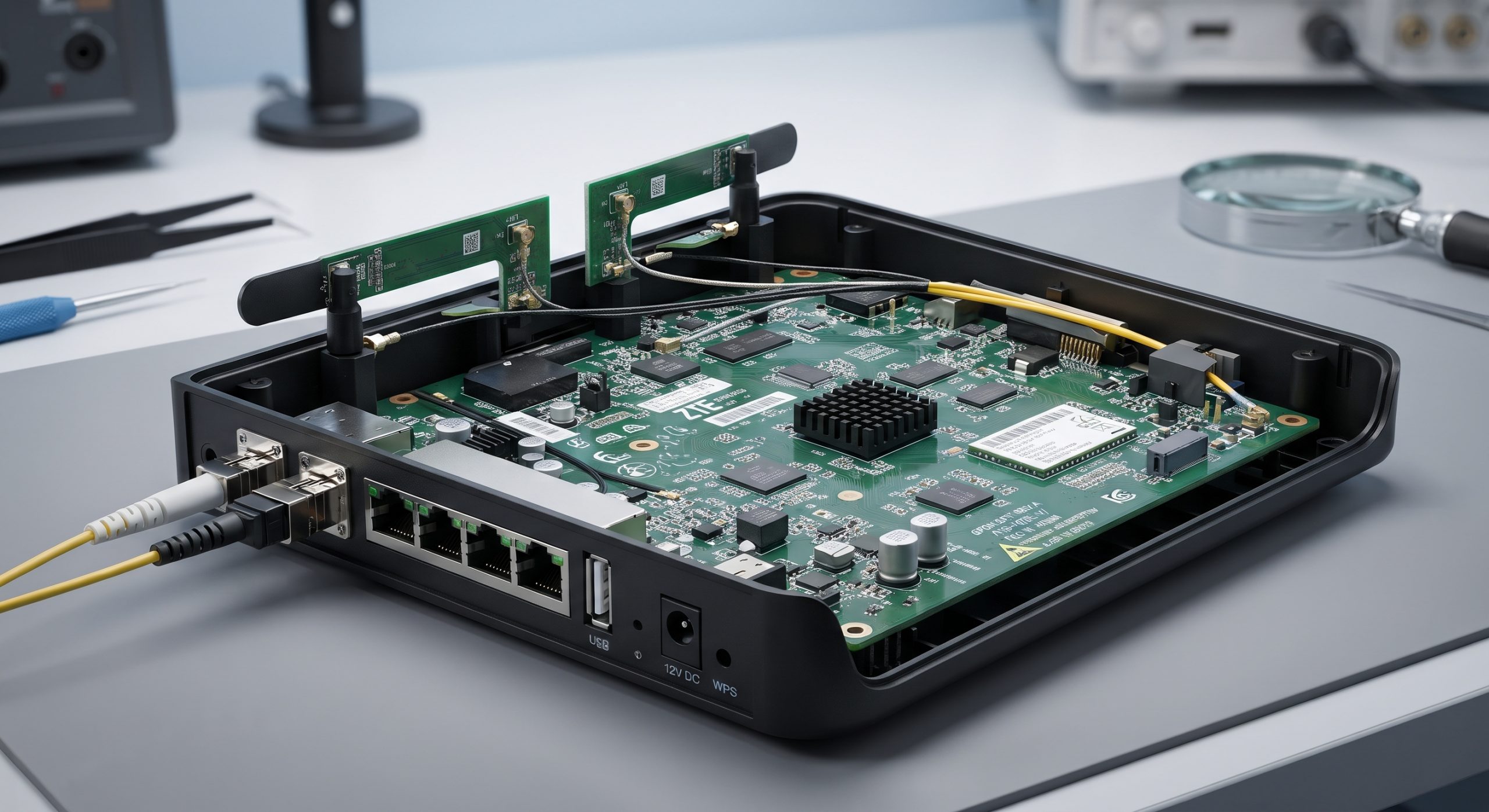
The F670L internal antenna variant preserves the core routing and GPON MAC architecture of the standard platform while integrating the radiating elements directly onto the PCB or within the upper housing assembly. The radio chain utilizes a 2×2 MIMO configuration for both frequency bands, ensuring spatial multiplexing and diversity gains are maintained despite the absence of external dipole housings. The internal antennas are specified with a maximum gain of 5 dBi, a figure that aligns with the external variant and indicates the use of high-efficiency printed or ceramic element designs to compensate for the absence of free-space clearance typically afforded by external whips . The RF front-end is engineered to support 20 MHz and 40 MHz channel bandwidths in the 2.4 GHz band and up to 80 MHz in the 5 GHz band, with transmit power calibrated to meet global regulatory EIRP limits while maximizing in-premises coverage.
HARDWARE FEATURES AND RF CHARACTERISTICS
The internal antenna configuration is optimized for ceiling-mounted or desktop placement where aesthetic discretion and physical robustness are prioritized. The antenna radiation pattern is quasi-omnidirectional in the azimuth plane, with a distinct elevation beamwidth tailored to illuminate the typical residential floor plan. The 5 dBi peak gain is realized through a balanced trade-off between directivity and pattern uniformity, ensuring that the 5 GHz band delivers high throughput within the primary room while the 2.4 GHz band provides the necessary penetration and diffraction around interior obstacles. The platform supports WMM (Wi-Fi Multi Media) for QoS prioritization of voice and video traffic, which is critical when the antenna gain is optimized for coverage rather than point-to-point link budget .
COMPLIANCE AND STANDARDS
The F670L radio subsystem complies with IEEE 802.11b/g/n for 2.4 GHz operations and IEEE 802.11a/n/ac for 5 GHz operations. The internal antenna variant adheres to the same electromagnetic compatibility (EMC) and radio equipment directive (RED) requirements as the external antenna model, including specific absorption rate (SAR) evaluations for close-proximity human exposure. The device supports WPA/WPA2 and WPS security protocols, ensuring that the extended coverage footprint does not compromise link-layer security .
TECHNICAL SPECIFICATIONS
The following table summarizes the radio frequency and physical parameters specific to the internal antenna configuration of the ZXHN F670L.
| Parameter | Specification |
|---|---|
| Antenna Configuration | Internal, 2×2 MIMO per band |
| Peak Gain (2.4 GHz) | 5 dBi (maximum) |
| Peak Gain (5 GHz) | 5 dBi (maximum) |
| Frequency Bands | 2.400 – 2.4835 GHz; 5.150 – 5.850 GHz |
| Wi-Fi Standards | 802.11b/g/n (2.4 GHz); 802.11a/n/ac (5 GHz) |
| Max PHY Rate | 300 Mbps (2.4 GHz) + 866 Mbps (5 GHz) = 1.2 Gbps |
| MIMO Technology | 2×2 Spatial Multiplexing |
| Form Factor | Desktop / Wall-mountable compact enclosure |
| GPON Interface | 1x SC/APC, Class B+ |
| LAN Interfaces | 4x GE (10/100/1000 Mbps) |
ORDERING OPTIONS
The F670L is available in multiple hardware configurations to suit varied operator requirements. The internal antenna variant is typically denoted by a specific SKU suffix within the ZTE ordering matrix, distinguished from the external 5 dBi antenna version. Operators should verify the specific hardware revision to ensure the desired antenna topology is provisioned. Both variants share the same GPON interface (SC/APC), LAN port density (4x GE), and voice port (1x POTS) configurations, ensuring management and service provisioning remain identical across the access network .
📥 Download Technical Specification
Click the button below to view or download the full official PDF datasheet.

Leave a comment