
SLA Demands in High-Density Liquid Cooling
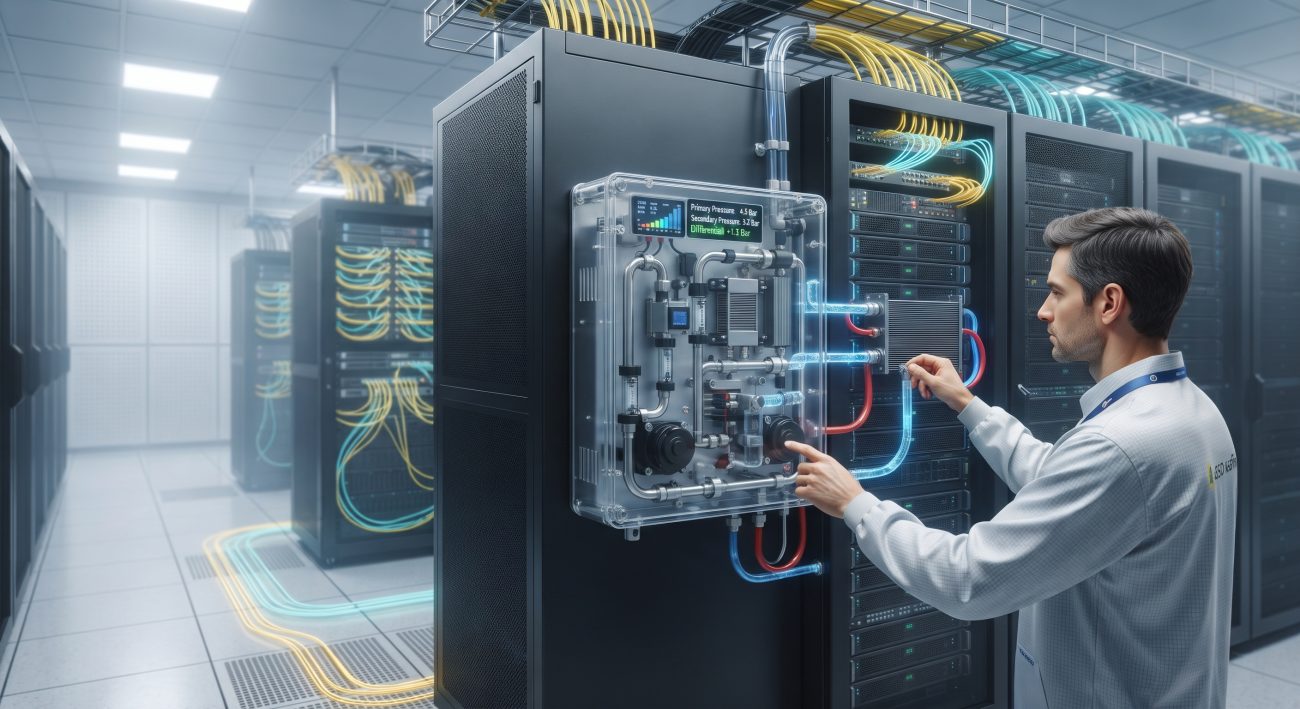
The thermal envelope of modern AI compute racks has shattered the ceiling of air-cooled viability. With per-rack power densities exceeding 100 kW and GPU thermal design power escalating toward 150 kW per rack in next-generation architectures, the Secondary Fluid Network Module has transitioned from a passive plumbing accessory to an active, mission-critical availability domain . For carrier-grade and colocation operators, the Service Level Agreement is no longer defined solely by network uptime; it is inseparably bound to the hydraulic stability of the Technology Cooling System.
The core engineering challenge is pressure differential control. Unlike facility water systems that operate at relatively stable pressures, the secondary loop must dynamically compensate for the variable flow resistance of dozens of server cold plates. A deviation of just 10-15 kPa from the design setpoint can trigger asymmetric flow distribution, causing downstream GPUs to throttle or, in worst-case scenarios, experience thermal runaway within 3 to 5 minutes . This analysis deconstructs the reliability engineering of secondary fluid modules, focusing on MTBF metrics, failover architecture, and the hydraulic logic that governs pressure differential stability.
Dual-Engine Failover Architecture and Hydraulic Isolation
Active-Standby Pump Topology with N+1 Redundancy
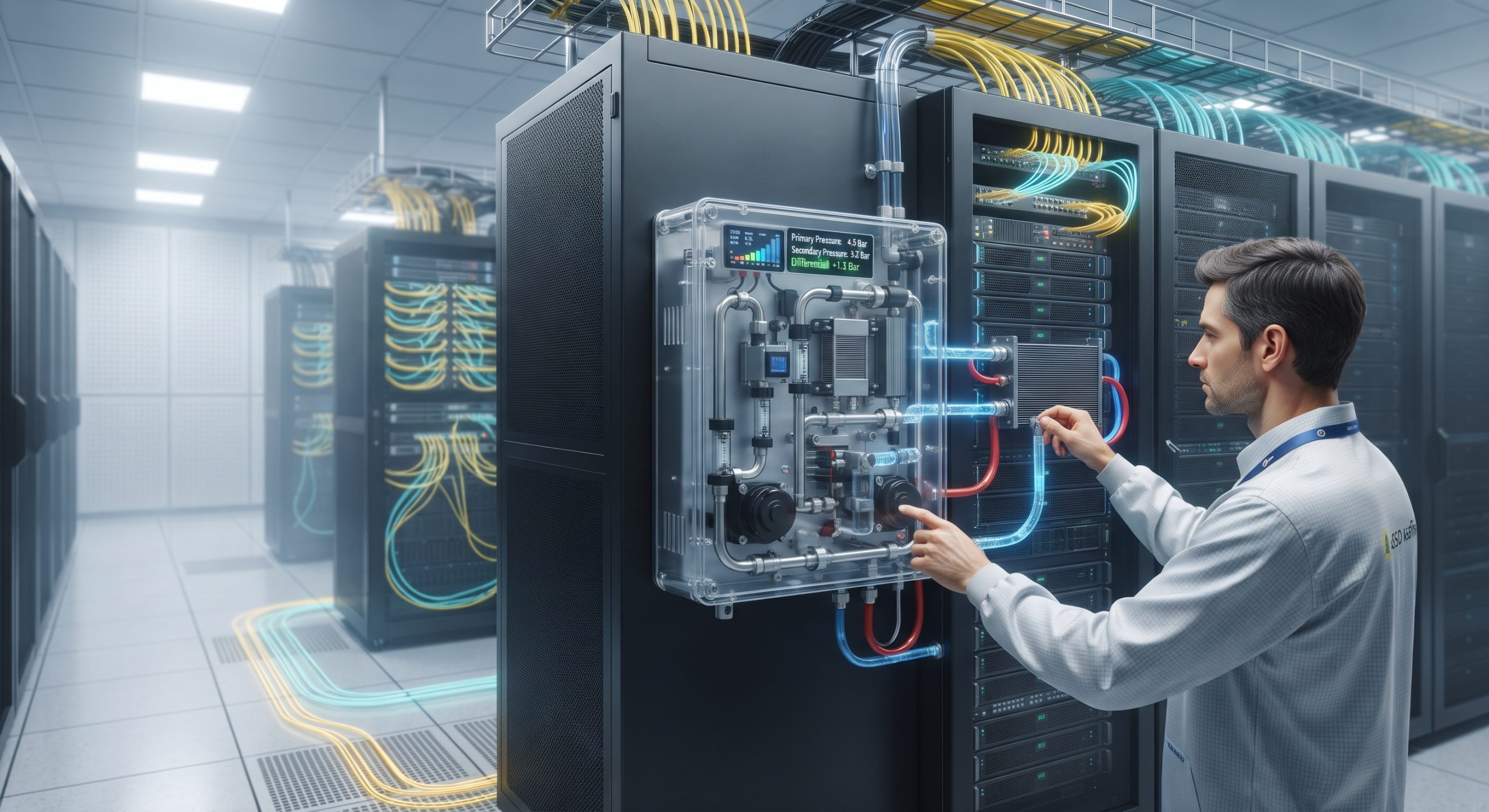
Carrier-grade secondary fluid modules abandon the single-pump paradigm in favor of N+1 redundancy configured in an active-standby or parallel assist topology. In a typical high-reliability in-rack CDU, three variable-speed centrifugal pumps operate in parallel, with the controller designating one as the lead pump and the remaining units as hot spares . The critical differentiation lies in the fail-safe signal loss behavior. When the control module detects a loss of communication or a pump failure, the system does not simply shut down; the pumps revert to a fail-safe mode, continuing to operate at the last known speed setpoint until manual intervention or automatic failover completes. This prevents a control plane hiccup from cascading into a thermal event.
From a pressure differential control standpoint, the transition between pumps must be bumpless. The controller monitors the delta-P across the supply and return manifolds via redundant hot-swappable pressure sensors. Upon detection of a pressure decay exceeding a 5% threshold within a 500 ms window, the standby pump ramps to synchronous speed, and the isolation valves sequence to redirect flow without introducing water hammer or air entrainment . The MTBF of the pump assembly itself, typically rated at > 100,000 hours for the mechanical seals and bearings in continuous duty, becomes a secondary concern when the failover logic is robust; the system-level availability is dictated by the valve and sensor response times.
Heat Exchanger Isolation and Cross-Contamination Prevention
The secondary fluid module enforces a strict hydraulic boundary between the facility water and the TCS loop. A plate heat exchanger with a double-wall construction or a pressure-boundary monitoring port provides an additional layer of integrity . Should a gasket breach occur, the pressure differential between the facility side and the TCS side ensures that any cross-leak flows toward the facility side, preventing contaminated water from reaching the micron-level cold plate microchannels. The MTBF for the brazed plate heat exchanger under thermal cycling exceeds 200,000 hours, but the risk of fouling-induced pressure drop remains the dominant degradation mechanism in field deployments .
| Key Parameter | Technical Specification |
|---|---|
| Rated Heat Dissipation Capacity | 150 kW @ 6 K ATD (Approach Temperature Difference) |
| Secondary Loop Flow Rate | 225 L/min at 1.5 bar delta-P setpoint |
| Pump Redundancy Configuration | N+1 (3 x Variable Speed Centrifugal Pumps) |
| Pressure Differential Control Range | 0.5 – 2.5 bar adjustable, ± 5% stability |
| System MTBF (Module Level) | > 100,000 hours (validated field data) |
| Failover Response Time | |
| Filtration Rating (TCS Side) | 25 μm absolute (standard), 50 μm optional |
| Wetted Materials Compliance | RoHS, REACH, SS316L / EPDM (glycol compatible) |
MTBF Metrics and Reliability Validation
Reliability predictions for secondary fluid modules must account for the Bathtub Curve specific to hydraulic components. The module-level MTBF validated through field data for a carrier-grade secondary fluid network module exceeds 100,000 hours, with critical sub-components such as pumps and heat exchangers achieving significantly higher individual ratings . However, operators must recognize that system availability is not the arithmetic sum of component MTBFs. The pressure differential stability—maintained within ±5% of setpoint—is the true leading indicator of thermal reliability.
Material selection further dictates lifecycle assurance. Wetted components conform to RoHS and REACH directives, with SS316L stainless steel and EPDM elastomers specified for glycol compatibility . Filtration on the TCS side is maintained at 25 μm absolute to protect cold plate microchannels from particulate fouling that would otherwise elevate pressure drop and force the pump to operate outside its best-efficiency region. In carrier-grade deployments, the secondary fluid module must also satisfy Telcordia GR-63-CORE and GR-487-CORE standards for environmental robustness, with design burst pressure validated at 4x maximum operating pressure per ASME B31.3 and ISO 4413 .
Mission-Critical Deployments and Operational Validation
In live AI training clusters and colocation environments, the secondary fluid module is validated not by datasheet specifications but by its response to transient load swings. When a GPU node transitions from idle to 100% TDP within milliseconds, the flow resistance through the cold plate changes dynamically. A carrier-grade module must maintain the supply-return differential pressure within the stability band while the pump ramps to accommodate the new flow demand. Field data from 150 kW-class deployments indicates that modules with sub-second failover response and ±5% delta-P stability prevent thermal throttling events that would otherwise degrade training throughput by 8-12% during peak load periods .
The integration of Modbus RTU and SNMP v3 telemetry enables continuous monitoring of delta-P, flow rate, and pump power draw, feeding into DCIM platforms for predictive maintenance . Operators should establish alarm thresholds at ±10% delta-P deviation and schedule filter replacement based on pressure drop trending rather than fixed intervals. For systems deployed in edge or uncontrolled environments, the dual-barrier seal architecture with secondary containment provides an additional failure-detection layer, ensuring that even a primary seal seepage is captured and alarmed before coolant reaches IT equipment .

Final Assessment
The Secondary Fluid Network Module for liquid-cooled cabinets represents a convergence of hydraulic engineering and carrier-grade reliability discipline. The metrics that matter are unambiguous: MTBF exceeding 100,000 hours, pressure differential stability within ±5%, and failover response under 500 ms. These are not aspirational figures; they are the baseline requirements for any deployment where GPU thermal runaway risk carries seven-figure operational consequences. As rack densities continue their inexorable climb toward 150 kW and beyond, the pressure differential control logic embedded in the secondary fluid module will remain the silent guarantor of thermal availability—unseen, uncelebrated, and absolutely indispensable.
Leave a comment