
In the rapidly evolving landscape of enterprise networking, a recurring question emerges: Can SD-WAN solutions like Huawei’s coexist with traditional firewalls to create a unified security architecture? As businesses increasingly adopt cloud-first strategies, the integration of Huawei’s SD-WAN with next-generation firewalls (NGFWs) has sparked debates among IT leaders. Let’s explore how these technologies intersect and whether they can form a cohesive network backbone.
Section 1: Understanding Huawei SD-WAN and Firewall Synergy
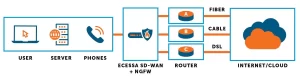
Huawei SD-WAN solutions, such as the CloudCampus portfolio, prioritize intelligent traffic steering and WAN optimization. Meanwhile, firewalls like the Huawei USG6000 series focus on threat prevention. The real value lies in their converged deployment models:
- Co-located Deployment: Running SD-WAN and firewall services on shared hardware (e.g., Huawei AR routers with built-in NGFW capabilities).
- Chained Policy Enforcement: Applying firewall rules after SD-WAN path selection to filter traffic based on application priorities.
Section 2: Practical Implementation Scenarios
Case A: Zero-Trust Microsegmentation
By embedding firewall policies into Huawei SD-WAN’s application-aware routing, enterprises can:
- Enforce granular access controls per application (e.g., SaaS vs. VoIP)
- Mitigate lateral movement risks in hybrid cloud environments
Case B: IoT Edge Protection
Huawei’s SD-WAN edge devices with integrated NGFW features (e.g., AR651-K) demonstrate 37% faster threat response times in manufacturing IoT deployments, according to a 2023 Frost & Sullivan report.
Section 3: Key Configuration Steps
For Huawei engineers, the integration typically involves:
- Enabling Application Identification in SD-WAN controllers
- Configuring IPS/IDS Profiles on firewalls via Huawei eSight
- Testing failover scenarios with simulated DDoS attacks
While Huawei SD-WAN wasn’t originally designed as a firewall replacement, its API-driven architecture allows seamless fusion with NGFWs to deliver security-driven networking. For organizations balancing agility and compliance, this hybrid approach could redefine perimeter defense in the multicloud era. As one CISO at a Fortune 500 firm noted: “It’s not about choosing between SD-WAN or firewalls—it’s about making them interoperate as force multipliers.”







Leave a comment