
As global enterprises grapple with exponential data growth driven by 5G, IoT, and cloud-native applications, the demand for routers that combine speed, agility, and intelligence has never been greater. Cisco’s 8000 Series Routers emerge as a game-changing solution, blending cutting-edge 400Gbps optimization with software-driven scalability. But what makes this platform a catalyst for modern network transformation? This article uncovers how Cisco is reshaping enterprise and service provider infrastructures, turning connectivity challenges into strategic advantages.
The 400G Revolution: Why Speed Matters
The shift to 400Gbps routing isn’t just about faster data transfer—it’s about future-proofing networks for next-gen demands. The Cisco 8000 Series leverages custom silicon and advanced optics to deliver 400Gbps line-rate performance across multiple ports, enabling enterprises to handle massive traffic spikes without compromising latency. For example, a global financial institution can now process real-time trading data, HD video conferencing, and cloud backups simultaneously, all while maintaining sub-millisecond responsiveness.
Beyond raw speed, these routers integrate intelligent traffic management through Cisco’s IOS XR software. Automated load balancing and AI-driven analytics predict congestion patterns, ensuring optimal bandwidth utilization. This is particularly critical for hyperscale data centers and content providers, where even microsecond delays can impact user experiences or revenue streams.
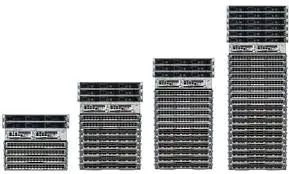
[A high-angle view of Cisco 8000 Series routers in a data center, showcasing their compact form factor and dense port configurations. The image highlights the sleek design and LED indicators signaling active 400Gbps ports, with a network diagram overlay illustrating seamless traffic flow between servers and cloud nodes.]
Hardware Innovation: Built for the Demanding Edge
The 8000 Series isn’t just about software—it’s engineered from the ground up for performance. Key hardware advancements include:
- Custom ASICs: Designed to handle 400Gbps throughput with minimal power consumption, reducing operational costs by up to 30% compared to previous generations.
- Modular Chassis: Supports hybrid deployments, allowing enterprises to mix 100G/400G line cards and adapt to evolving needs without full infrastructure overhauls.
- Enhanced Security: Hardware-accelerated encryption (via Cisco Secure Boot and TPM 2.0) safeguards data at Layer 2 through Layer 7, crucial for sectors like healthcare and government.
For instance, a multinational retailer uses 8000 Series routers at its edge locations to process point-of-sale transactions, inventory updates, and customer analytics locally. This reduces reliance on centralized cloud servers, cutting latency by 60% and improving operational efficiency.
Software-Driven Agility: Beyond Traditional Routing
Cisco’s DNA Center integration transforms the 8000 Series into a self-optimizing network asset. Features like Network Assurance use machine learning to detect anomalies and recommend fixes, while SD-WAN capabilities simplify branch office connectivity. A case study reveals that a European logistics company reduced provisioning time for new sites from 48 hours to under an hour using automated configuration templates.
Additionally, the routers support multi-cloud architectures, bridging on-premises data centers with AWS, Azure, and Google Cloud. Service providers leverage this flexibility to offer scalable VPNs and SD-WAN-as-a-Service packages, accelerating time-to-market for digital offerings.
Sustainability Meets Performance
At a time when sustainability is non-negotiable, the 8000 Series sets a new benchmark. Its low-power design aligns with Cisco’s commitment to carbon neutrality, while intelligent power allocation dynamically adjusts energy use based on traffic loads. In a pilot project, a university data center slashed its annual energy bills by $120,000 after deploying the routers, proving that high performance doesn’t come at the expense of environmental responsibility.
Future-Proofing with Open Ecosystems
Recognizing the importance of interoperability, Cisco has embraced open standards with the 8000 Series. Integration with Kubernetes, VMware, and third-party NFV platforms allows businesses to build bespoke network services. A fintech startup, for example, combined Cisco routers with Red Hat OpenShift to deploy a secure, hybrid cloud environment for its blockchain-based payment platform.
The Cisco 8000 Series Routers are more than just a hardware upgrade—they’re a strategic enabler for the connected enterprise. By merging 400Gbps speed with intelligent automation, modular design, and sustainability, Cisco empowers organizations to tackle today’s challenges while laying the groundwork for tomorrow’s innovations. As networks evolve toward edge computing, AI-driven services, and multi-cloud ecosystems, the 8000 Series stands as a testament to routing technology’s potential to drive progress at every layer of the infrastructure stack.







Leave a comment