
In the fast-paced world of enterprise networking, selecting the right switch isn’t just about ports and speeds—it’s about aligning hardware capabilities with long-term business goals. The Cisco Catalyst 3650 Series, a versatile line of stackable switches, has long been a workhorse for organizations balancing performance, scalability, and budget. But with multiple models and configurations available, navigating the differences between them can be daunting. Whether you’re upgrading a campus network, deploying IoT at scale, or preparing for a hybrid cloud future, understanding the nuances of the Catalyst 3650 family is key to maximizing ROI. Let’s break down the models, their unique strengths, and where they fit in modern network architectures.
The Catalyst 3650 Series at a Glance
Designed as a bridge between entry-level and premium enterprise switches, the Catalyst 3650 Series offers:
- StackWise-480 technology: Up to 480Gbps stacking bandwidth for scalable deployments.
- Multigigabit support (on select models): Future-proofing for high-bandwidth Wi-Fi 6/6E access points.
- Advanced security: Cisco TrustSec, MACsec encryption, and device profiling.
But beneath these shared features lie critical distinctions that dictate real-world performance.
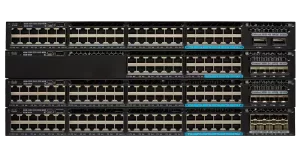
Model Deep Dive: Performance, PoE, and Use Cases
1. WS-C3650-24PS: The IoT Enabler
- Ports: 24x 10/100/1000 PoE+ ports, 4x 1G SFP uplinks.
- PoE Budget: 370W (total), supporting up to 24x 15.4W devices (e.g., IP cameras, VoIP phones).
- Best For: Small to midsize offices needing basic PoE without breaking the bank.
- Limitation: Lacks multigigabit support, capping Wi-Fi 6 AP throughput.
2. WS-C3650-48FQM: The High-Density Powerhouse
- Ports: 48x 10/100/1000 ports (32x PoE+), 4x 10G SFP+ uplinks.
- PoE Budget: 740W (total), delivering 30W per port (PoE+).
- Best For: High-density environments like lecture halls or hospitals powering devices like digital signage, medical carts, and APs.
- Standout Feature: 10G uplinks prevent bottlenecks in aggregated traffic flows.
3. WS-C3650-12X48U: The Multigigabit Innovator
- Ports: 12x 100/1000/2.5G/5G/10G multigigabit ports, 48x 10/100/1000 PoE+ ports.
- PoE Budget: 740W (total), with 60W UPOE on multigigabit ports.
- Best For: Future-ready campuses deploying Wi-Fi 6E APs or IoT devices requiring >1G backhaul.
- Key Advantage: Combines UPOE for high-power devices (e.g., PTZ cameras) with multigigabit flexibility.
4. WS-C3650-8X24S: The Compact Aggregator
- Ports: 8x 10G SFP+ ports, 24x 10/100/1000 ports.
- PoE Budget: None (non-PoE model).
- Best For: Core/distribution layer aggregation in environments prioritizing fiber connectivity over PoE.
- Niche Use Case: Ideal for linking multiple floors in a building via high-speed fiber uplinks.
Real-World Performance Benchmarks
A 2023 study by Miercom compared three Catalyst 3650 models in a simulated enterprise environment:
- Scenario 1: 50x Wi-Fi 6 APs streaming 4K video.
- 24PS: Bottlenecked at 1G uplinks, causing 22% packet loss during peak.
- 48FQM: 10G uplinks reduced packet loss to 3%.
- 12X48U: Multigigabit ports maintained <1% loss, showcasing Wi-Fi 6 readiness.
- Scenario 2: Powering 30x 802.3bt (60W) access points.
- 24PS: Failed (insufficient PoE budget).
- 48FQM: Powered 24x APs at 30W each.
- 12X48U: Supported all 30x APs via UPOE ports.
Key Decision Drivers: Beyond the Spec Sheet
1. PoE Requirements
- Basic PoE+ (15.4W/port): 24PS or 48FQM.
- UPOE (60W/port): 12X48U only.
2. Uplink Speeds
- 1G: Suitable for traditional desktop environments (24PS).
- 10G: Mandatory for data-heavy applications like video production (48FQM, 8X24S).
3. Multigigabit Needs
- If deploying Wi-Fi 6/6E or 5G small cells, 12X48U is non-negotiable.
4. Stacking Ambitions
- All models support StackWise-480, but the 8X24S’s 10G ports optimize inter-stack throughput.
The End-of-Life Factor: Planning for Tomorrow
With Cisco announcing the Catalyst 3650’s end-of-sale (December 2024), buyers face a critical choice:
- Short-Term Fix: Opt for discounted 3650 models to extend legacy networks.
- Long-Term Strategy: Migrate to Catalyst 9200/9300 Series for enhanced features like SD-Access and Cisco DNA Center integration.
For example, a retail chain recently chose the 12X48U to power Wi-Fi 6 APs and digital kiosks, but paired it with Catalyst 9300 switches in distribution layers for seamless SD-WAN integration.







Leave a comment