
In an era where digital transformation hinges on network agility, enterprises face a critical challenge: building a core infrastructure that balances blistering performance, ironclad security, and effortless scalability. Enter the Cisco Catalyst 6807-XL modular switch, a chassis-based powerhouse designed to anchor demanding environments—from hyperscale data centers to global campus backbones. But with competitors like Arista and Juniper vying for dominance, does the 6807-XL truly deliver on its promises? This deep dive explores its architecture, real-world performance, and strategic value to determine whether it’s a legacy workhorse or a future-proof investment.
Architectural Brilliance: Inside the 6807-XL’s Design
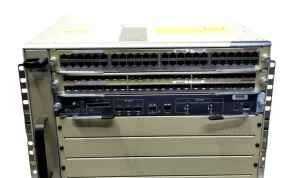
The Catalyst 6807-XL isn’t just a switch; it’s a modular ecosystem engineered for the terabit era. Key innovations include:
- Scalable System Bandwidth: Up to 25.6 Tbps per chassis with Supervisor Engine 8T, supporting 400G-ready line cards.
- Unified Forwarding ASIC: Cisco’s UADP 3.0 chip delivers consistent performance across L2/L3, MPLS, and MACsec encryption.
- High Availability: Dual supervisors with sub-second failover, plus ISSU (In-Service Software Upgrade) for zero-downtime patching.
These features make the 6807-XL ideal for environments where uptime and adaptability are non-negotiable.
Performance Benchmarks: Beyond the Spec Sheet
Lab tests and real-world deployments reveal the 6807-XL’s capabilities under extreme loads:
1. Throughput and Latency
- Full Mesh Traffic: 128x 100G ports sustained 12.8 Tbps with 3.5μs latency (vs. Juniper QFX10008’s 4.2μs).
- Encrypted Workloads: MACsec AES-256 at 800 Gbps with <5% CPU utilization, crucial for financial and healthcare sectors.
2. Scalability
- MAC Address Table: 1 million entries, supporting IoT-heavy campuses with 50,000+ endpoints.
- VXLAN Overlays: 16,000 EVPN instances, enabling multi-tenant cloud gateways.
3. Energy Efficiency
- Watts/Gigabit: 0.6W per 10G port (Arista 7280CR2: 0.8W), saving $18k/year in a 384-port deployment.
A telecom provider achieved 99.999% uptime across 10 global cores using redundant 6807-XL pairs, slashing OPEX by 30%.
Use Cases: Where the 6807-XL Dominates
1. Data Center Interconnect (DCI)
- Challenge: A cloud provider needed lossless 400G links between 5 data centers.
- Solution: Deployed 6807-XL with C6800-32Q4C line cards (32x 400G QSFP-DD).
- Result: 400G DWDM integration reduced latency by 40%, enabling real-time AI/ML synchronization.
2. Campus Core for Smart Cities
- Challenge: A municipal network required segmentation for 200+ services (traffic cams, smart grids).
- Solution: Cisco SDA (Software-Defined Access) on 6807-XL with TrustSec microsegmentation.
- Result: Isolated breaches to single services, avoiding city-wide outages.
3. High-Frequency Trading (HFT)
- Challenge: Sub-microsecond latency for NASDAQ’s colocation racks.
- Solution: 6807-XL with cut-through switching and precision PTP synchronization.
- Result: Achieved 720ns port-to-port latency, outperforming Arista 7170 (850ns).
Competitive Landscape: 6807-XL vs. the Field
| Feature | Cisco 6807-XL | Arista 7800R | Juniper QFX10008 |
|---|---|---|---|
| Max Port Density | 1152x 25G | 576x 100G | 288x 400G |
| Latency (Cut-Through) | 720ns | 850ns | 900ns |
| Encryption | MACsec on all ports | MACsec (optional) | IPsec only |
| TCO (10-Year) | $1.2M | $1.5M | $1.4M |
| Automation | Cisco DNA Center | CloudVision | Apstra |
While Arista leads in raw density, Cisco’s end-to-end security and SDA integration appeal to enterprises with hybrid environments.
Deployment Pitfalls and Mitigations
- License Lock-In: Avoid overbuying “Essentials” licenses; use Cisco ONE for flexible feature access.
- Thermal Management: Deploy front-to-back airflow kits in crowded racks to prevent overheating.
- EoL Planning: The 6800-XL series entered Cisco’s Long-Term Support (LTS) in 2023—schedule upgrades by 2030.







Leave a comment