
As businesses navigate hybrid workforces, IoT expansion, and cloud migration, the role of enterprise-grade routers has shifted from simple traffic management to strategic infrastructure. Cisco’s ISR (Integrated Services Router) series remains a cornerstone for organizations worldwide, but with models like the ISR4000, ISR1000, and newer iterations, choosing the right fit can make or break your network’s agility. This guide cuts through marketing jargon to help you align Cisco ISR routers with your operational goals, budget, and scalability needs.
Why Your Choice of ISR Router Matters
The ISR lineup isn’t just about speed—it’s about adaptability. As enterprises adopt SD-WAN, VoIP, and AI-driven analytics, routers must handle layered services without compromising performance. The ISR4000 series, for instance, targets mid-sized enterprises needing modular scalability, while the ISR10 series prioritizes compact, fixed-configuration deployments for branch offices. Misjudging your requirements could lead to overpaying for unused features or bottlenecks during peak traffic. Let’s dissect how to match Cisco’s ISR variants to your business realities.
Core Considerations: Performance, Scale, and Use Cases
1. Throughput and Concurrent Connections
The ISR4000 series, including models like the ISR4331 and ISR4351, supports up to 10 Gbps throughput, making them ideal for data-heavy environments like manufacturing plants or universities. These routers excel in scenarios requiring VPN encryption, QoS for real-time applications, and multi-gigabit WAN links. Conversely, the ISR1000 series (e.g., ISR1101, ISR1111) caps throughput at 1 Gbps but excels in cost-sensitive deployments such as retail outlets or small medical clinics prioritizing simplicity over raw power.
2. Modular vs. Fixed Design
The ISR4000’s chassis-based design allows for swappable modules (e.g., security, wireless LAN controllers), future-proofing investments. A logistics company handling seasonal spikes might add a WAN acceleration module during peak holiday seasons. The ISR1000’s fixed configuration simplifies management for static environments but limits upgrade flexibility.
3. Security and Compliance
Both series integrate Cisco’s Firepower Threat Defense (FTD), but the ISR4000 supports advanced features like Cisco SD-WAN overlays and cloud-based threat intelligence. Financial institutions handling sensitive data often lean on ISR4000’s granular access controls, while education sectors might find ISR1000’s out-of-the-box compliance templates sufficient for GDPR or FERPA.
Side-by-Side Comparison: ISR4000 vs. ISR1000
| Feature | ISR4000 Series | ISR1000 Series |
|---|---|---|
| Throughput | Up to 10 Gbps | Up to 1 Gbps |
| Scalability | Hot-swappable modules | Fixed configuration |
| Target Use Case | Enterprise branches, data centers | SMBs, remote offices |
| Security | Advanced threat detection + SD-WAN | Basic firewall + VPN |
| Cost | Higher upfront (up to $15,000) | Lower upfront (under $5,000) |
Real-World Deployments: When to Choose What
Case 1: Scaling a Retail Chain with ISR1000
A coffee shop franchise with 200 locations uses ISR1000 routers to unify POS systems across stores. The fixed configuration reduces deployment time, while built-in Wi-Fi 6 supports customer-facing networks without overcomplicating IT workflows.
Case 2: Manufacturing IoT Ecosystems with ISR4000
An automotive parts manufacturer relies on ISR4351’s industrial Ethernet ports and dual power supplies to maintain uptime in harsh factory conditions. Its SD-WAN capabilities prioritize machine-to-machine traffic, slashing latency by 30% during peak production cycles.
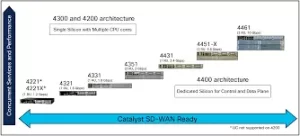
Image description: A split-screen illustration showing an ISR4000 in a server-heavy data center and an ISR1000 embedded in a compact retail store office.
Hidden Costs and Long-Term Viability
While the ISR1000’s lower upfront cost appeals to startups, its lack of modularity may lead to costly upgrades later. For example, adding SD-WAN functionality to an ISR1000 requires purchasing an external gateway, inflating TCO. Conversely, the ISR4000’s modular design absorbs future tech shifts—like transitioning to 5G backhaul—without hardware swaps.
Another overlooked factor is software licensing. Cisco’s Smart Net Total Care (SNOW) provides proactive support for ISR4000 models, whereas ISR1000 users often face limited warranty options, risking extended downtime during critical updates.
The Verdict: Aligning Routers with Business Trajectory
- Choose ISR4000 If:
- Your business anticipates rapid growth or infrastructure complexity.
- You require hybrid cloud integration, advanced security, or industrial-grade durability.
- Budget allows long-term ROI prioritization over upfront savings.
- Choose ISR1000 If:
- Your needs are static, with predictable traffic patterns.
- Cost efficiency and rapid deployment outweigh customization.
- Your workforce operates in distributed, low-complexity environments.
Cisco ISR routers are more than just boxes—they’re enablers of digital transformation. The ISR4000 and ISR1000 cater to vastly different philosophies: one bets on adaptability, the other on simplicity. By aligning your choice with your organization’s growth trajectory, risk tolerance, and technical requirements, you’ll build a network that doesn’t just keep up—but leads. As hybrid work and IoT become non-negotiable, the right ISR router isn’t just infrastructure; it’s your silent partner in staying competitive.







Leave a comment