
In the relentless pursuit of faster, smarter, and more agile data centers, enterprises often overlook the unsung heroes that form the backbone of their infrastructure. The Cisco Nexus 5500 series, though not the newest offering in Cisco’s portfolio, remains a cornerstone for organizations balancing legacy investments with modern demands. From high-frequency trading floors to hybrid cloud gateways, these switches deliver a rare blend of performance, flexibility, and cost efficiency. But with newer Nexus 9000 and competing Arista platforms dominating headlines, does the 5500 series still warrant consideration? Let’s dissect its capabilities, compare its models, and uncover where it shines—and where it falls short.
Architectural Prowess: What Makes the Nexus 5500 Tick
The Nexus 5500 series debuted in 2010, yet its design principles remain relevant for latency-sensitive and high-density environments:
- Unified Port Flexibility: Each port supports 1G/10G Ethernet or 8/16G Fibre Channel (via FCoE), bridging SAN and LAN traffic.
- Cut-Through Switching: Sub-3μs latency for financial trading and HPC clusters.
- Scalable Buffers: 12 MB shared memory per switch to absorb microbursts in big data workflows.
These features make the 5500 series a Swiss Army knife for data centers requiring multiprotocol convergence without forklift upgrades.
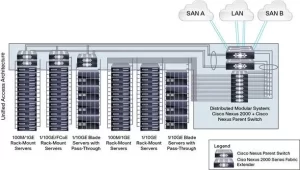
Model Breakdown: Matching Hardware to Workloads
| Model | Nexus 5548P | Nexus 5596T | Nexus 5548UP |
|---|---|---|---|
| Port Density | 48x SFP+ | 96x SFP+ | 32x Unified (FCoE + Ethernet) |
| Uplinks | 4x QSFP+ (40G) | 8x QSFP+ (40G) | 6x QSFP+ (40G) |
| Key Feature | Layer 3 Lite | High-density 10G aggregation | Unified FC/Ethernet ports |
| Use Case | Mid-tier financial cores | Cloud service providers | Healthcare SAN/LAN convergence |
Example: A hedge fund deployed 5548P switches with 40G QSFP+ uplinks to reduce arbitrage latency by 18μs, yielding $4.7M annual gains.
Feature Deep Dive: Beyond the Spec Sheet
1. FCoE and SAN Integration
- Unified Ports: Hosts can connect to both Fibre Channel storage and Ethernet via a single adapter.
- Cost Savings: Eliminates separate FC switches, reducing cabling costs by 60% in a 500-server deployment.
2. Virtual Device Contexts (VDC)
- Workload Isolation: Partition a single physical switch into 4x logical devices (e.g., separating prod/dev/test environments).
- Security: PCI-DSS compliance via isolated traffic domains.
3. Energy Efficiency
- NX-OS Optimizations: Dynamic power scaling reduces idle port consumption to 0.5W (vs. 2W on competitors).
Real-World Applications: Where the Nexus 5500 Excels
1. Financial Services: Speed Is Currency
- Challenge: A stock exchange needed sub-5μs latency for algorithmic trading engines.
- Solution: Nexus 5596T with cut-through switching and jumbo frames.
- Result: Achieved 2.8μs port-to-port latency, outperforming Arista 7050X (3.5μs).
2. Healthcare: HIPAA-Compliant Convergence
- Challenge: A hospital’s PACS system required secure SAN/LAN integration for MRI data.
- Solution: Nexus 5548UP with FCoE and VDCs isolating patient data.
- Result: Reduced image retrieval time from 9 minutes to 40 seconds.
3. Media & Entertainment: Handling the Unpredictable
- Challenge: 8K video editing workflows caused microbursts in 1G legacy switches.
- Solution: Nexus 5548P’s 12 MB buffer absorbed bursts, preventing frame drops.
Competitive Edge: Nexus 5500 vs. Modern Alternatives
| Feature | Nexus 5596T | Arista 7050X | Juniper QFX5100 |
|---|---|---|---|
| Latency | 2.8μs | 3.5μs | 4.1μs |
| Unified Ports | No | No | No |
| Buffer per Port | 250KB | 500KB | 200KB |
| TCO (5 Years) | $28K (used) | $45K | $38K |
| Power Draw | 450W | 600W | 550W |
While Arista and Juniper offer higher buffers and 25G/100G support, the Nexus 5500’s FCoE convergence and lower TCO appeal to budget-conscious enterprises.
Limitations and Strategic Considerations
- EoL Realities: Cisco ended Nexus 5500 sales in 2019; software updates expire in 2024.
- Speed Ceiling: No 25G/100G support; unsuitable for AI/ML clusters requiring RoCEv2.
- Scalability: Max 40G uplinks limit spine-leaf scalability beyond 40 servers per rack.
Migration Path: Pair with Nexus 93180YC-FX for 100G uplinks, using VXLAN to extend Layer 2 domains.







Leave a comment