
As enterprises grapple with exponential data growth, driven by AI analytics, IoT ecosystems, and real-time decision-making, the demand for storage-optimized infrastructure has never been greater. Enter the Cisco UCS S3260—a server engineered not just to store data, but to transform how organizations manage, scale, and secure their most critical workloads. Combining high-density storage with the agility of Cisco’s Unified Computing System (UCS), the S3260 addresses a pressing challenge: delivering enterprise-grade performance without compromising flexibility in an era where data is both an asset and a liability.
The Architecture of Efficiency
The Cisco UCS S3260 stands out with its modular, storage-dense design. Built to support up to 60 drives in a 4U chassis, it offers a staggering 480 TB of raw storage capacity, making it ideal for industries like healthcare, media, and financial services where large datasets are the norm. Unlike traditional servers that prioritize compute over storage, the S3260 strikes a balance. Its dual-node configuration allows businesses to deploy two independent servers within a single chassis, each capable of supporting up to 28 drives. This architecture enables IT teams to consolidate workloads—such as big data analytics, archival systems, or virtualization clusters—while maintaining strict isolation for security-sensitive applications.
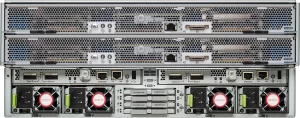
What truly sets the S3260 apart is its seamless integration with the Cisco UCS ecosystem. By leveraging UCS Manager, organizations can automate provisioning, monitor health metrics, and enforce policies across thousands of servers from a single interface. For hybrid cloud environments, the server’s compatibility with Cisco Intersight extends management capabilities to off-premises infrastructure, simplifying operations for distributed teams. Additionally, support for NVMe drives ensures low-latency access to data, a critical feature for AI/ML pipelines and real-time databases.
Performance Meets Sustainability
In an age where energy consumption is a growing concern, the UCS S3260 incorporates sustainability into its DNA. Cisco’s “Thermal Logic” technology optimizes cooling efficiency by dynamically adjusting fan speeds based on workload demands. This reduces power usage by up to 30% compared to conventional servers, aligning with corporate ESG goals. The server’s modularity also plays a role in reducing e-waste: components like power supplies, fans, and drive trays can be replaced individually, extending the hardware’s lifecycle and minimizing downtime.
Security is another cornerstone of the S3260’s design. With cyberattacks targeting storage systems increasingly common, Cisco embeds hardware-rooted safeguards. The Trusted Platform Module (TPM) ensures secure boot processes, while integrated RAID controllers with encryption capabilities protect data at rest. For regulated industries, the server’s FIPS 140-2 compliance and support for role-based access control (RBAC) simplify adherence to frameworks like HIPAA and GDPR.
Future-Proofing the Data Center
The UCS S3260 isn’t just about solving today’s challenges—it’s built for tomorrow’s unknowns. Its support for 25Gb Ethernet and future-ready 100Gb uplinks ensures compatibility with high-speed networks, while the Cisco UCS VIC (Virtual Interface Card) technology allows administrators to reconfigure network and storage interfaces on the fly. This adaptability is crucial as workloads evolve, enabling businesses to pivot from on-premises Hadoop clusters to cloud-native Kubernetes environments without costly hardware refreshes.
For DevOps teams, the S3260’s API-driven management unlocks infrastructure-as-code (IaC) workflows. Integration with tools like Ansible and Terraform automates deployment, reducing human error and accelerating time-to-value. Meanwhile, Cisco’s Intersight Workload Optimizer analyzes resource utilization patterns, recommending workload placements that maximize efficiency—an AI-driven approach to capacity planning.







Leave a comment