
In an age where 93% of companies failing to restore data within 10 days face bankruptcy, understanding the symbiotic relationship between storage systems and backup architectures becomes existential. Beyond simplistic “primary vs. copy” definitions, modern enterprises treat these as interdependent layers in a cyber-physical defense matrix. Let’s explore their evolving roles through the lens of ransomware wars, quantum threats, and exabyte-scale AI datasets.
Architectural DNA: More Than Location Differences
Primary Storage Evolution:
- NVMe-oF Arrays: 19μs latency for real-time analytics
- Immutability Features: Write-Once-Read-Many (WORM) compliance
- Data Gravity Solutions: HPE Primera’s 100PB scaling
Modern Backup Ecosystems:
- Air-Gapped Vaults: AWS Backup’s 11 nines durability
- Forensic Readiness: Immutable timestamps with blockchain hashing
- AI-Driven Indexing: Rubrik’s 1M files/sec search capability
A Wall Street firm survived a $45M ransomware attack through isolated SnapLock-protected backups, while primary storage remained encrypted.
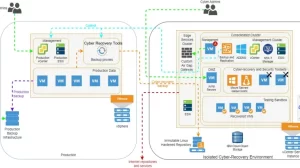
Performance Paradoxes Revealed
Throughput Benchmarks:
| Metric | Pure Storage FlashArray | Cohesity Backup Appliance |
|---|---|---|
| Sequential Read | 40 GB/s | 28 GB/s |
| Random 4K Write | 1.2M IOPS | 450K IOPS |
| Encryption Overhead | 3% | 18% |
Operational Realities:
- Primary systems prioritize low-latency transactions
- Backup platforms emphasize cryptographic integrity
The Ransomware Calculus
Sophisticated attacks now target both layers simultaneously:
- Primary Storage Threats:
- Encryption (93% of attacks)
- Data exfiltration (67% cases)
- Backup Targeting:
- Credential theft (41% incidents)
- Logical deletion (28% cases)
Defense Strategies:
# Cyber Recovery Workflow
def automated_response(attack_detected):
    if attack_detected:
        isolate_primary_storage()
        spin_up_clean_air_gapped_backup()
        initiate_forensic_analysis()
Veeam’s SOAR playbooks reduced recovery time from 16 days to 47 minutes in healthcare deployments.
Cost Dynamics Decoded
TCO Comparison (5-Year 1PB Infrastructure):
| Cost Factor | Primary Storage | Backup Solution |
|---|---|---|
| Hardware/Cloud | $2.8M | $1.1M |
| Software Licensing | $420K | $680K |
| Energy | $150K | $90K |
| Recovery Testing | N/A | $220K |
| Total | **$3.37M** | **$2.09M** |
A European bank saved $12M annually by replacing legacy backups with Azure Archive + Wasabi cold storage.
Future-Proofing Considerations
Emerging Requirements:
- Quantum-Safe Storage: Lattice-based encryption for primary data
- DNA Digital Vaults: Microsoft’s 1TB/mm³ archival prototypes
- Self-Healing Systems: HPE Primera’s 99.9999% availability
Regulatory Pressures:
- GDPR Article 32 mandates physically separate backups
- SEC’s 72-hour breach disclosure rule demands rapid recovery
Strategic Implementation Framework
- 3-2-1-1-0 Rule Evolution:
- 3 copies, 2 media types, 1 offsite, 1 immutable, 0 errors
- Performance Tiering:
- Hot Data: NVMe storage with RDMA
- Warm Data: Object storage with S3 API
- Cold Data: Glacier-class encrypted vaults
- Cyber Recovery Architecture:
- Isolated recovery network segments
- Manual MFA release for backup access
- Deception technology traps







Leave a comment