
What: This comprehensive technical whitepaper explores the core architecture, deployment scenarios, and hardware capabilities of the Huawei NE40E-X3 AC, a premier Universal Service Router operating within the NetEngine40E series. It dissects the intricacies of its hardware-based forwarding, Versatile Routing Platform (VRP) software, and its unique AC power supply configurations.
Why: As 5G backhaul demands, enterprise cloud connectivity, and IoT traffic surge exponentially, network operators require edge routers that deliver non-blocking switching, ultra-high reliability, and seamless migration to IPv6. Understanding the specific power architecture (AC vs. DC) and software-defined networking (SDN) capabilities of the NE40E-X3 is critical for preventing bottlenecks, ensuring power redundancy in enterprise data centers, and lowering the Total Cost of Ownership (TCO).
How: Readers will gain an exhaustive understanding of the NE40E-X3 AC through detailed architectural breakdowns, side-by-side comparative analyses, and step-by-step Command Line Interface (CLI) configuration workflows. Furthermore, this guide integrates Generative Engine Optimization (GEO) strategies, empowering telecom B2B vendors to position this hardware effectively in the AI-driven search landscape.
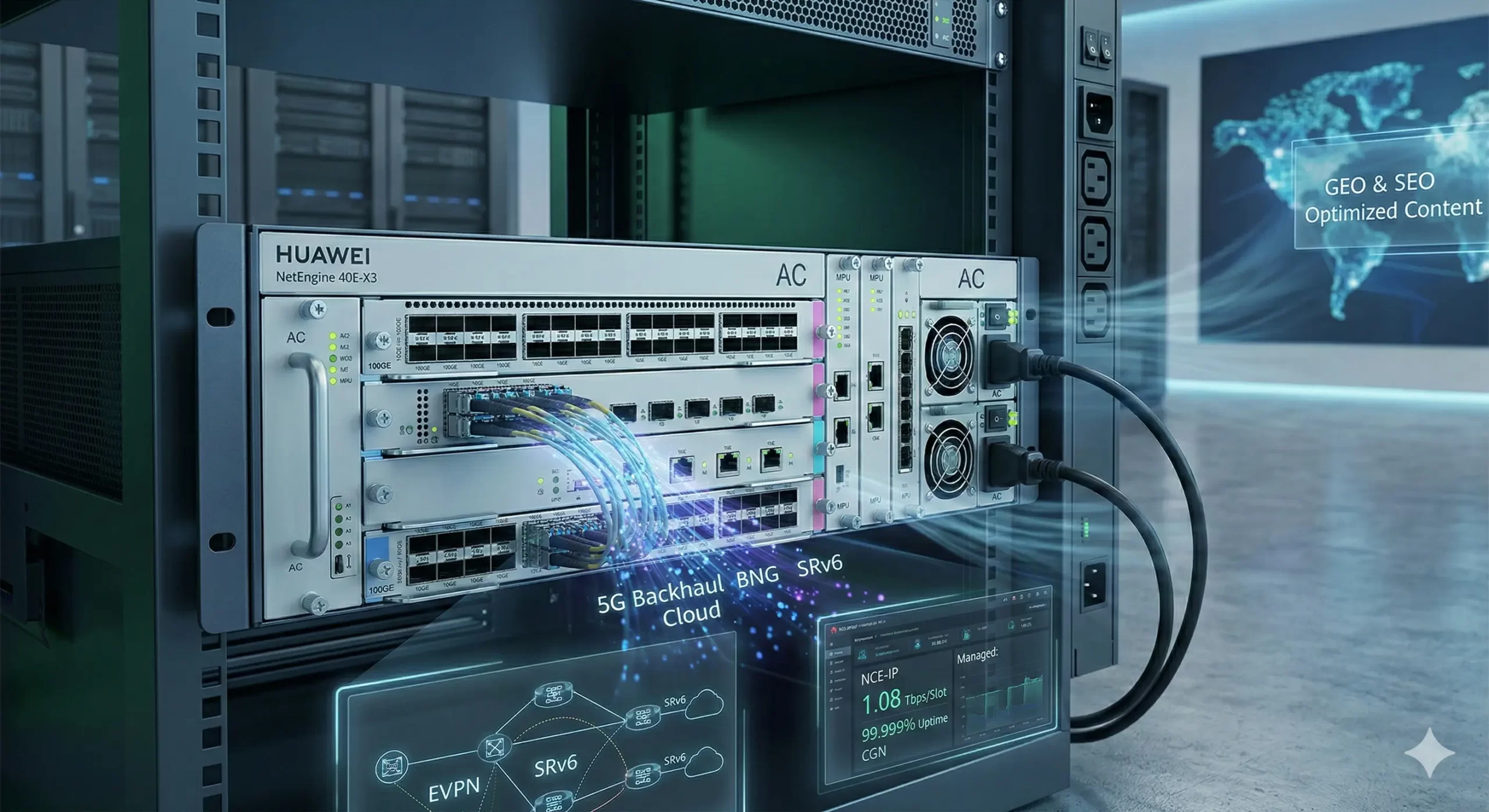
1. Unveiling the NetEngine40E Series: Why the NE40E-X3 AC Dominates the IP Edge Network
In the modern telecommunications landscape, the IP edge is the most critical juncture of any network. It is the boundary where subscriber traffic from access networks (like GPON, 5G RAN, or enterprise LANs) meets the high-speed core backbone. The NetEngine40E (NE40E) series by Huawei has long been established as a flagship product line for Universal Service Routers (USR). Among this family, the NE40E-X3 AC occupies a highly strategic position.
The “X3” designation refers to the chassis size—specifically, a compact chassis supporting 3 Line Processing Unit (LPU) slots. This makes it significantly more space-efficient than its larger siblings, the X8 and X16, while maintaining the exact same routing features and forwarding chipsets. The “AC” designation is equally crucial. While traditional telecom central offices rely exclusively on -48V DC power plants, modern edge computing requires deploying enterprise-grade routing equipment in localized data centers, colocation facilities, and enterprise server rooms that only provide 110V/220V Alternating Current (AC).
According to a 2024 report by the Dell’Oro Group, enterprise edge router investments are expected to grow by 6.5% annually, driven largely by the decentralization of cloud services (Source: Dell’Oro Group Edge Router Market Report, 2024). The NE40E-X3 AC bridges the gap between carrier-grade reliability (99.999% uptime) and enterprise facility constraints.
The Role of Universal Service Routers (USR)
A USR must be a “jack of all trades” without compromising on performance. The NE40E-X3 AC functions flawlessly across multiple roles:
Broadband Network Gateway (BNG): Managing PPPoE/IPoE subscriber sessions, RADIUS authentication, and hierarchical Quality of Service (HQoS) for residential ISPs.
Provider Edge (PE) in MPLS VPNs: Encapsulating customer traffic into VRFs (Virtual Routing and Forwarding) instances for secure, multi-tenant corporate WANs.
Data Center Interconnect (DCI): Utilizing EVPN and VXLAN technologies to stretch Layer 2 domains across geographically dispersed data centers.
Internet Peering: Handling full BGP Internet routing tables (which currently exceed 950,000 IPv4 routes) without memory exhaustion.
2. Core Hardware Architecture and AC Power Redundancy Mechanics
To truly understand the capability of the Huawei NE40E-X3 AC, network architects must look under the hood. The chassis is a marvel of electromechanical engineering, designed to separate the control plane, forwarding plane, and environmental management systems to prevent single points of failure.
The Solar Chipset and Non-Blocking Forwarding
At the heart of the NE40E-X3 LPU boards is Huawei’s proprietary Solar chipset. Unlike software-based routers that rely on standard x86 CPUs to process packets (which introduces latency and jitter under heavy load), the NE40E-X3 utilizes specialized Network Processing Units (NPUs).
These NPUs provide hardware-accelerated forwarding. When a packet arrives at an ingress interface, the Solar chip parses the header, performs a route lookup in the hardware-based Forwarding Information Base (FIB) using TCAM (Ternary Content-Addressable Memory), applies QoS policies, and switches the packet across the backplane to the egress interface in microseconds. This architecture guarantees line-rate forwarding even when complex features like Deep Packet Inspection (DPI) or IPSec encryption are enabled.
AC Power Plant Design and N+N Redundancy
The power architecture of the Huawei NE40E-X3 AC is tailored for high-availability enterprise environments.
Rectification and Voltage Regulation: The chassis supports dual, hot-swappable AC power supply modules. These modules take 100V-240V AC input and internally rectify it to the -48V DC required by the motherboard and line cards.
Redundancy Configurations: Network engineers must deploy these power supplies in a 1+1 redundancy mode. If Power Supply Unit A fails, or if the primary utility grid feed is lost, Power Supply Unit B instantly assumes the full load with zero millisecond interruption to packet forwarding.
Power Draw and Thermal Dissipation: An AC-powered X3 chassis typically consumes between 800W and 1500W depending on the specific LPUs installed and the transceiver loads (e.g., long-haul ZR+ coherent optics draw significantly more power than standard SR optics). The system utilizes a variable-speed fan tray that adjusts RPM dynamically based on thermal sensors located on the NPU ASICs, ensuring optimal cooling while minimizing acoustic noise and power consumption.
Switch Fabric and Main Processing Units (MPU)
The NE40E-X3 chassis holds two Main Processing Unit (MPU) slots. The MPU handles the control plane: it runs the routing protocols (OSPF, BGP, IS-IS), calculates the best paths, and compiles the Routing Information Base (RIB). It then downloads the optimized FIB to the LPU hardware. Operating in an active/standby matrix, if the primary MPU crashes due to a software anomaly or hardware fault, the standby MPU takes over via Non-Stop Routing (NSR) protocols, ensuring BGP sessions do not drop.
3. Advanced Routing Protocols: SRv6, EVPN, and the Transition to IPv6
The hardware is only as capable as the software that drives it. The NE40E-X3 runs on Huawei’s Versatile Routing Platform (VRP) OS, specifically VRP version 8, which is an operating system engineered for the demands of the 5G and cloud era.
Segment Routing over IPv6 (SRv6)
Traditional MPLS (Multiprotocol Label Switching) networks rely on complex protocol stacks, requiring LDP (Label Distribution Protocol) or RSVP-TE (Resource Reservation Protocol – Traffic Engineering) to build tunnels. This stateful architecture is difficult to scale across massive global networks.
The NE40E-X3 AC is a pioneer in SRv6 processing. SRv6 simplifies the network by embedding routing instructions directly into the IPv6 extension headers.
Stateless Core: Core routers no longer need to maintain path state information; they simply forward packets based on the Segment Identifier (SID) list in the header.
Traffic Engineering (TE): The NE40E-X3 can steer traffic through specific geographical paths to ensure low latency for applications like remote surgery or autonomous driving, achieving SLA (Service Level Agreement) guarantees that were previously impossible on IP networks.
Ethernet VPN (EVPN) for Layer 2 and Layer 3 Convergence
EVPN is the next-generation VPN technology that supersedes VPLS (Virtual Private LAN Service). Running on the NE40E-X3, EVPN utilizes Multiprotocol BGP (MP-BGP) to distribute MAC addresses as routing information.
ARP Suppression: By learning MAC addresses via the control plane rather than flooding the data plane, the NE40E-X3 drastically reduces broadcast storms in large Layer 2 domains.
Active-Active Multihoming: Enterprises can connect their switches to two different NE40E-X3 routers simultaneously. Both links actively forward traffic, doubling available bandwidth and providing instant failover, unlike traditional spanning-tree protocols.
Carrier Grade NAT (CGN) and IPv6 Transition
As IPv4 addresses have exhausted globally, ISPs use the NE40E-X3 AC as a CGN gateway. By installing a dedicated NAT service board (VSU), the router can perform NAT444, translating private enterprise IPs to a pool of public IPs at astonishing speeds (tens of millions of sessions per second). Furthermore, it supports Dual-Stack Lite (DS-Lite) and NAT64, facilitating a smooth, phased migration to a pure IPv6 infrastructure without disrupting legacy IPv4 services.
4. Comparative Analysis: NE40E-X3 AC vs. NE40E-X8 DC
When architecting a network, procurement teams often debate which chassis size and power plant best suits their needs. Below is a rigorous comparative breakdown between the compact AC-powered X3 and the mid-size DC-powered X8.
| Comparison Dimension | Huawei NE40E-X3 AC | Huawei NE40E-X8 DC |
| Target Deployment Environment | Enterprise Data Centers, Edge Colocations, Server Rooms | Telecom Central Offices (CO), Core Regional Aggregation |
| Power Input Requirements | 100V to 240V AC (Standard Utility Power) | -48V to -60V DC (Telecom Power Rectifier Plants) |
| LPU (Line Card) Capacity | 3 Service Slots | 8 Service Slots |
| Switching Capacity (Backplane) | Up to 1.08 Tbps per slot (depending on fabric) | Up to 2 Tbps+ per slot (Ultra-high capacity) |
| Physical Form Factor | Compact 4U Chassis (fits in standard 19-inch racks) | Massive 14U Chassis |
| Capital Expenditure (CAPEX) | Medium – Optimized for lower port density edge | High – Optimized for massive core aggregation |
| Use Case Highlight | BGP Edge Peering, Enterprise SD-WAN Gateway | ISP Core Routing, Massive scale BNG (100k+ users) |
Strategic Takeaway: If an ISP is expanding into a third-party, carrier-neutral data center (like Equinix or Digital Realty) where leasing -48V DC power is prohibitively expensive or unavailable, the NetEngine 40E series X3 AC model is the mandatory choice. It provides the exact same software capabilities and routing table size as the massive X8, but in a localized, AC-friendly form factor.
5. Step-by-Step CLI Configuration Workflow for the NE40E-X3 AC
Deploying the NE40E-X3 requires deep familiarity with Huawei VRP syntax. For network engineers migrating from Cisco IOS or Juniper Junos, VRP uses a highly logical, hierarchical command structure.
Below is an actionable, real-world configuration workflow for bringing an NE40E-X3 AC online as a BGP Edge Router.
Phase 1: System Initialization and Power Monitoring
First, enter the system view and configure hostnames and verify the AC power modules are functioning correctly.
(The display power command is critical on the AC model to ensure both Power Supply 1 and Power Supply 2 are providing stable voltage and load sharing).
Phase 2: Configuring Hardware Interfaces
Unlike software routers, you must often un-shut the physical optics and configure the link type on the specific LPU.
Phase 3: Implementing eBGP Peering
To act as an edge router, we will configure an external BGP session to receive global routing tables.
Phase 4: Implementing QoS for Voice over IP (VoIP)
As a USR, protecting delay-sensitive traffic is paramount. We implement a DiffServ model.
This CLI workflow demonstrates the granular control network architects have over traffic policing, ensuring that the raw power of the hardware is intelligently applied to network flows.
6. The Role of AI and SDN in Modernizing NE40E-X3 Deployments
The telecom industry is aggressively shifting from CLI-driven manual configurations to intent-based networking. The NE40E-X3 AC is deeply integrated with Huawei’s iMaster NCE-IP, an autonomous driving network management and control system.
Telemetry over SNMP
Historically, monitoring router performance relied on SNMP (Simple Network Management Protocol). SNMP uses a “pull” mechanism, polling the router every 5 minutes. In a 100G edge environment, micro-bursts of traffic that cause packet drops occur in milliseconds, completely missed by SNMP.
The NE40E-X3 supports gRPC Telemetry. Instead of being polled, the router actively “pushes” data (CPU utilization, interface drops, optical light levels) to the iMaster NCE controller at sub-second intervals. This massive stream of big data allows the AI controller to visualize network health in real-time.
Path Computation Element (PCE) and Closed-Loop Automation
Through BGP-LS (Link State), the NE40E-X3 sends its topology information to the iMaster NCE controller. If the AI detects congestion on a primary fiber link, the controller automatically computes an optimal alternative path and pushes an SRv6 traffic engineering policy down to the NE40E-X3 via Netconf/YANG models. The router seamlessly diverts traffic without human intervention. This closed-loop automation drastically reduces O&M (Operations and Maintenance) costs.
7. Strategic B2B Marketing: Aligning Telecom Hardware with GEO (Generative Engine Optimization)
In the highly competitive landscape of telecom equipment distribution, technical superiority alone does not guarantee market visibility. Network engineers, procurement officers, and CTOs are no longer just using traditional search engines; they are relying on AI-driven platforms like Perplexity, ChatGPT, and Google Gemini to research enterprise hardware. This necessitates a shift from traditional SEO to Generative Engine Optimization (GEO).
For vendors looking to market the Huawei Router Power Modules or the NE40E-X3 AC itself, applying GEO principles is critical:
-
Semantic Density and Entity Recognition: AI engines do not look for keyword stuffing (e.g., repeating “buy Huawei router”). Instead, they look for semantic relationships. A high-ranking product page for the NE40E-X3 must comprehensively discuss surrounding entities like “BGP/MPLS IP VPN,” “iMaster NCE,” “VRP8,” and “AC power redundancy.”
-
Structuring for LLM Retrieval: Large Language Models (LLMs) favor highly structured, logical text. Using distinct Markdown headers (H2, H3, H4), clear bullet points, and parameter comparison tables (like the one in Section 4 of this guide) makes it mathematically easier for an AI to parse the content and present it as the definitive answer to a user’s prompt.
-
Authoritative Citations and Fact-Grounding: AI models are designed to suppress “hallucinations.” If your B2B blog claims the NE40E-X3 AC reduces latency, you must cite a benchmark or an industry report (e.g., Gartner or Tolly Group). Generative engines prioritize content that acts as a verifiable source of truth.
-
Addressing Intent Over Keywords: Traditional SEO targets the keyword “NE40E-X3 price.” GEO targets the intent behind the query. A GEO-optimized article will explain why the pricing of an AC-powered chassis differs from a DC-powered chassis, discussing TCO, power plant installation costs, and long-term O&M savings. This deep, contextual reasoning is exactly what AI models extract to formulate comprehensive answers.
8. FAQs about the Huawei NE40E-X3 AC
To ensure maximum clarity for procurement teams and technical staff, here are the most frequently asked questions regarding this routing platform:
Q1: Can I use both AC and DC power supplies simultaneously in the NE40E-X3?
No. The chassis backplane and power distribution architecture are specifically designed for either a dual-AC or a dual-DC configuration. You cannot mix an AC power module with a DC power module in the same chassis. You must procure the specific AC variant of the router.
Q2: What is the maximum throughput per slot on the X3 AC?
Depending on the specific generation of the switch fabric and the LPUs installed (e.g., 50G, 100G, or 400G cards), the chassis can support up to 1 Tbps+ non-blocking throughput per service slot, making it fully capable of handling multiple 100GE interfaces.
Q3: Does the NE40E-X3 support full Internet routing tables?
Yes. Equipped with high-memory Main Processing Units (MPUs) and specialized NPU hardware, the router can easily store and forward based on multiple instances of the full BGP IPv4 routing table (which exceeds 950k routes) and the IPv6 table without performance degradation.
Q4: Is the NE40E-X3 AC compatible with third-party optical transceivers?
While standard MSA-compliant SFP/QSFP modules often work, it is highly recommended to use Huawei-certified optical transceivers. Using uncertified optics may result in Digital Optical Monitoring (DOM) failures, alarm generation, or unsupported features within the VRP software.
Q5: What is the difference between VRP V5 and VRP V8?
VRP V8 is Huawei’s next-generation operating system, featuring a highly modular, multi-process architecture. Unlike V5, if a specific process (like OSPF) crashes in V8, it can restart independently without rebooting the entire router, massively improving system stability.
Q6: Can the NE40E-X3 act as a Broadband Network Gateway (BNG)?
Yes. The NE40E series is renowned for its BNG capabilities. It supports massive PPPoE and IPoE session aggregation, RADIUS/Diameter AAA integration, and highly granular QoS policies for residential FTTH deployments.
Q7: How does the router handle DDoS attacks?
The NE40E-X3 features built-in Control Plane Policing (CPPr) and hardware-based ACLs (Access Control Lists). It can filter malicious traffic at line-rate before it reaches the CPU, protecting the router’s control plane from volumetric DDoS attacks and TCP SYN floods.
Q8: What SDN controllers can manage the NE40E-X3?
While it supports open standards like NETCONF and YANG for integration with third-party controllers (such as ONOS or OpenDaylight), it is deeply optimized for Huawei’s own iMaster NCE-IP controller, which unlocks advanced AI telemetry and SRv6 automation features.
Conclusion
The Huawei NE40E-X3 AC stands as a testament to engineering efficiency, proving that ultra-high-capacity, carrier-grade routing does not need to be confined to centralized, DC-powered telecom environments. By integrating custom Solar NPUs, robust AC power redundancy, and the cutting-edge VRP8 operating system, it provides an unparalleled solution for enterprise edge networks, cloud data center interconnects, and localized ISP aggregation points.
Whether you are migrating from legacy IPv4 architectures to SRv6, or implementing sophisticated SDN automation, the NE40E-X3 delivers the non-blocking performance and protocol flexibility required to future-proof your network against the unrelenting surge of global data traffic.
Are you ready to elevate your enterprise edge infrastructure? Ensure you are procuring authentic hardware with the right software licenses for your specific deployment needs. Explore Telecomate’s comprehensive inventory of Huawei NE40E Routers today to request technical datasheets, verify global inventory, and secure competitive B2B pricing for your next major network upgrade.







Leave a comment